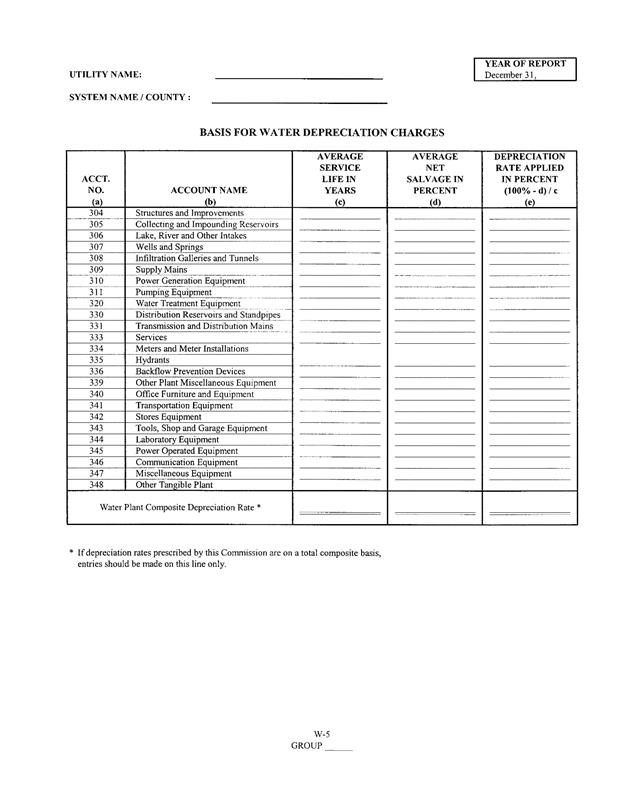
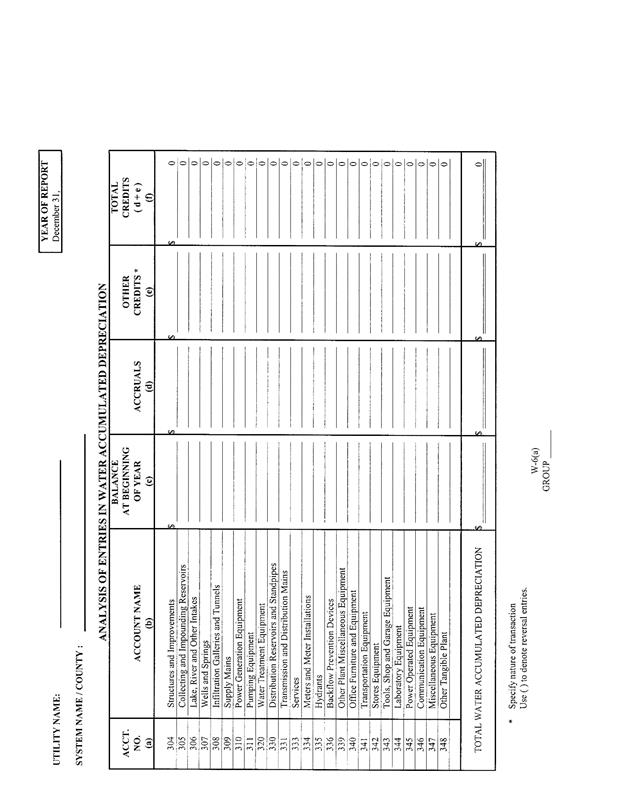
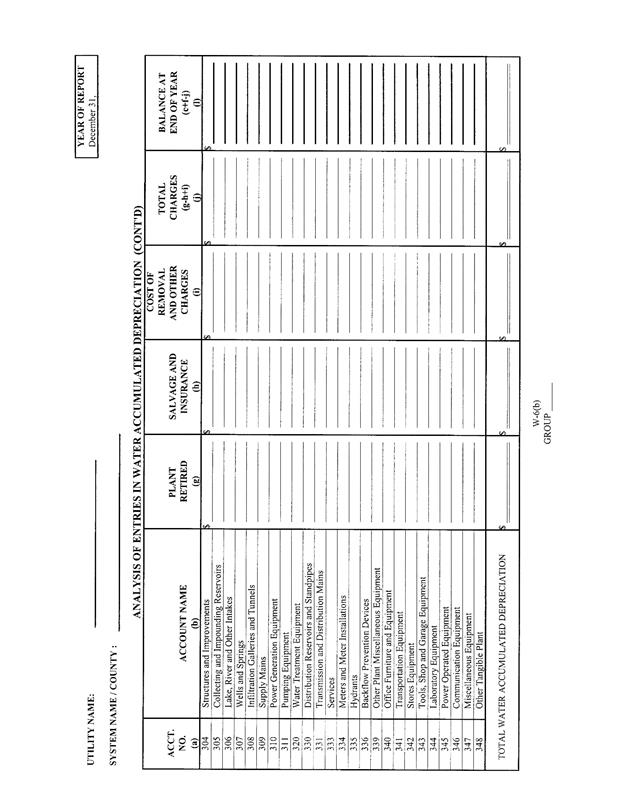
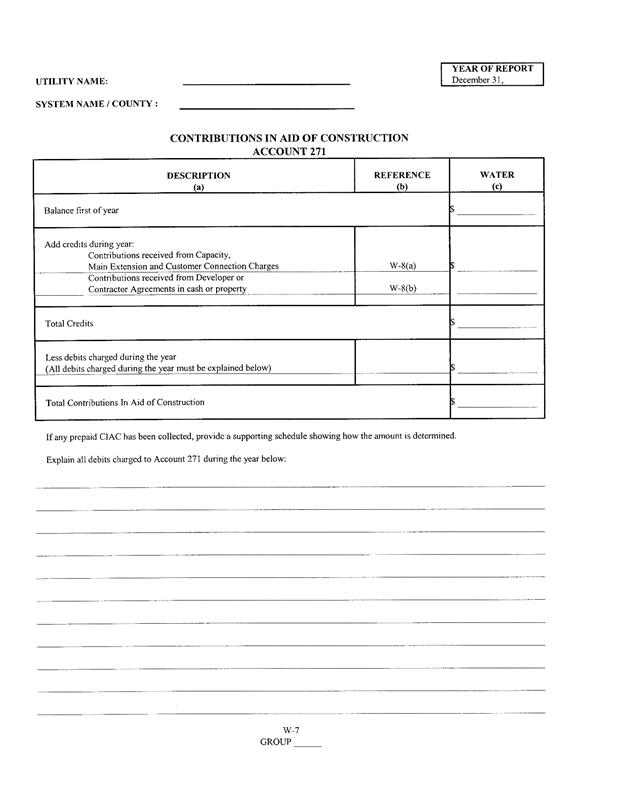
|
State of Florida

|
Public Service Commission
Capital Circle Office Center ● 2540 Shumard
Oak Boulevard
Tallahassee, Florida 32399-0850
-M-E-M-O-R-A-N-D-U-M-
|
|
DATE:
|
May 20, 2026
|
|
TO:
|
Office of Commission Clerk (Teitzman)
|
|
FROM:
|
Office of the General Counsel (Augspurger,
Bloom) SMC
Division of Accounting
and Finance (Vogel, Norris) MC
Division of Economics
(Guffey) EJD
|
|
RE:
|
Docket No. 20260022-WS – Proposed amendment
of Rules 25-30.115, Uniform System of Accounts for Water and Wastewater
Utilities; 25-30.033, Application for Original Certificate of Authorization
and Initial Rates and Charges; 25-30.037, Application for Authority to
Transfer; 25-30.0372, Alternative Procedure for Establishing Rate Base Value
of Acquired Utility System; 25-30.110, Records and Reports, Annual Reports;
25-30.140, Depreciation; 25-30.433, Rate Case Proceedings; 25-30.444, Utility
Reserve Fund; and 25-30.445, General Information and Instructions Required of
Water and Wastewater Utilities in an Application for a Limited Proceeding.
|
|
AGENDA:
|
06/02/26 – Regular Agenda – Rule Proposal - Interested Persons May
Participate
|
|
COMMISSIONERS ASSIGNED:
|
All Commissioners
|
|
PREHEARING OFFICER:
|
La Rosa
|
|
RULE STATUS:
|
Proposal May Be Deferred
|
|
CRITICAL DATES:
|
9/22/26 - Date by which rules must be proposed pursuant
to Section 120.54(2)(a)2., F.S.
|
|
SPECIAL INSTRUCTIONS:
|
None
|
|
|
|
|
Case Background
Pursuant to Section
367.121(1)(b), Florida Statutes (F.S.), the Commission (PSC) has the power to
prescribe a uniform system and classification of accounts for all utilities,
including water and wastewater utilities. Rule 25-30.115, Florida Administrative Code (F.A.C.), directs regulated
water and wastewater utilities to keep their accounts and records in
conformance with the National Association of Regulatory Utility Commissioners
(NARUC) Uniform System of Accounts (USOA). In addition to Rule 25‑30.115,
F.A.C., the Commission has referred to or specifically incorporated by
reference the existing USOA in multiple water and wastewater rules: Rules 25-30.033, 25-30.037, 25-30.110,
25-30.140, 25-30.0372, 25-30.433, 25-30.444, and 25-30.445, F.A.C. As part of
the Commission’s 5-year review of all of its rules under Section 120.5435,
F.S., the Commission determined that these rules needed to be amended to
provide necessary updates and clarification.
The current iteration of Rule 25-30.115,
F.A.C., requires utilities to follow the now obsolete 1996 version of NARUC’s
Uniform System of Accounts for water and wastewater utilities. In 2024, NARUC
adopted two new Uniform Systems of Accounts for water and wastewater utilities.
NARUC’s “Uniform System of Accounts for Water Utilities” was adopted by
the NARUC Board of Directors on November 13, 2024, with corrections issued on
January 24, 2025. NARUC’s “Uniform System of Accounts for Wastewater
Utilities” was also adopted on November 13, 2024, with corrections on April 4,
2025 and August 27, 2025. Together, these two updated systems of accounts will
be referred to as the “NARUC USOA.”
Additionally, Rule 25-30.433, F.A.C.,
references 26 CFR Part 1, s. 1.46-6(b)(2)(i), (3) and (4)(ii), as issued May 22, 1986; however, that
federal regulation has been updated and now carries an effective date of April
7, 2008.
Also, many of the rules, specifically Rule
30-30.0372, F.A.C., Alternative Procedure for Establishing Rate Base Value of
Acquired Utility System, require clarifications and updates to reflect current
Commission practices and procedures.
The
Commission’s Notice of Development of Rulemaking was published in Volume 52,
Number 59, of the Florida Administrative Register on March 26, 2026. No person
or entity requested a workshop regarding the draft rule language, and no
workshop was held.
This
recommendation addresses whether the Commission should propose the amendment of
Rules 25-30.115, 25-30.033, 25-30.037, 25-30.0372, 25-30.110, 25-30.140,
25-30.433, 25-30.444, and 25-30.445, F.A.C. The Commission has jurisdiction
pursuant to Sections 350.115, 350.127(2), 367.031, 367.045, 367.071, 367.081,
367.081(2), 367.081(2)(c), 367.0811, 367.0812, 367.0812(1), 367.0814, 367.0822,
367.121, 367.121(1), 367.121(1)(a), 367.121(1)(b), 367.1213, 367.145(2), and
367.156(1), F.S.
Discussion
of Issues
Issue 1:
Should the Commission propose the amendment of Rule
25-30.115, F.A.C., Uniform System of Accounts for Water and Wastewater
Utilities; Rule 25-30.033, F.A.C., Application for Original Certificate of
Authorization and Initial Rates and Charges; Rule 25-30.037, F.A.C.,
Application for Authority to Transfer; Rule 25-30.0372, F.A.C., Alternative
Procedure for Establishing Rate Base Value of Acquired Utility System; Rule
25-30.110, F.A.C., Records and Reports; Annual Reports; Rule 25-30.140, F.A.C.,
Depreciation; Rule 25-30.433, F.A.C., Rate Case Proceedings; Rule 25-30.444,
F.A.C., Utility Reserve Fund; and Rule 25-30.445, F.A.C., General Information
and Instructions Required of Water and Wastewater Utilities in an Application
for a Limited Proceeding?
Recommendation:
Yes. The Commission should propose the amendment of
Rules 25-30.115, 25-30.033, 25-30.037, 25-30.0372, 25-30.110, 25-30.140,
25-30.433, 25-30.444, and 25-30.445, F.A.C., as set forth in Attachments A and
B. Pursuant to Section 120.695, F.S., the Commission should certify that Rules
25-30.115, 25-30.033, 25-30.037, 25-30.0372, 25-30.110, 25-30.140, 25-30.433,
and 25-30.445, F.A.C., are rules for which a violation would constitute a minor
violation. However, Rule 25-30.444 is a not a rule for which a violation would
constitute a minor violation and therefore should not be certified as such.
(Augspurger, Bloom, Vogel, Guffey)
Staff Analysis:
The purpose of this rulemaking is to amend Rule
25-30.115, F.A.C., to ensure alignment with the most recent NARUC USOA, to
update the reference to a provision of the Code of Federal Regulations in Rule
25-30.433, and to otherwise update and clarify the rules per Section 120.5435, F.S., in particular Rule
25-30.0372, F.A.C. In addition, these amendments provide necessary updates to
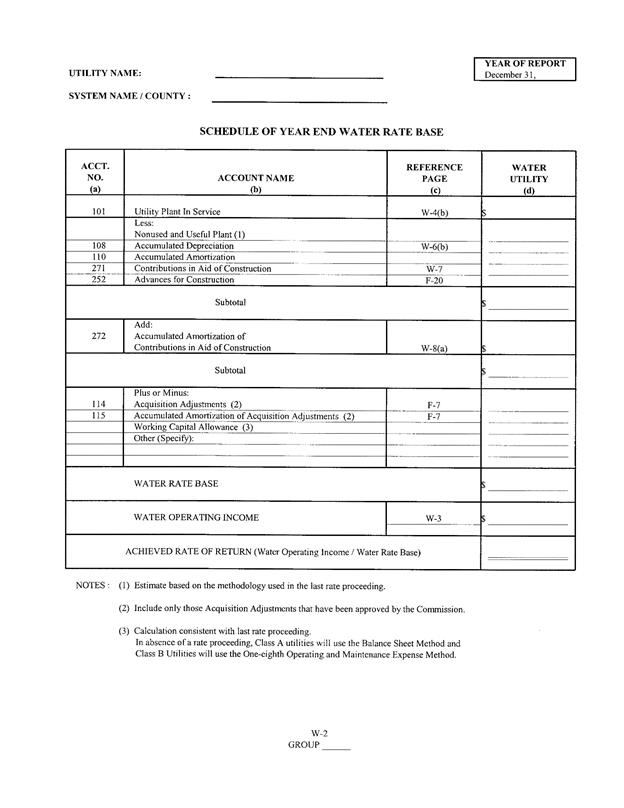
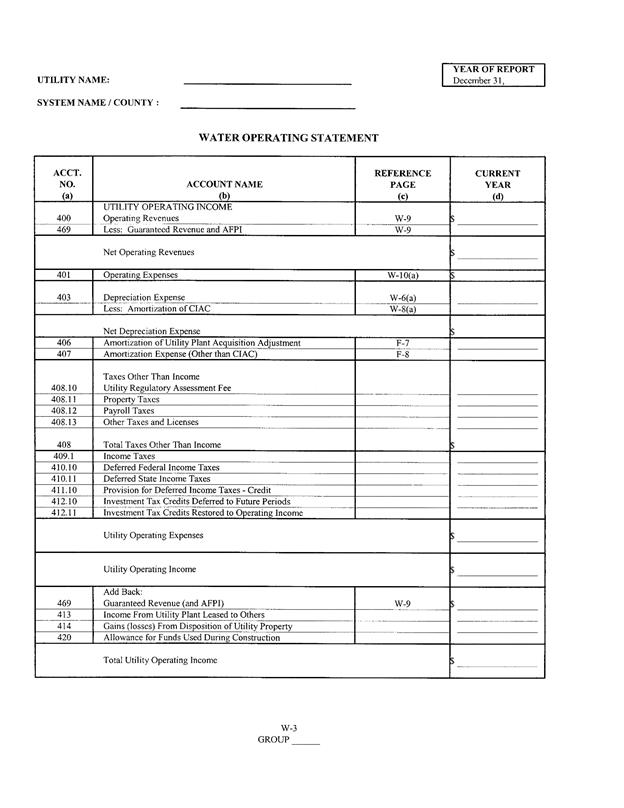
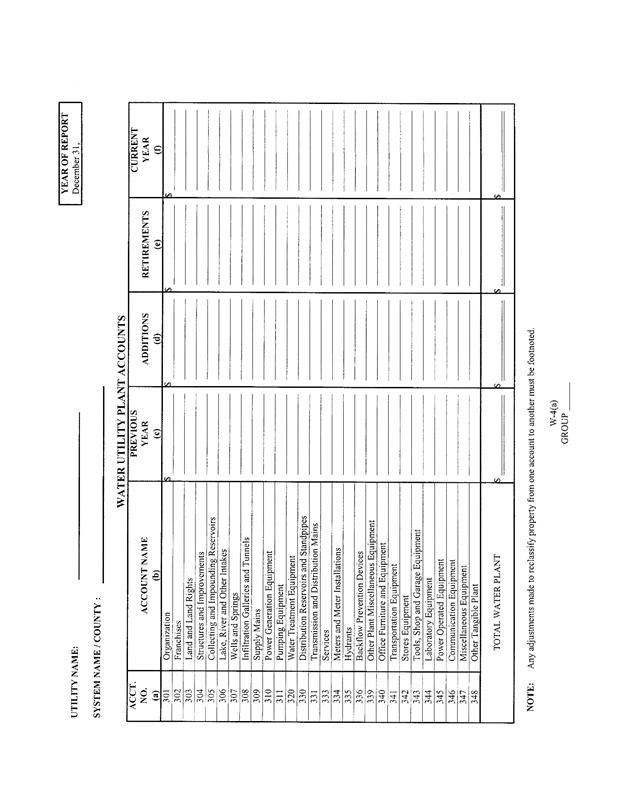
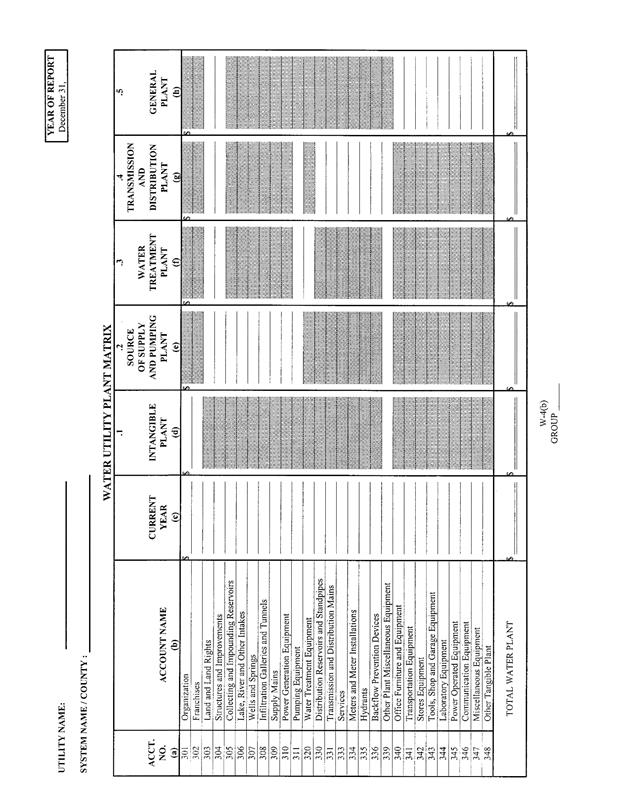
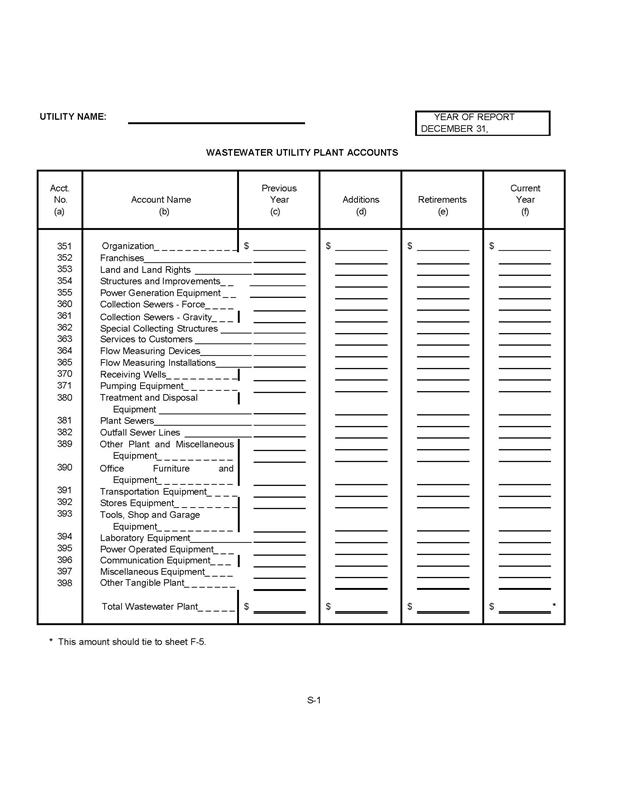
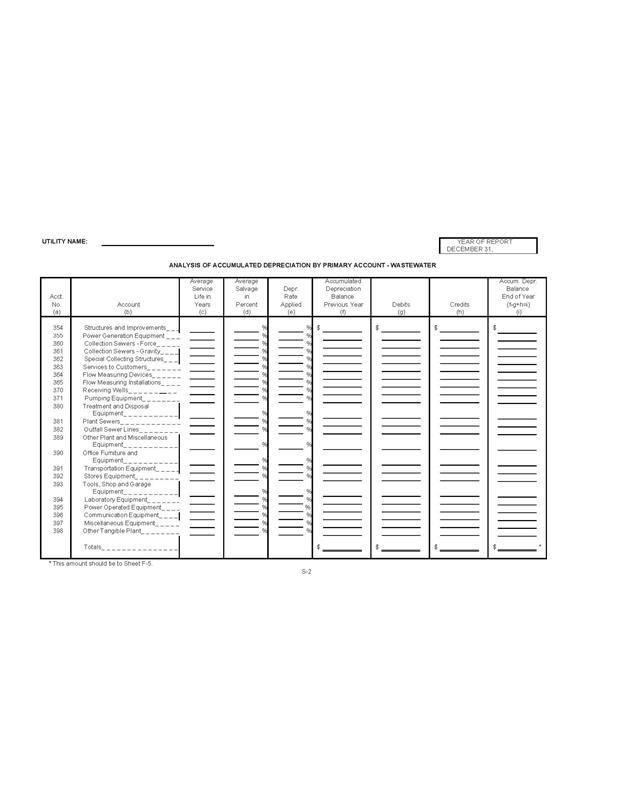
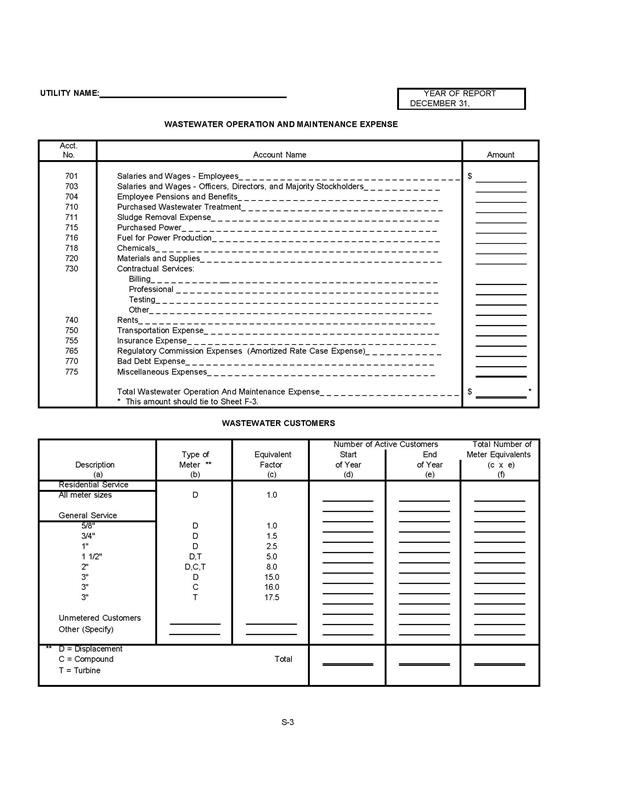
Commission forms referenced in the above-mentioned rules. Staff is recommending
that the rules be amended as set forth in Attachment A and that the Commission
forms be amended as set forth in Attachment B.
Updated NARUC USOA
Rule 25-30.115, F.A.C., currently requires regulated water and
wastewater utilities to maintain their accounts and records in conformance with
the 1996 USOA. In 2024, NARUC updated its USOA for both water and wastewater
utilities. Staff’s
proposed amendments to Rule 25-30.115, F.A.C., direct regulated water and
wastewater utilities to maintain their books and records in conformity with the
newly adopted NARUC USOA.
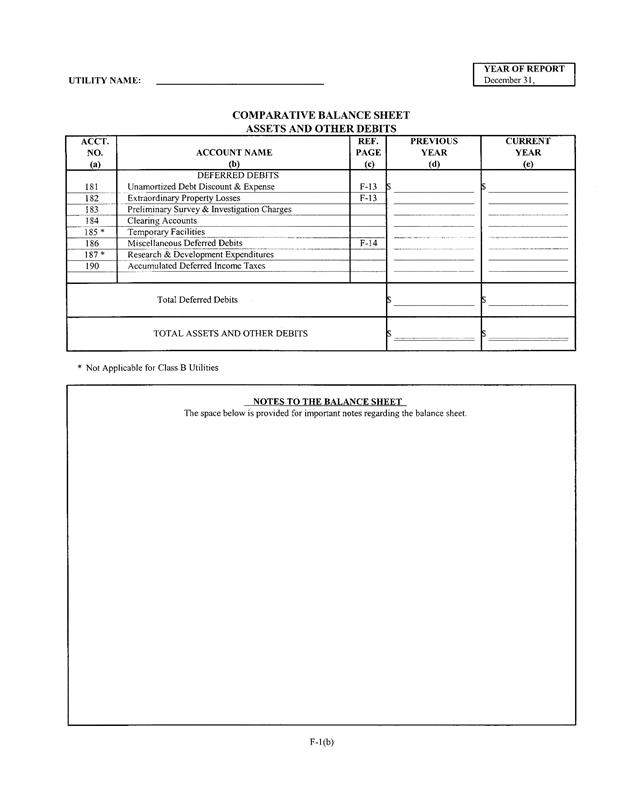
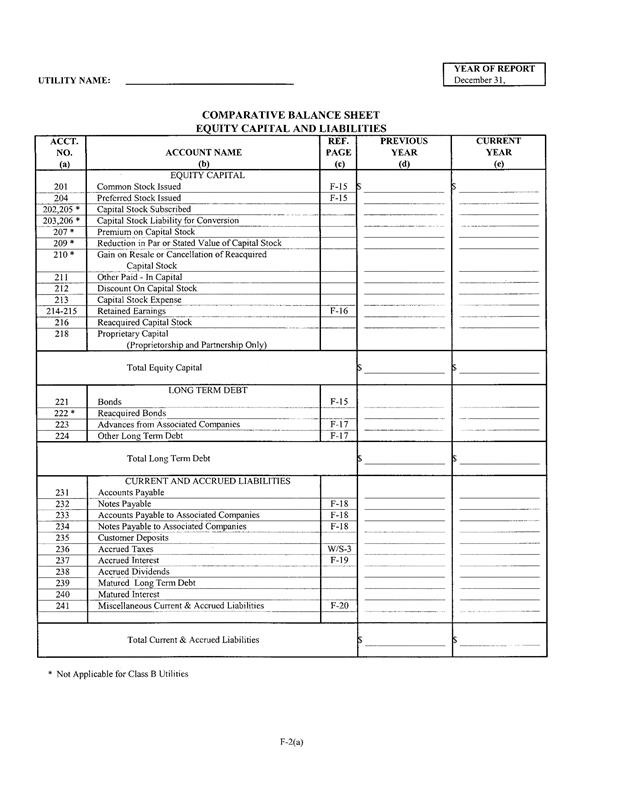
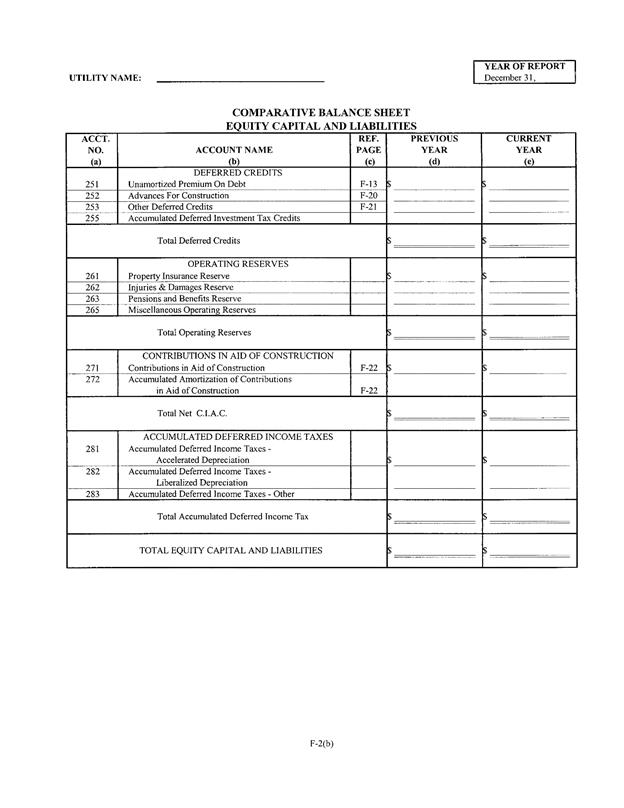
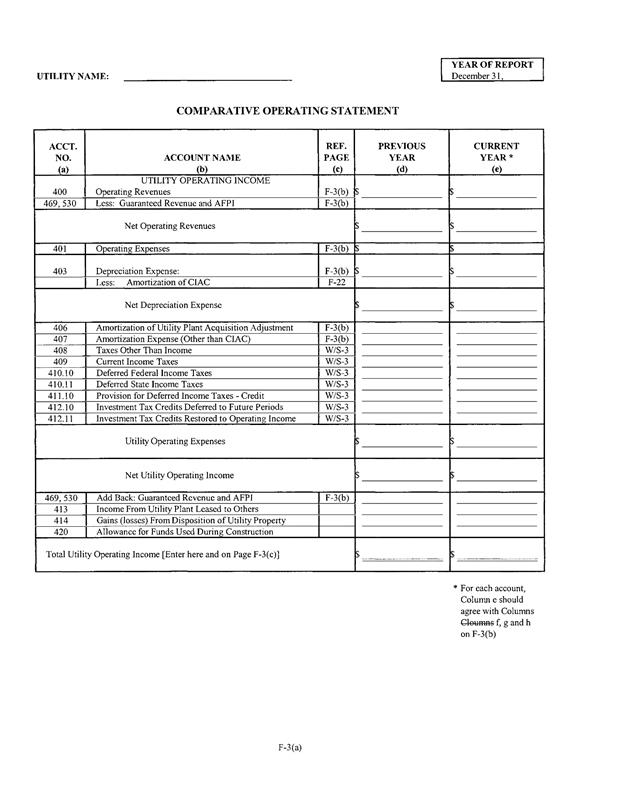
The NARUC USOA includes several significant account updates. The NARUC
USOA removes accounts associated with technologies no longer in service, such
as telegraph equipment, and adds new accounts that reflect modern utility
operations. The NARUC USOA also updates the gross revenue thresholds for
classifying utilities as either Class A (greater than $1,750,000), B
($350,000-$1,750,000), or C (less than $350,000). The updated NARUC USOA aligns
more closely with U.S. Generally Accepted Accounting Principles, enabling
utilities to more efficiently manage both regulatory and financial reporting
requirements. In addition, the revised NARUC USOA promotes greater uniformity
on a national level for regulatory commissions that receive reports from
utilities of varying sizes. Overall, the update establishes a consistent
baseline for all water and wastewater utility reporting. Staff believes it is
best practice for the Commission to ensure that utilities it regulates maintain
conformity with the most recent version of the Uniform Systems of Accounts
adopted by NARUC.
References to USOA in Other Related Rules
Rules 25-30.033, 25-30.037, 25-30.0372, 25-30.110,
25-30.140, 25-30.433, 25-30.444, and 25-30.445, F.A.C., currently contain
references to the 1996 USOA. As noted above, NARUC updated its Uniform System
of Accounts for both water and wastewater utilities in 2024. Staff recommends
amending these rules to replace references to the outdated USOA with references
to the NARUC USOA, as identified and incorporated by reference in Rule
25-30.115, F.A.C. This approach centralizes the identification of the
particular NARUC USOA version within Rule 25-30.115, F.A.C., thus improving
regulatory consistency and efficiency. This approach also avoids multiple
different rule amendments if NARUC updates its Uniform System of Accounts for
water or wastewater utilities in the future as only Rule 25-30.115, F.A.C., will
require amendment.
Updates to Rule 25-30.0372, F.A.C., Alternative
Procedure for Establishing Rate Base Value of Acquired Utility System
Rule 25-30.0372, F.A.C., implements Section 367.0811,
F.S., which concerns the Alternative Procedure for Establishing Rate Base Value
for acquired water and wastewater utility systems. The rule defines who is
considered a “Licensed Appraiser,” the procedure for conducting Appraisals, and
the petition filing requirements under the statute. In addition to updating
references to the NARUC USOA, staff recommends making additional substantive
changes to this rule. Specifically, paragraph (1)(a) requires Licensed
Appraisers to hold a certification from the Institute of Business Appraisers. That
organization and its certification no longer exist, and therefore should be
removed from paragraph (1)(a).
Also, staff recommends that paragraph (2)(b) should be
further clarified to require that appraisers cannot be employed by the same
entity. The Commission had originally intended that the selection of appraisers
be fair to everyone involved, and staff believes using this criteria would
further this goal.
Lastly, staff recommends that paragraph (2)(e) should also
require that licensed appraisers email or mail the Commission the expiration
dates of their certifications or designations required by paragraph (1)(a) of
the rule.
Reference to the CFR in Rule 25-30.433, F.A.C.,
Rate Case Proceedings
Rule 25-30.433(14), F.A.C., addresses the imputing of
interest on deferred income tax credits in cases covered by 26 CFR Part 1, s.
1.46-6(b)(2)(i), (3) and (4)(ii), as
issued May 22, 1986, and incorporates that regulation by reference. The federal
regulation has been updated and now has an effective date of April 7, 2008.
Thus, staff recommends that Rule 25-30.433 should be amended to include by
reference the current version of 26 CFR Part 1, s. 1.46-6(b)(2)(i), (3)
and (4)(ii), with an effective date of April 7, 2008.
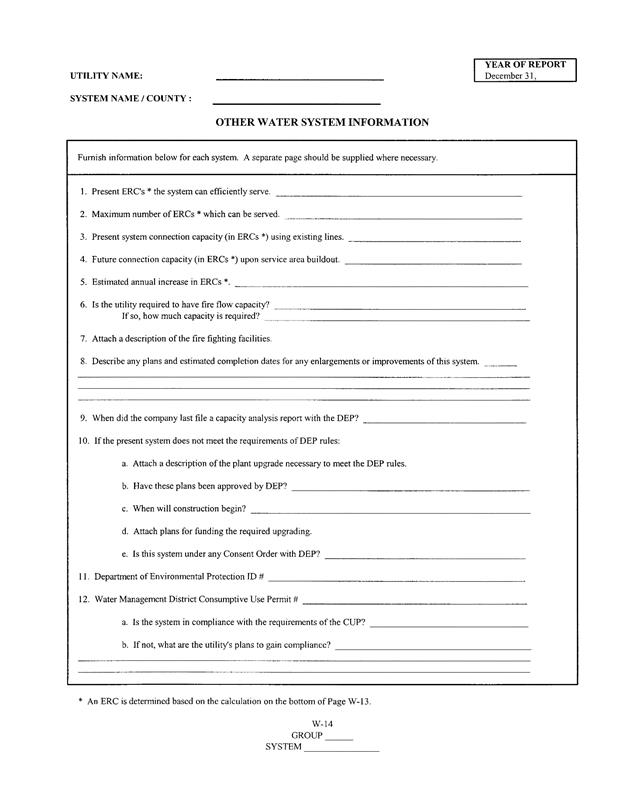
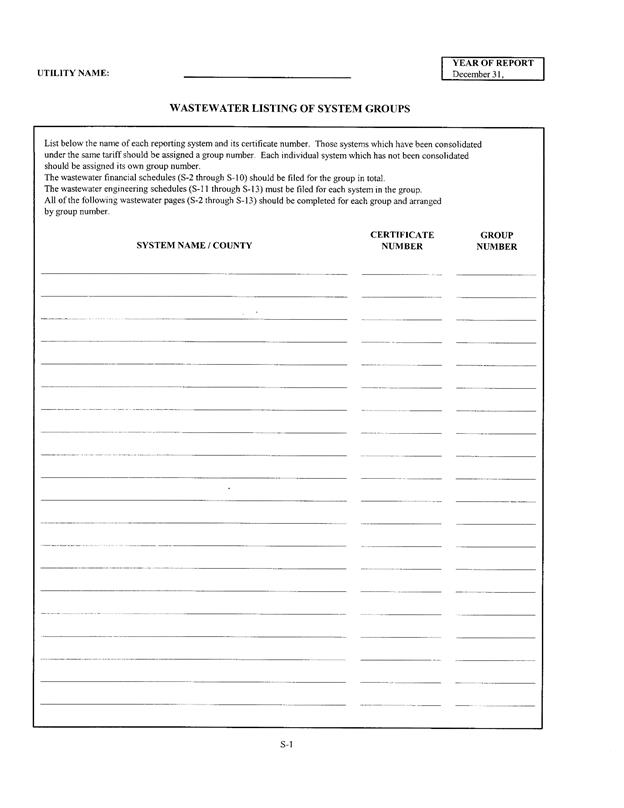
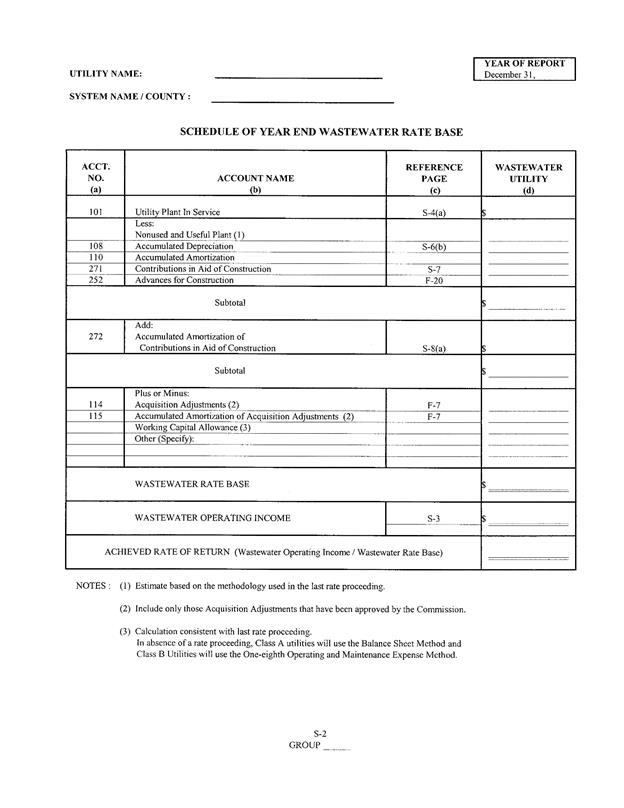
Reference to the USOA in Related Forms
incorporated by reference in the Rules
Rules 25-30.115, 25-30.033, 25-30.037, 25-30.0372, and
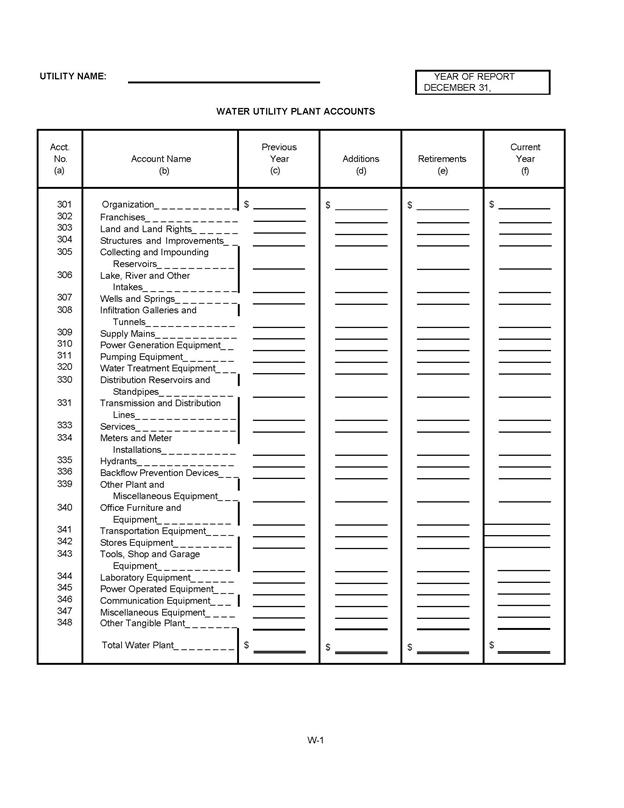
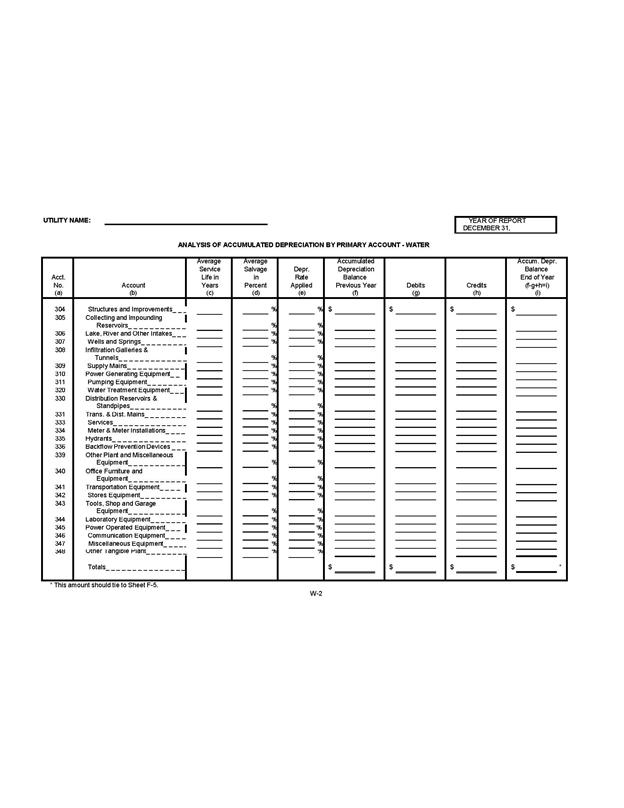
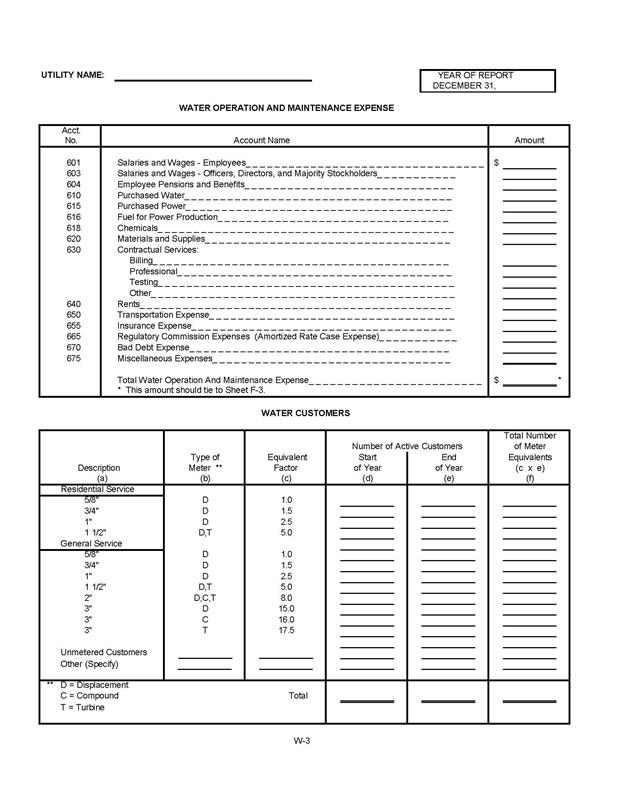
25-30.445, F.A.C., refer to and incorporate various Commission forms that
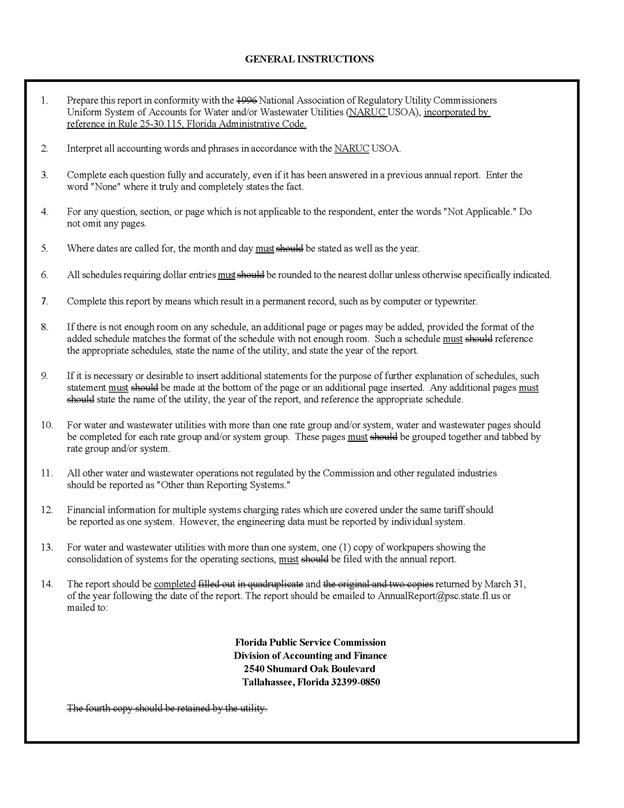
reference the prior USOA. These forms have been updated to maintain consistency
in referring to the current NARUC USOA, incorporated in Rule 25-30.115.
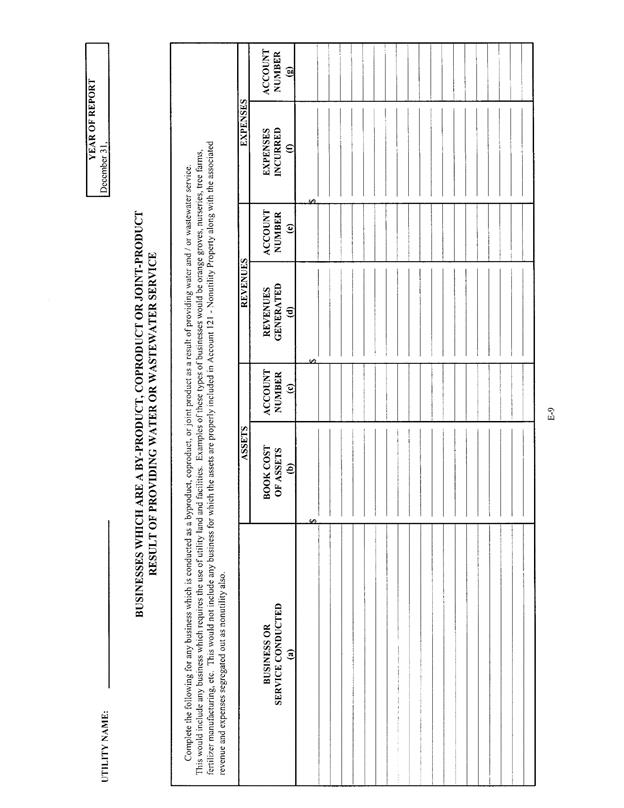
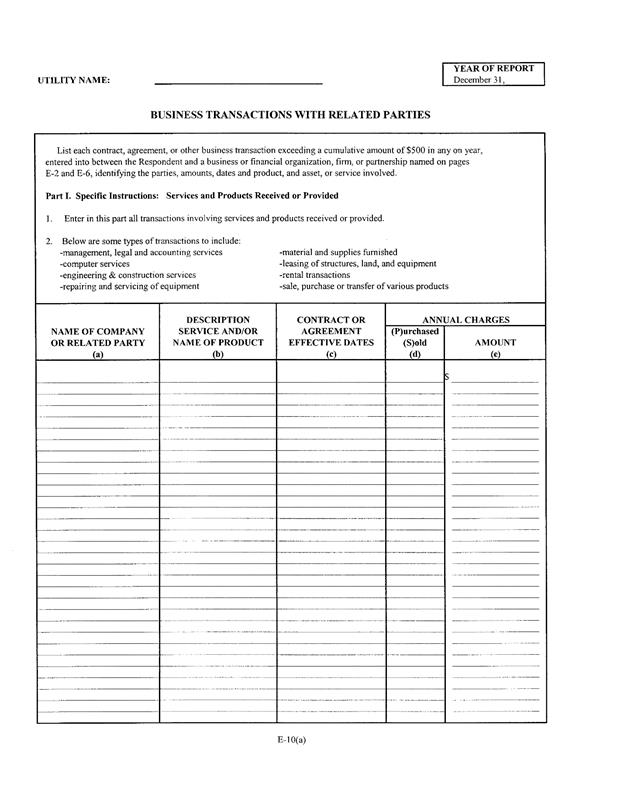
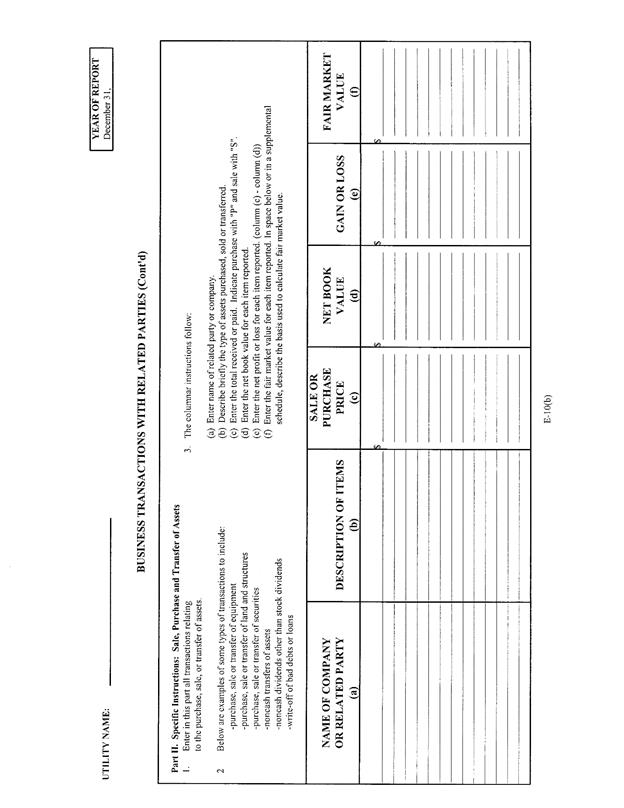
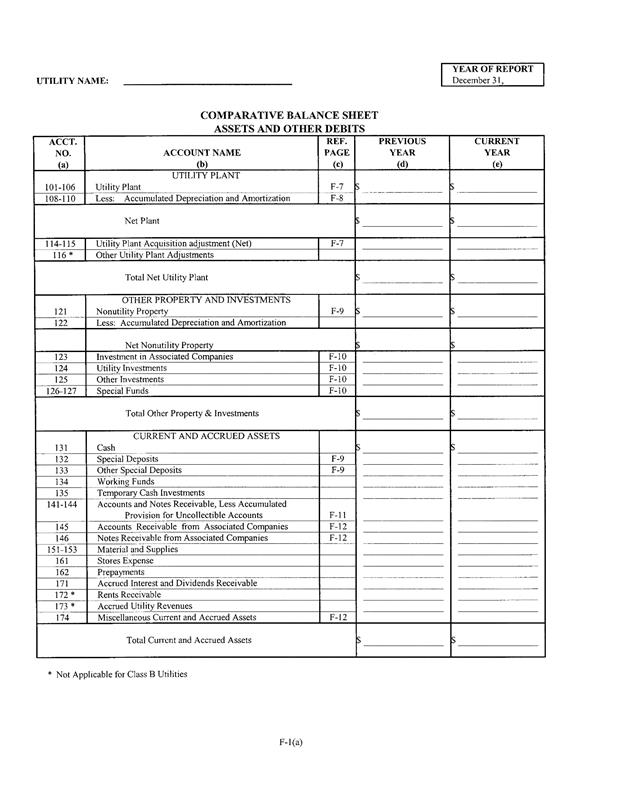
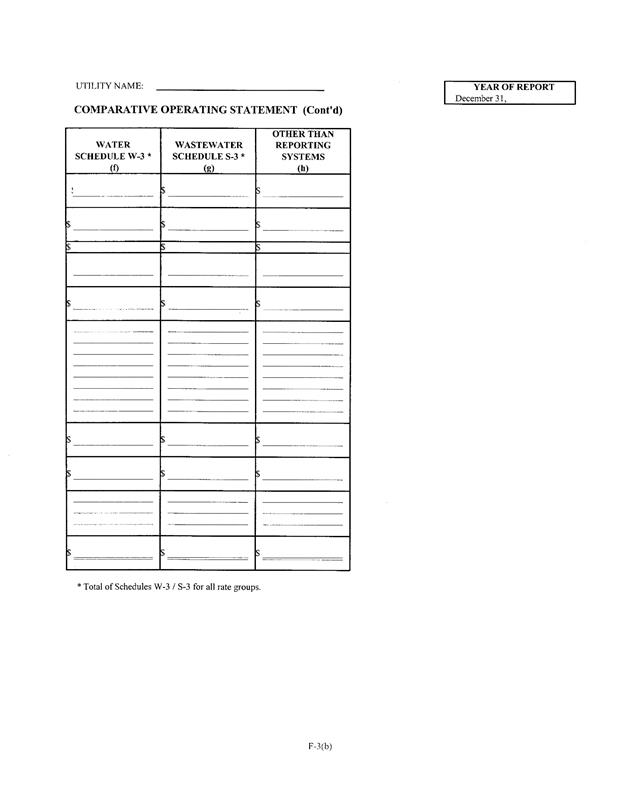
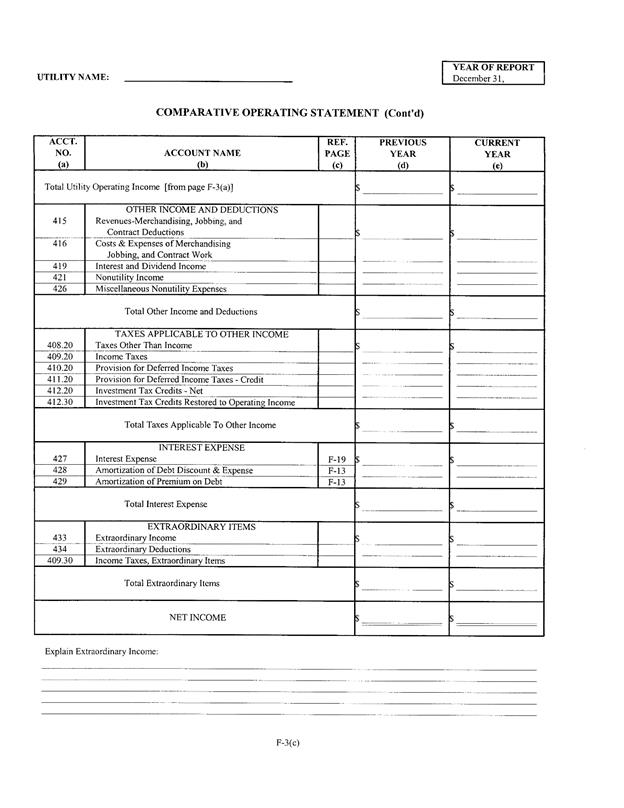
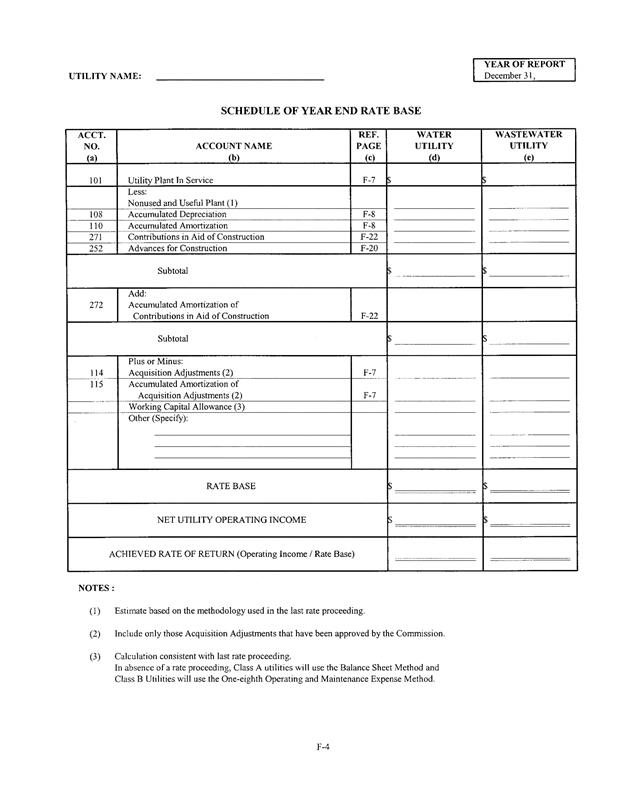
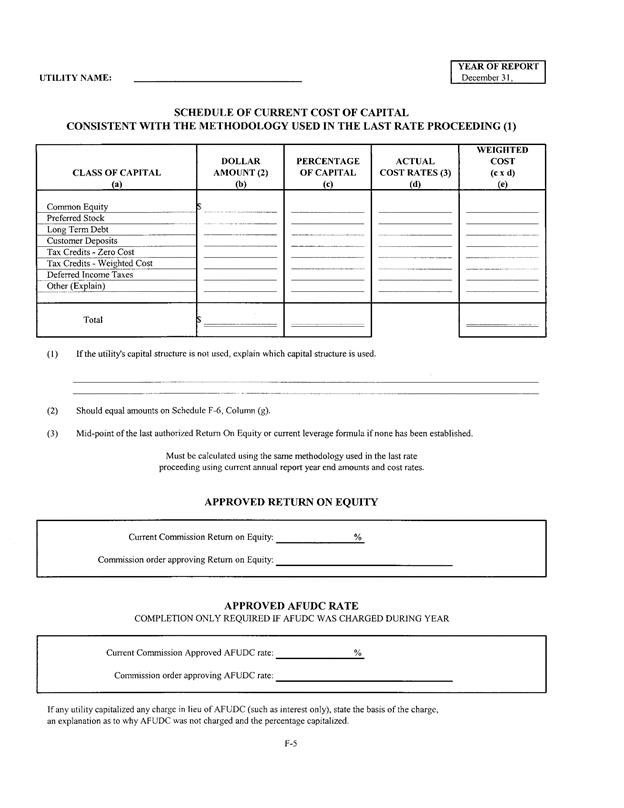
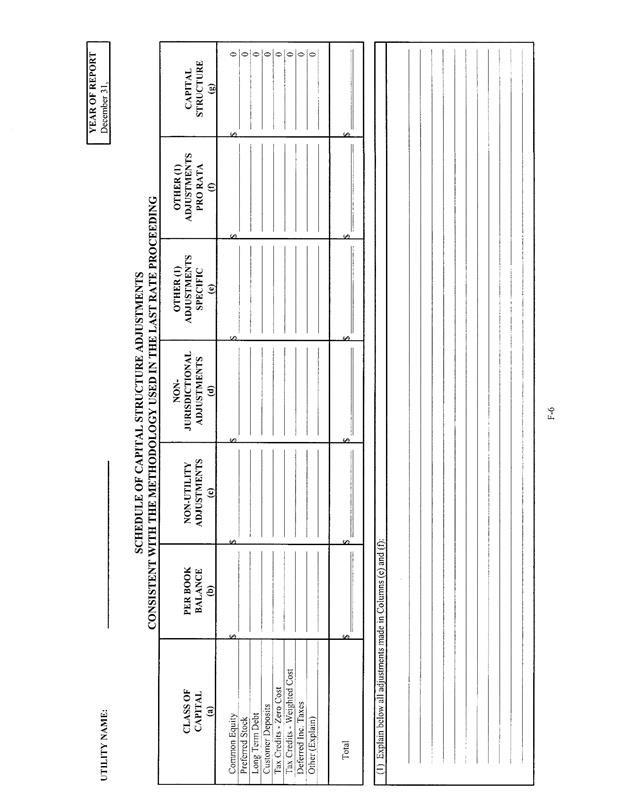
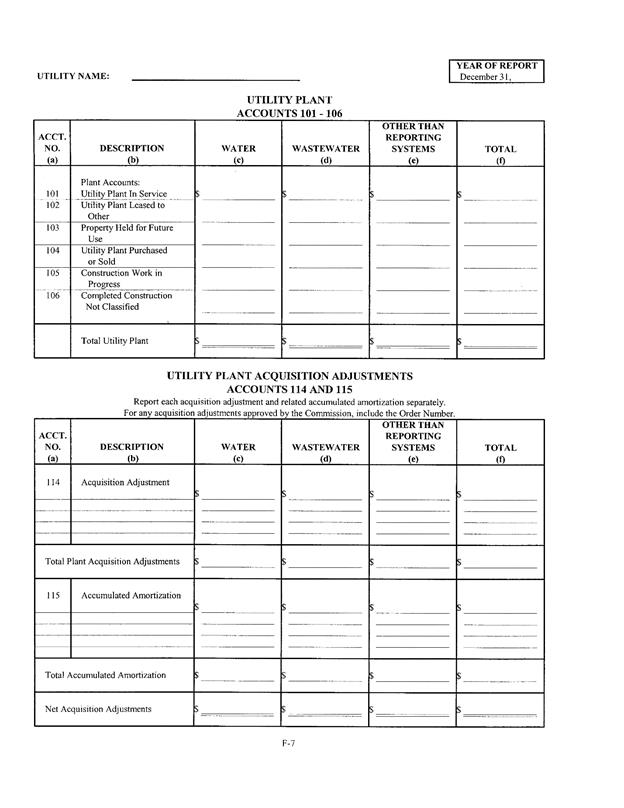
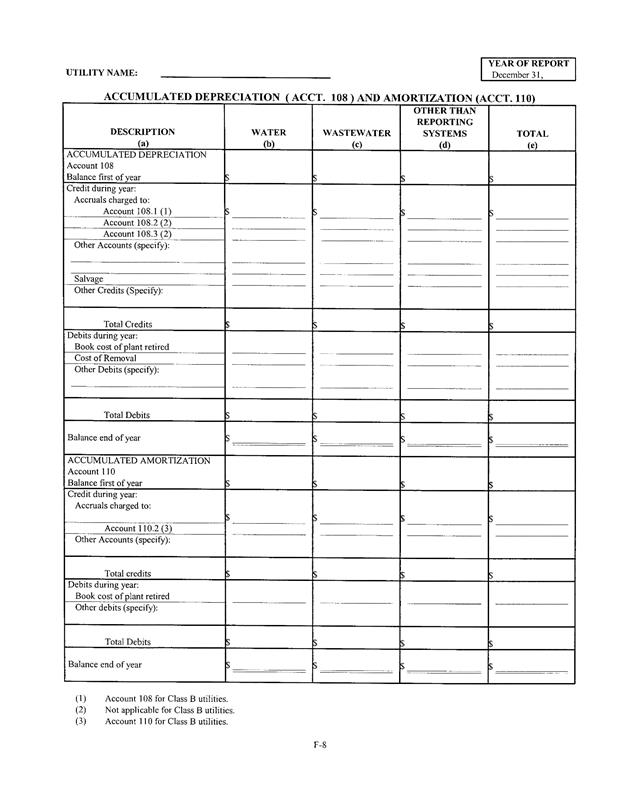
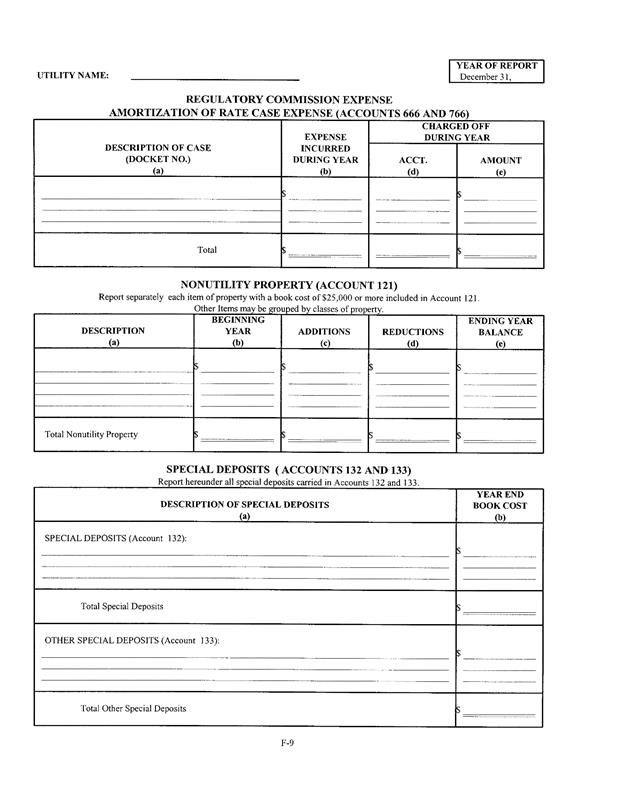
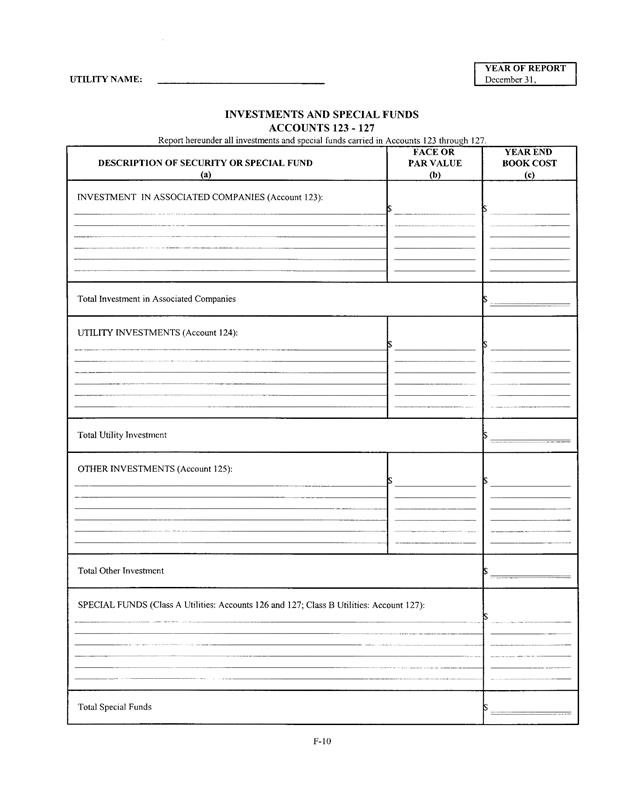
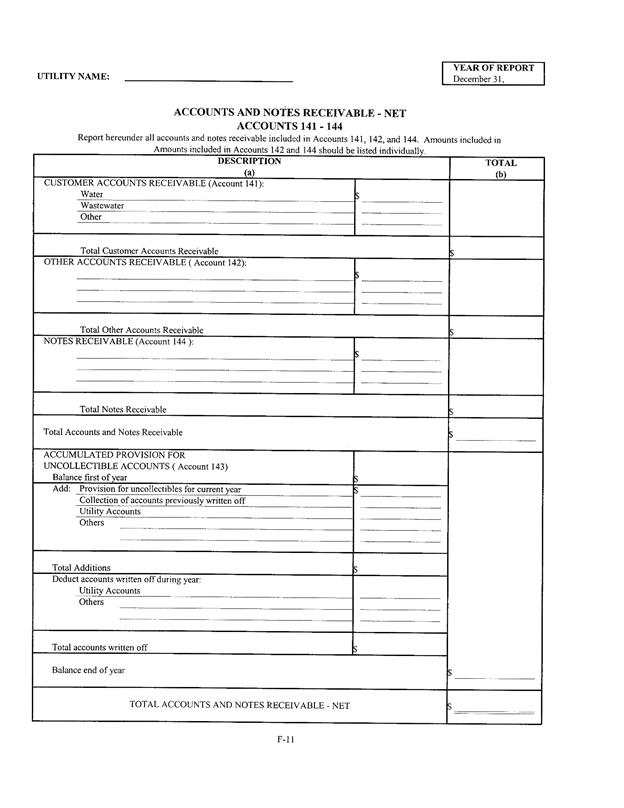
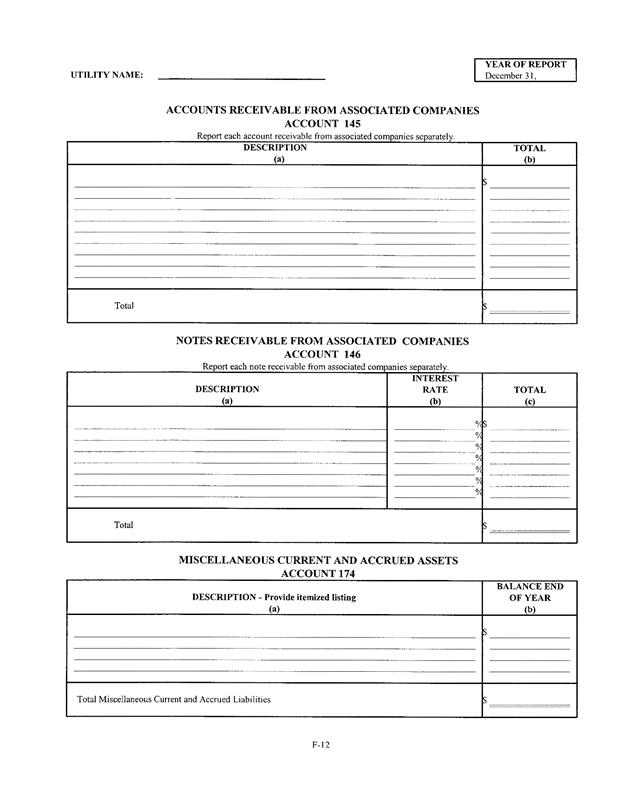
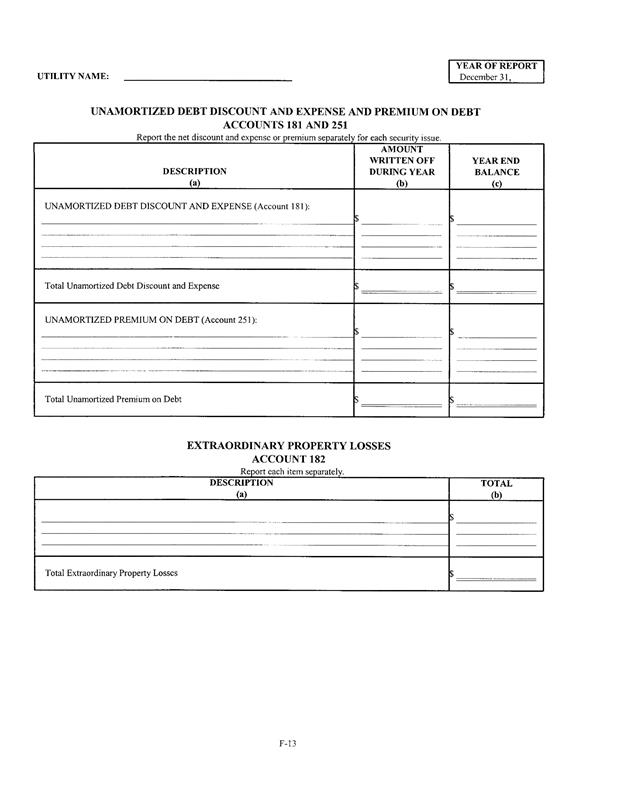
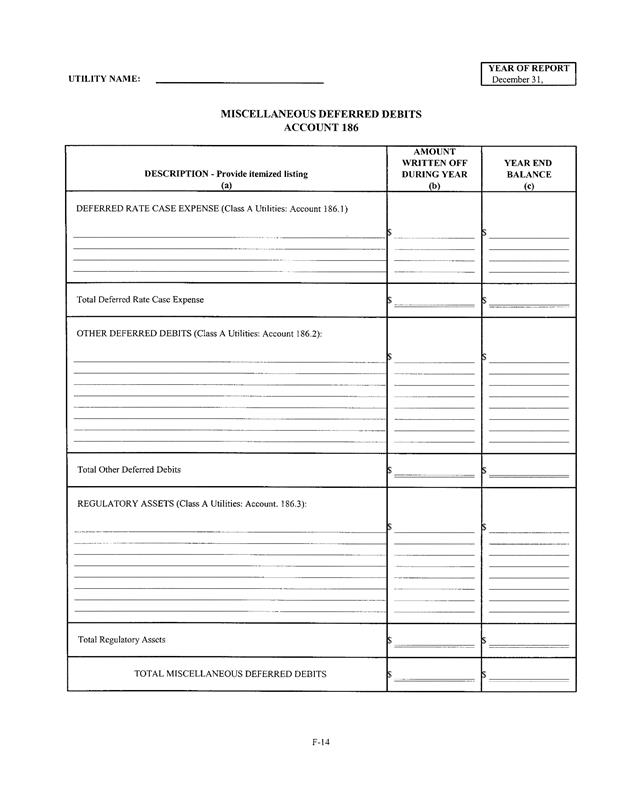
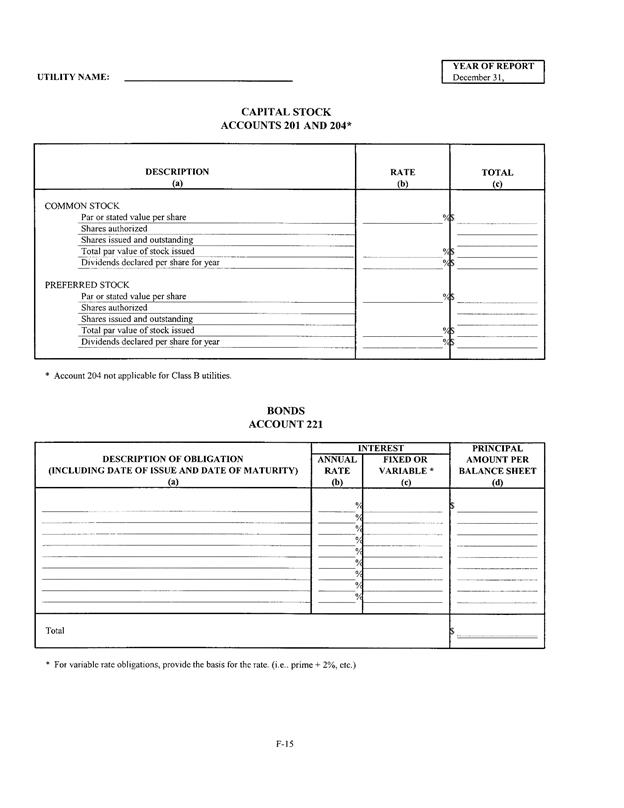
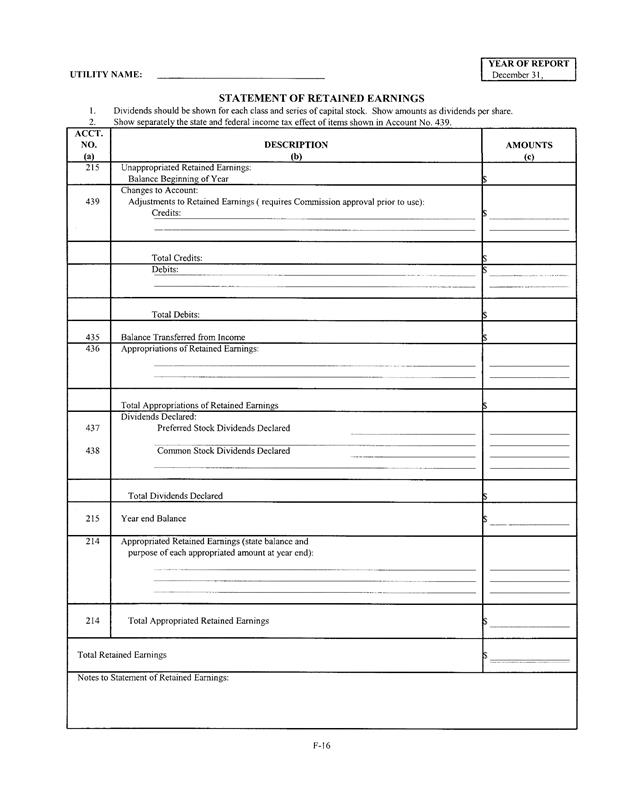
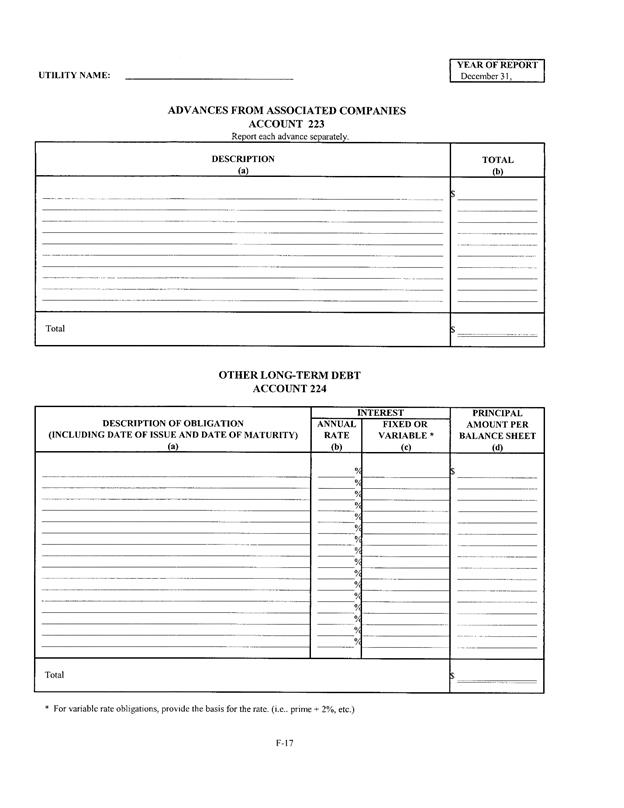
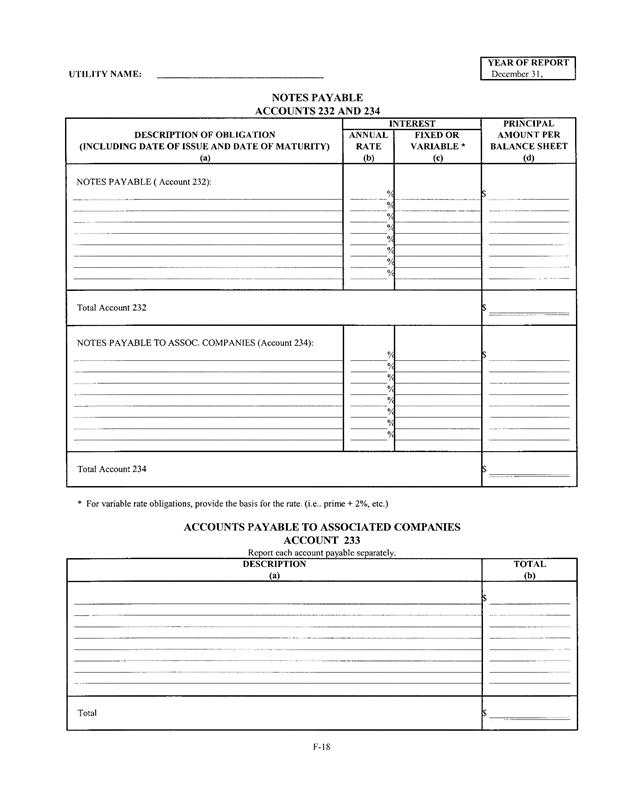
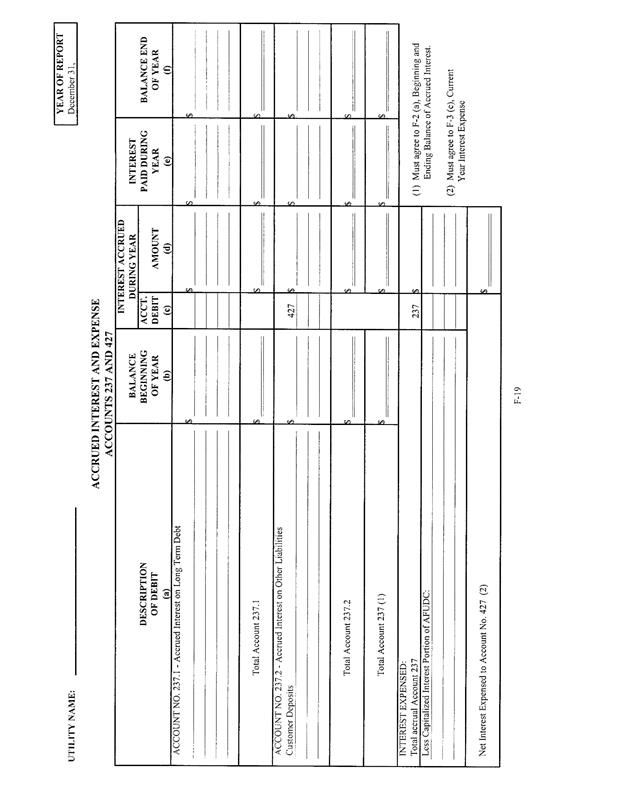
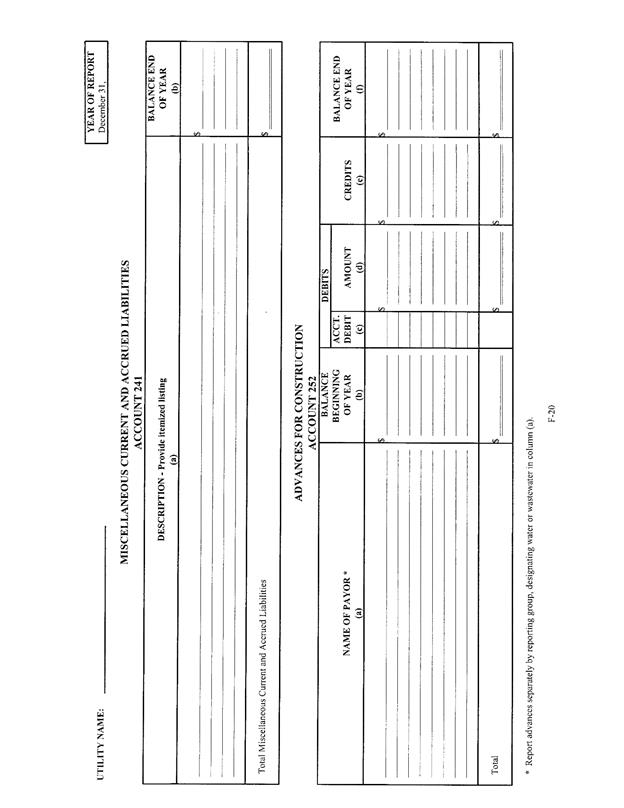
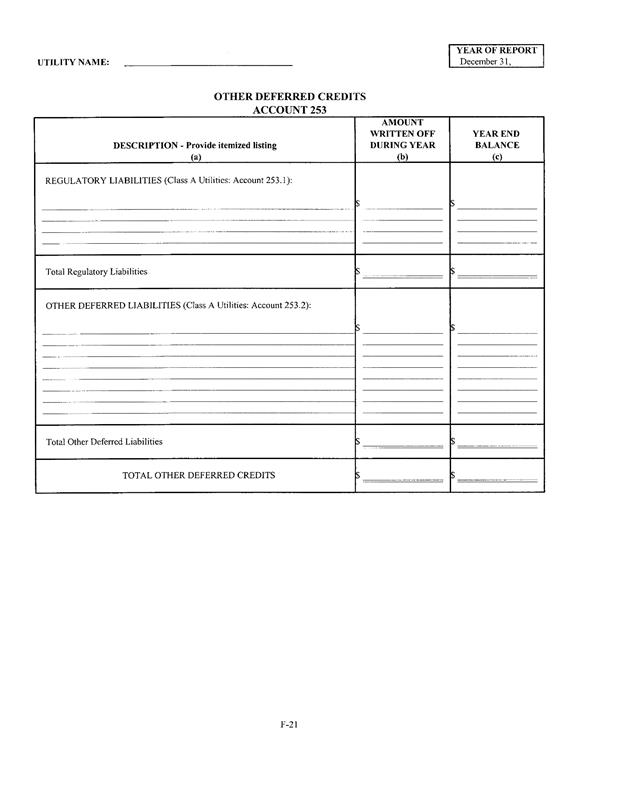
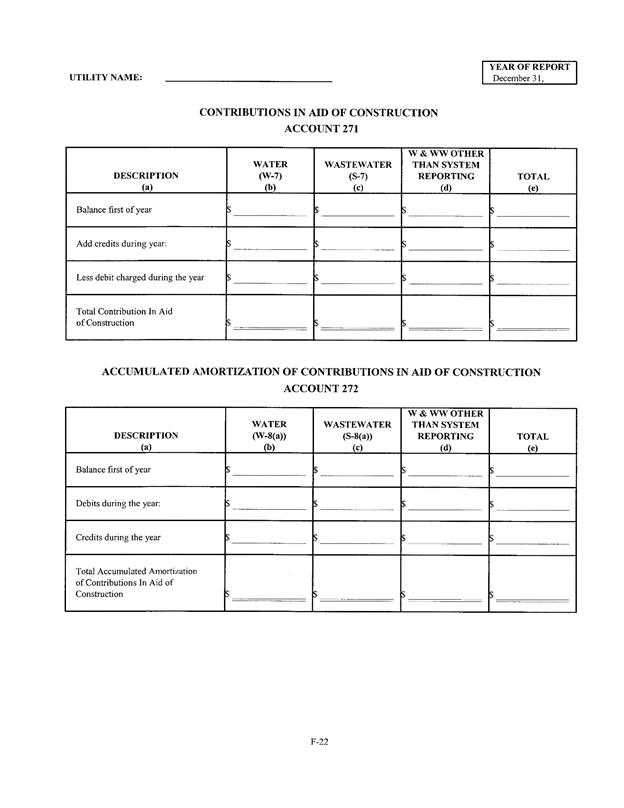
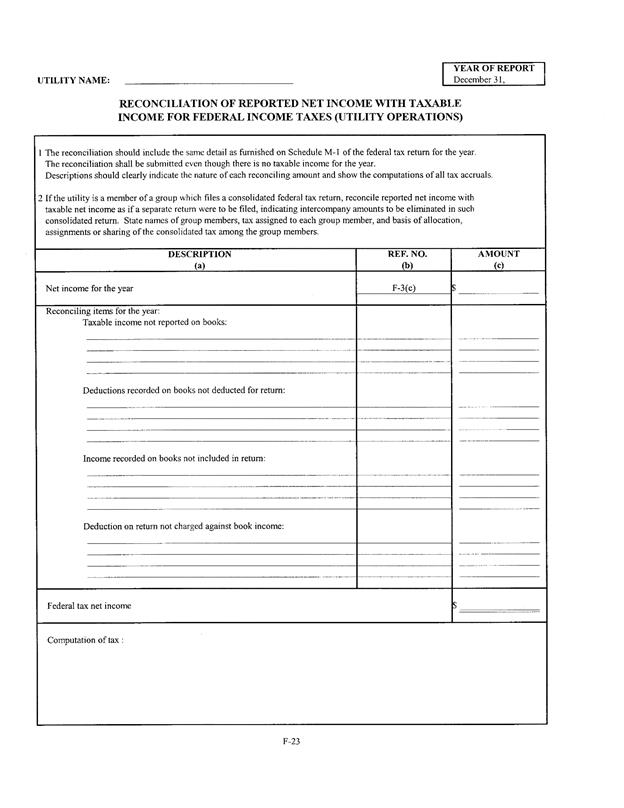
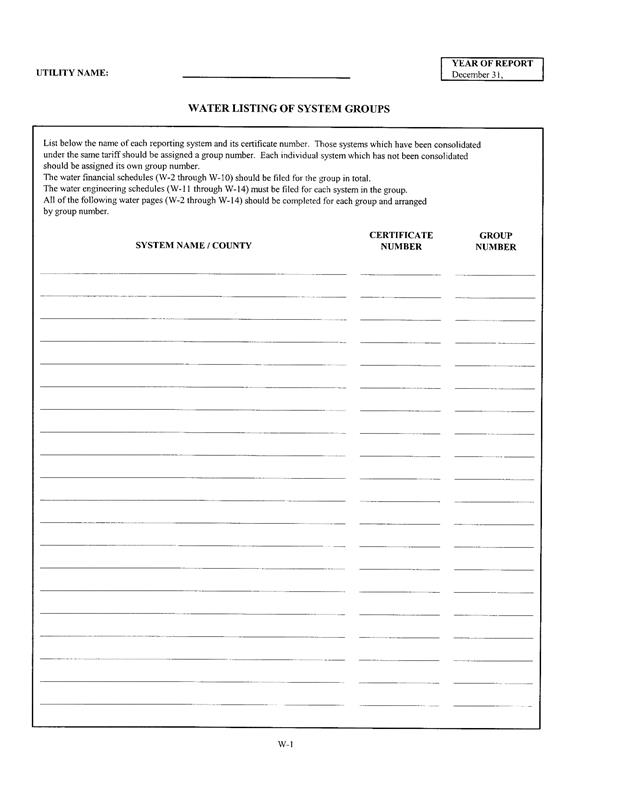
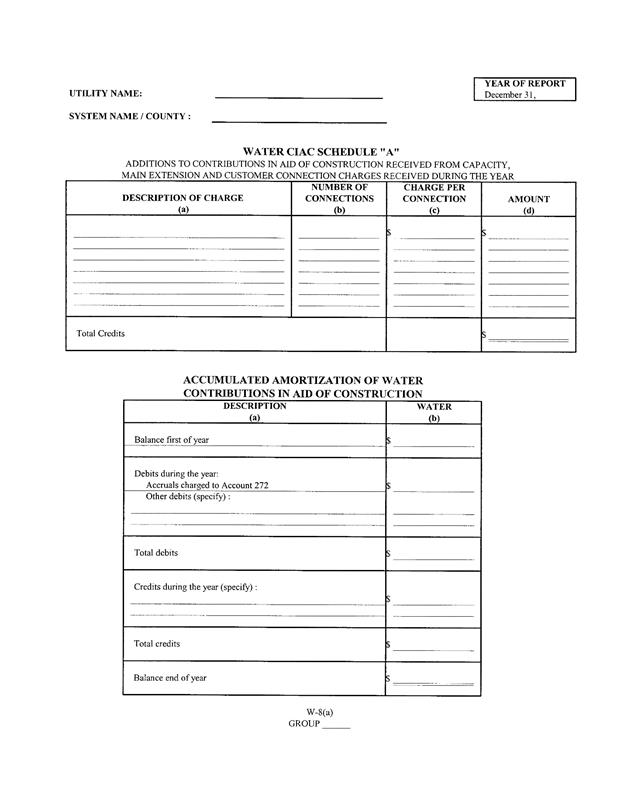
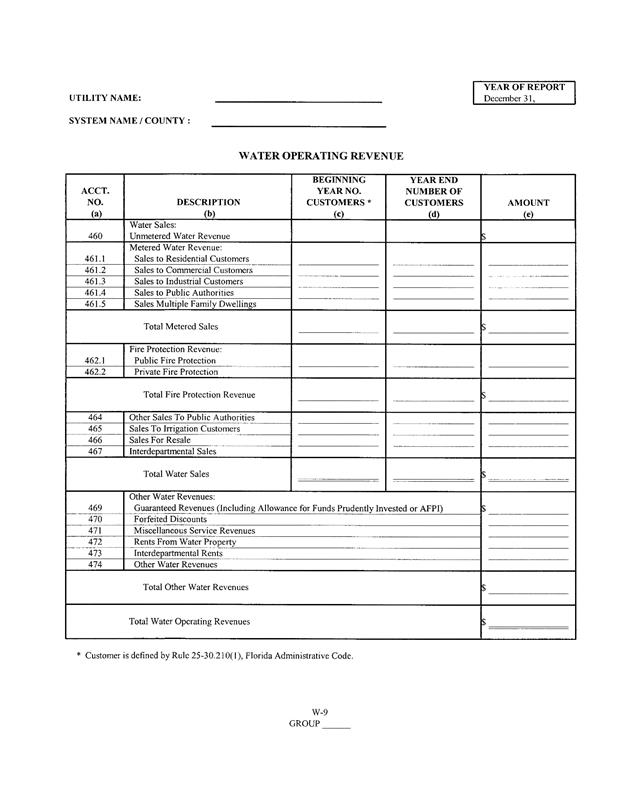
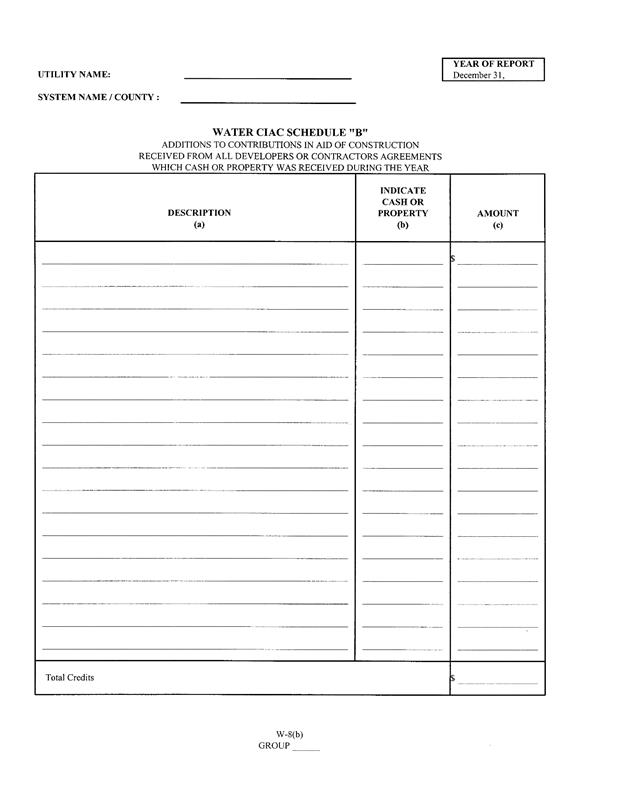
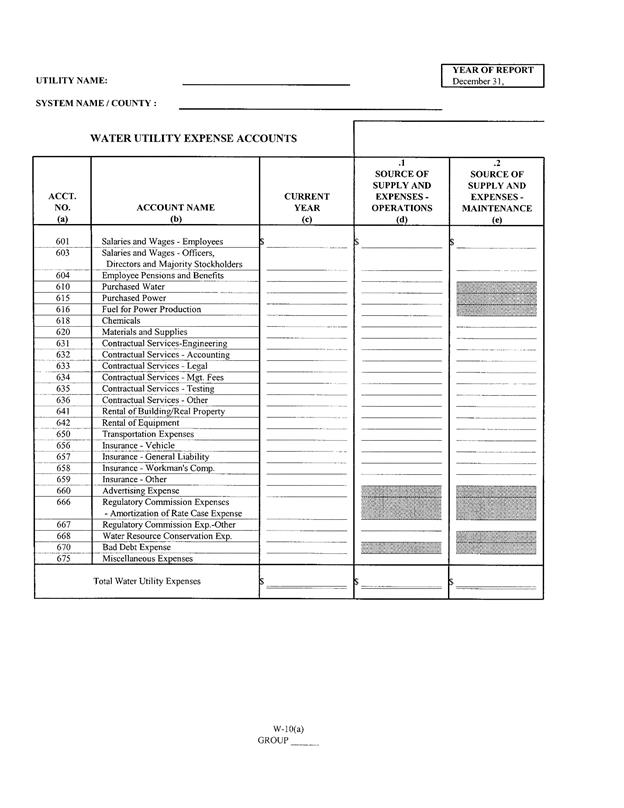
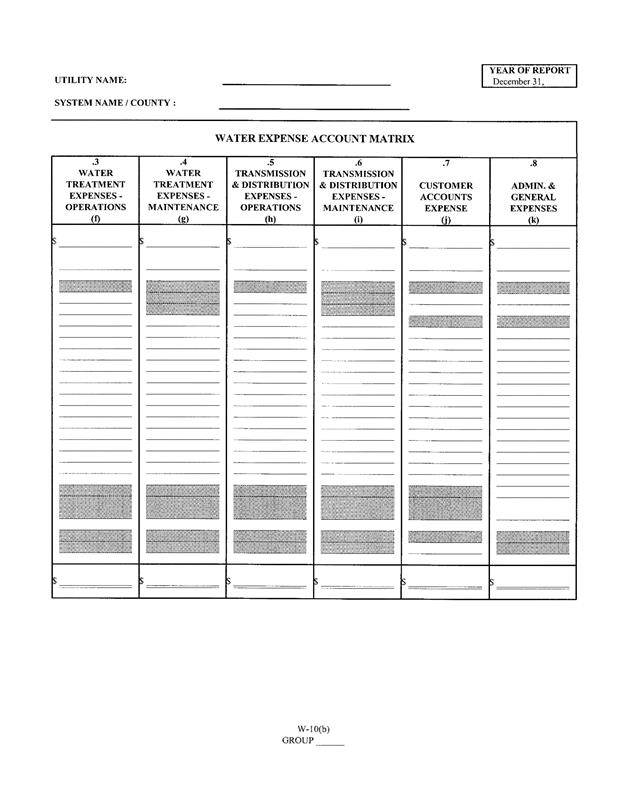
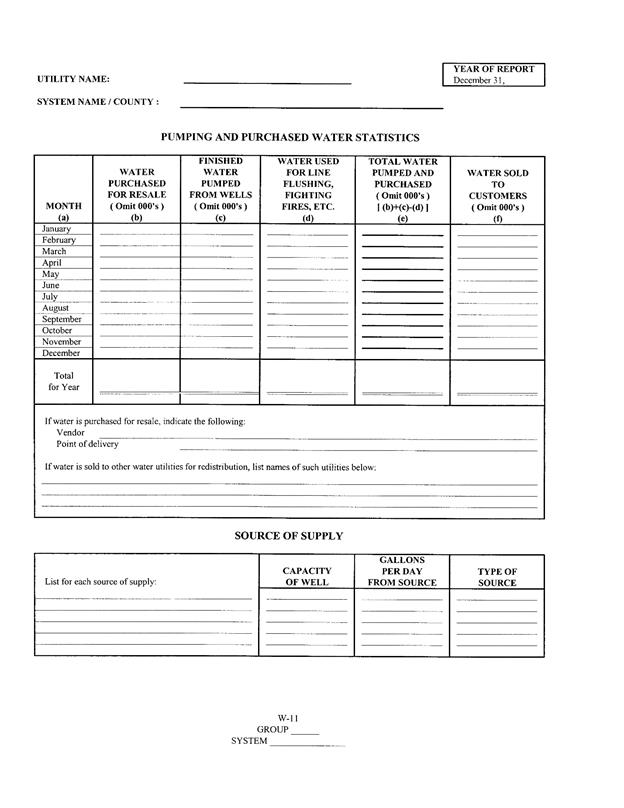
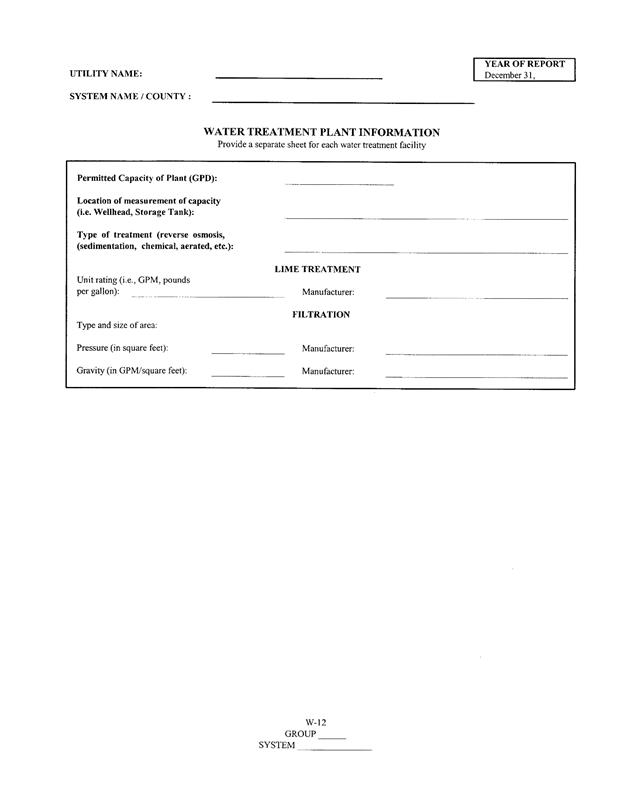
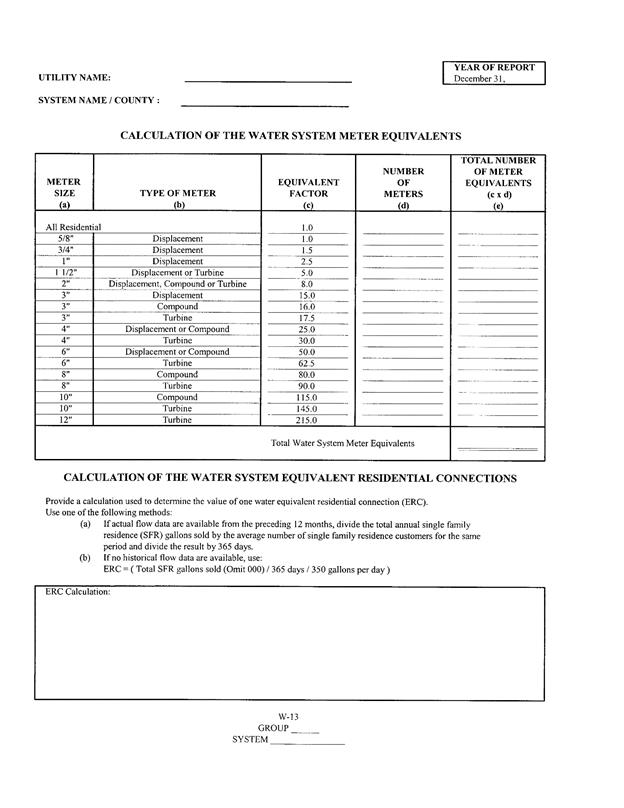
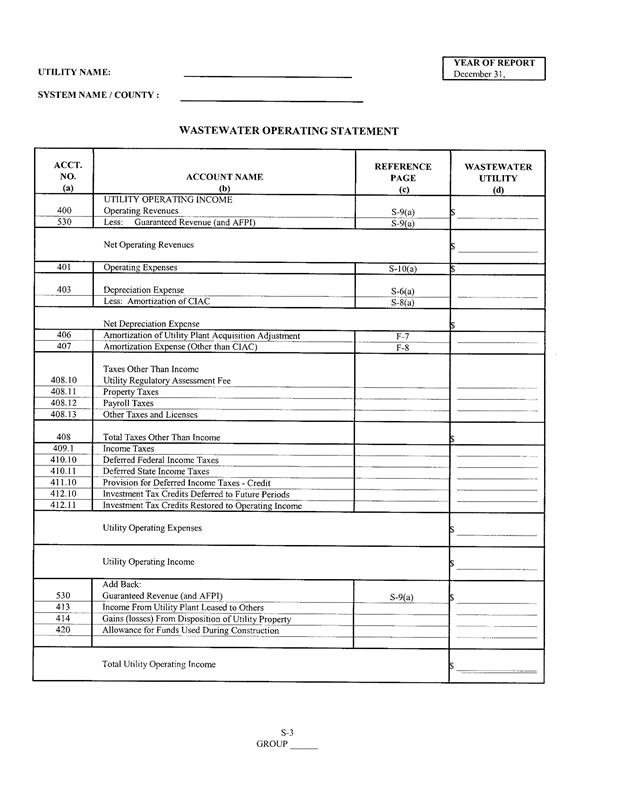
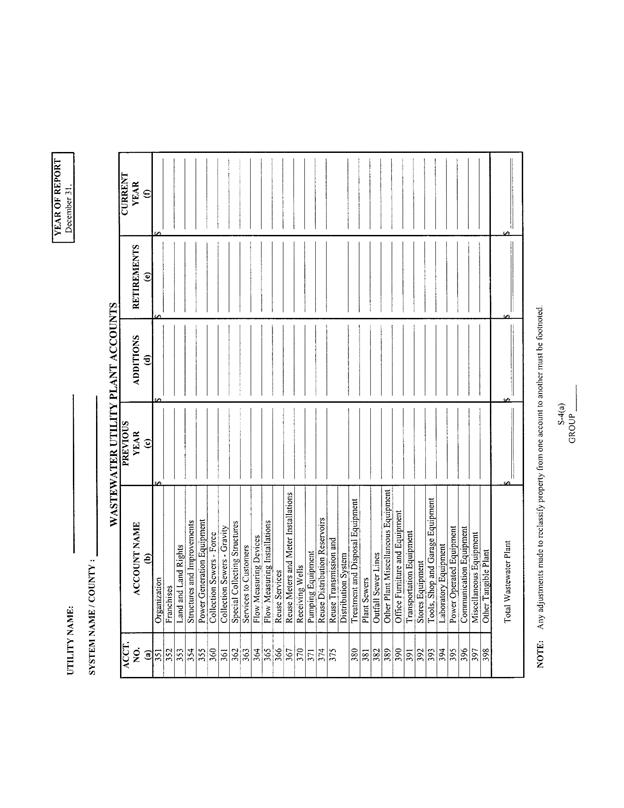
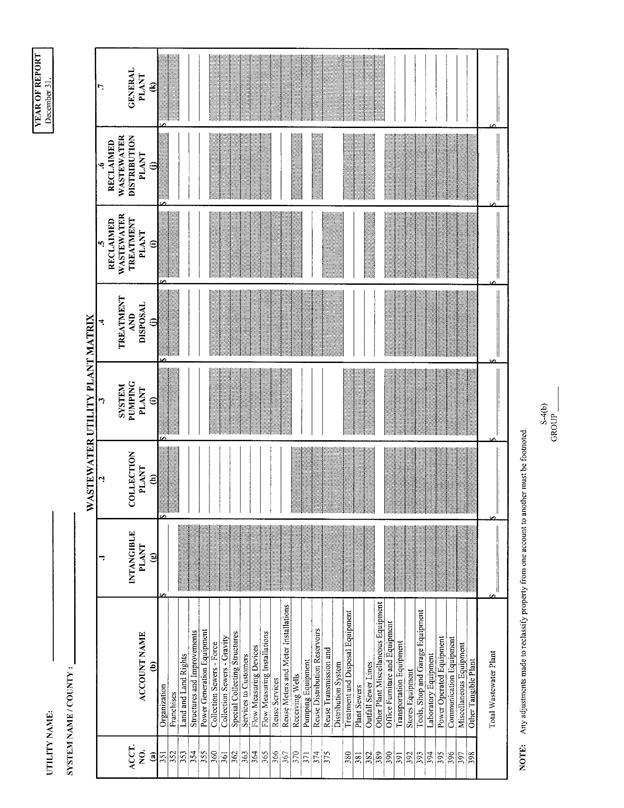
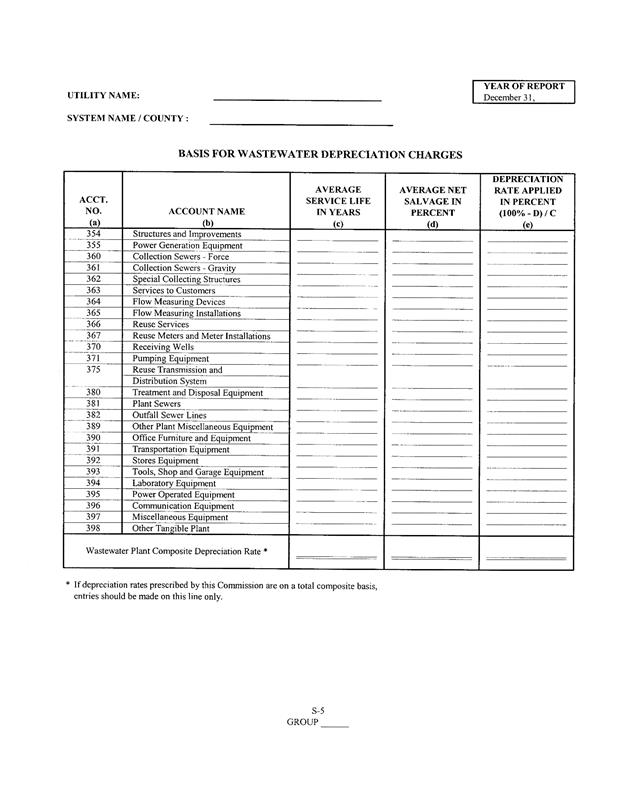
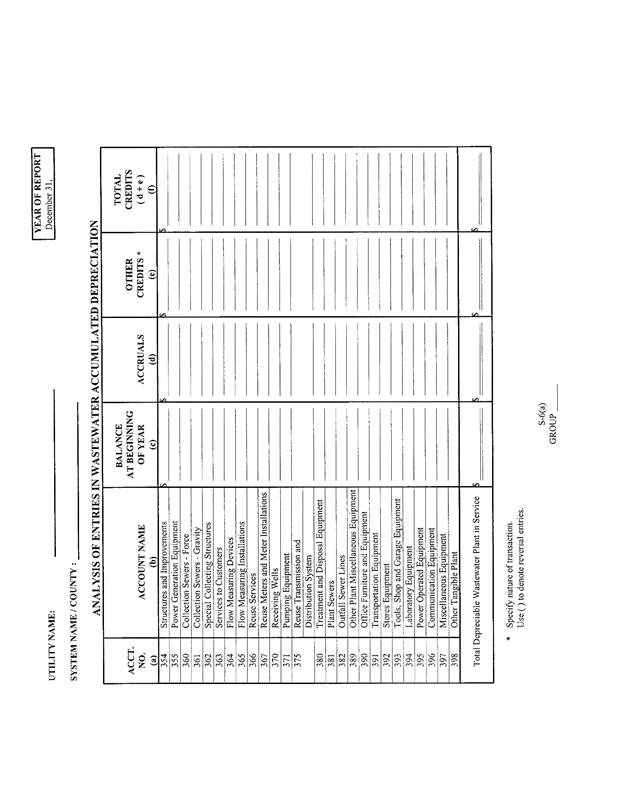
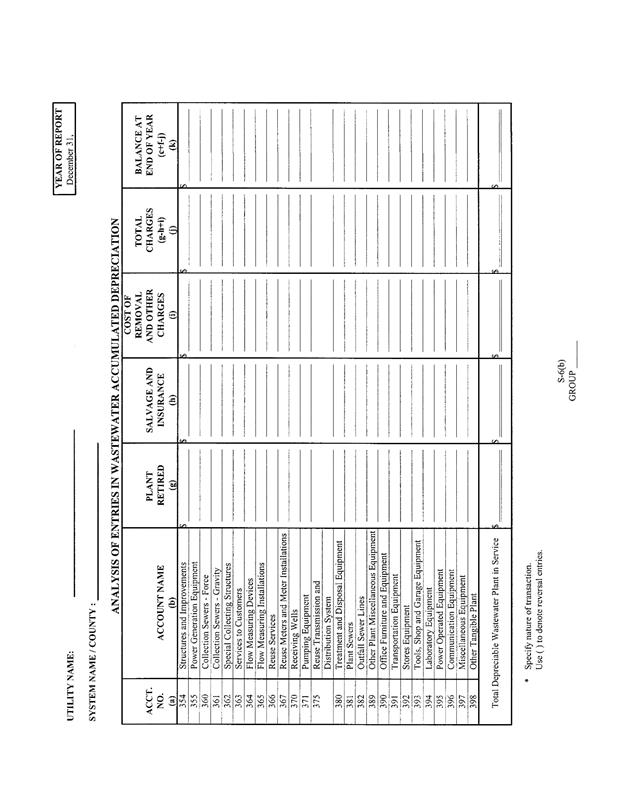
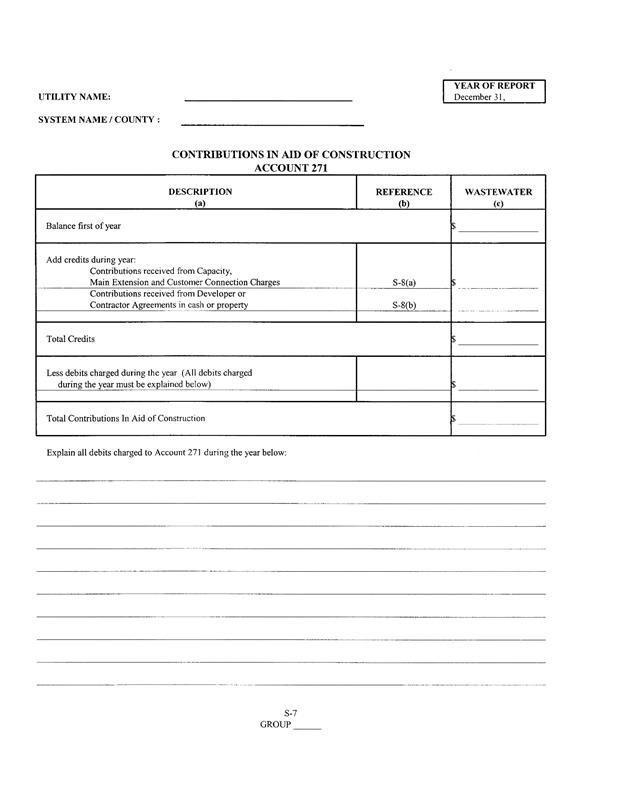
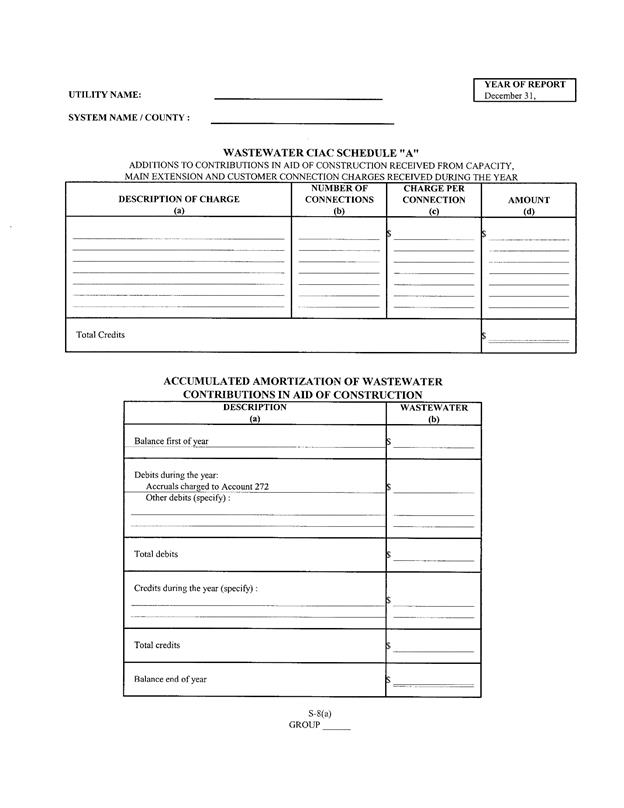
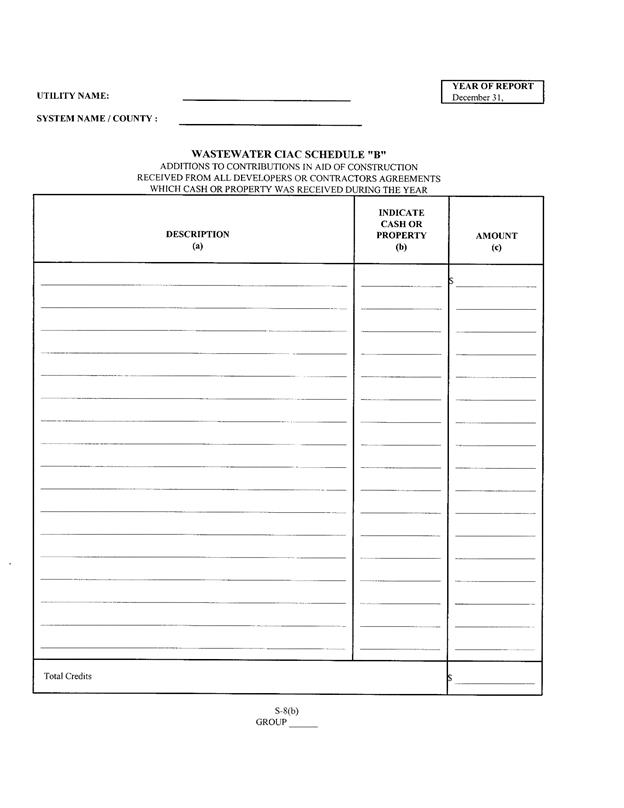
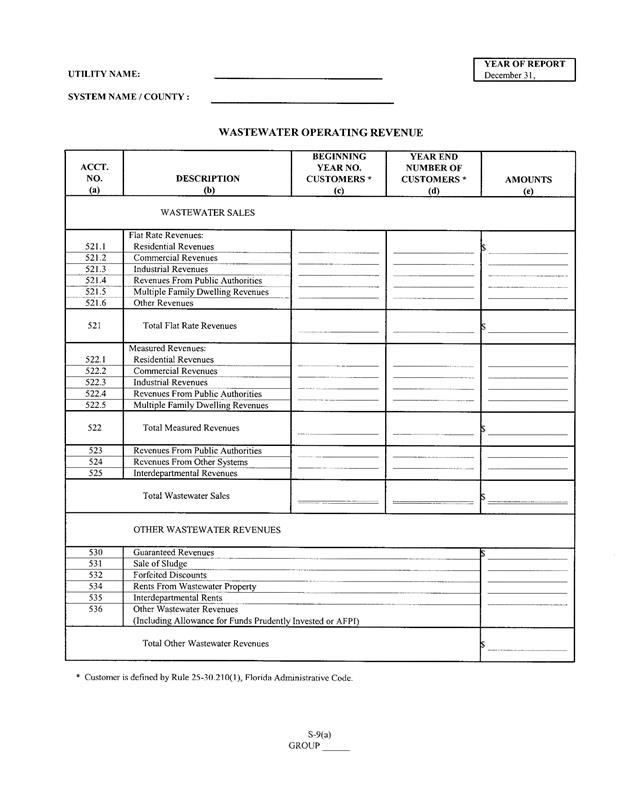
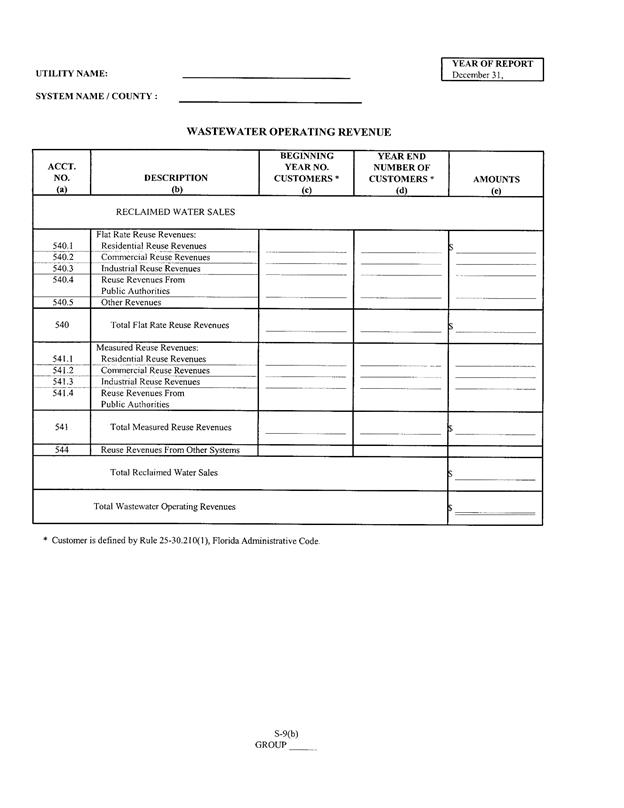
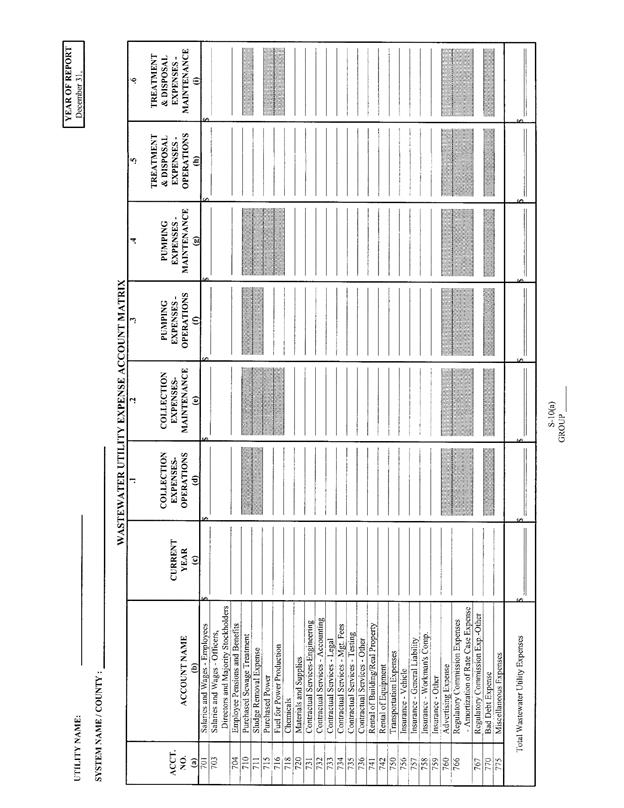
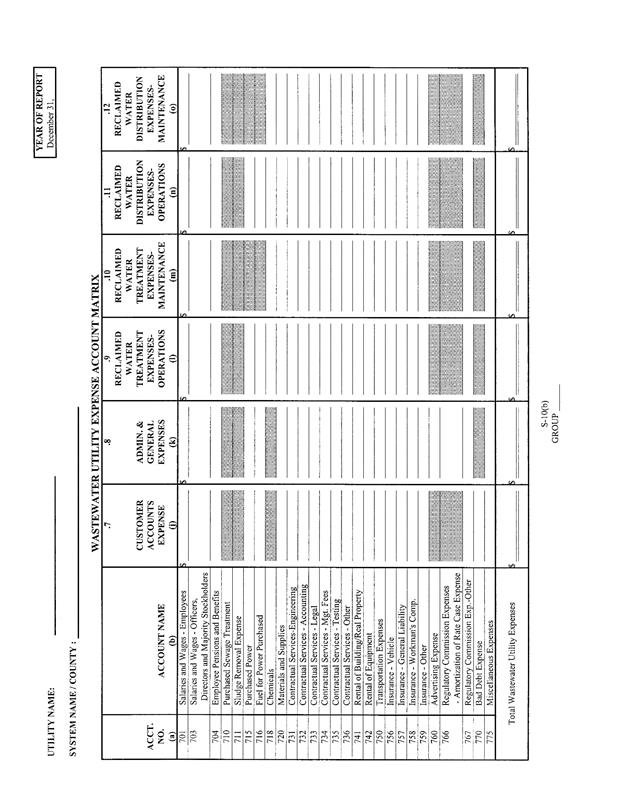
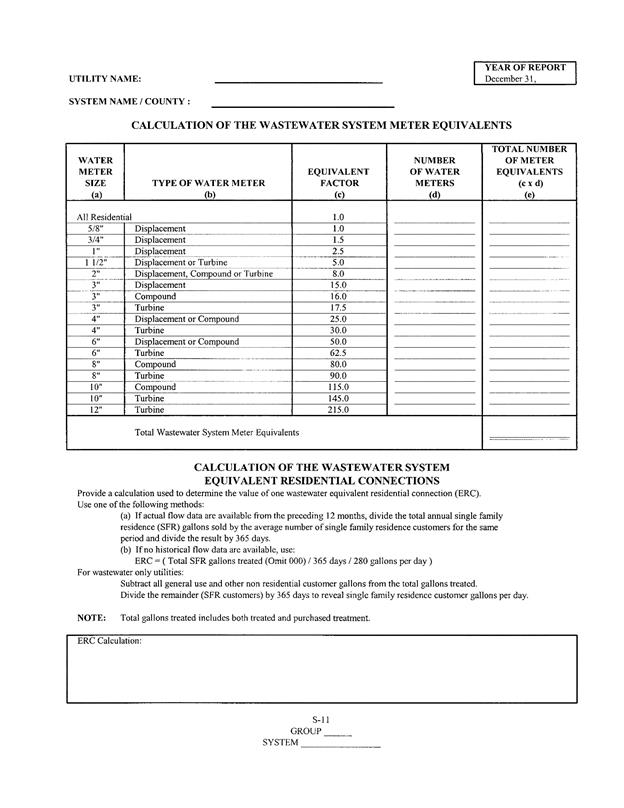
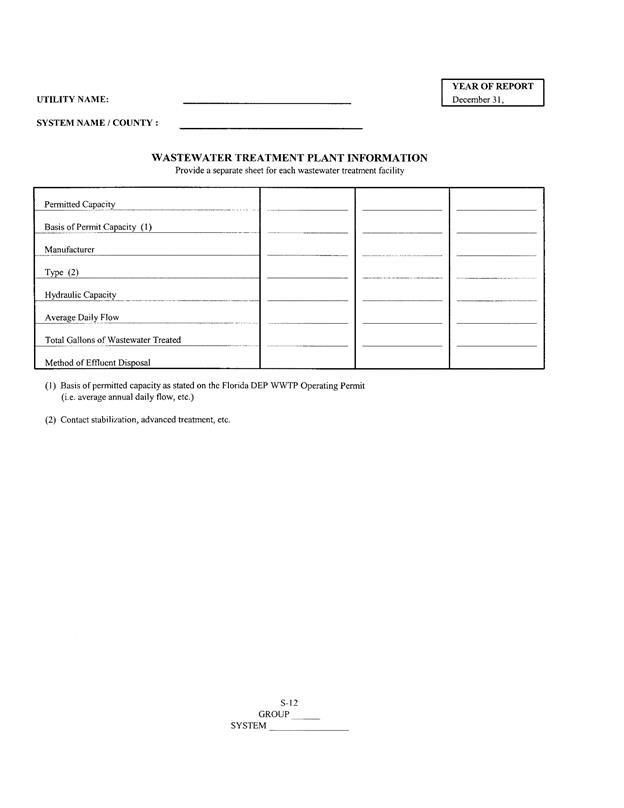
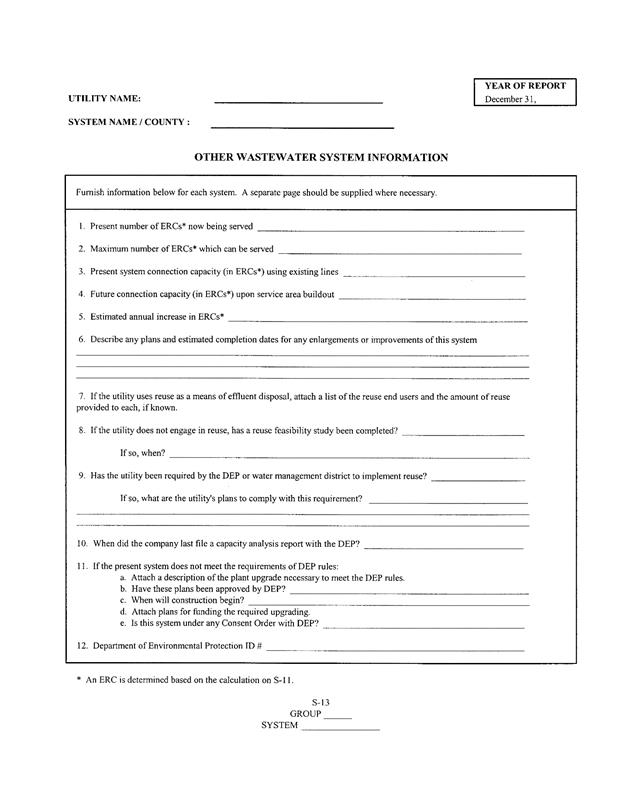
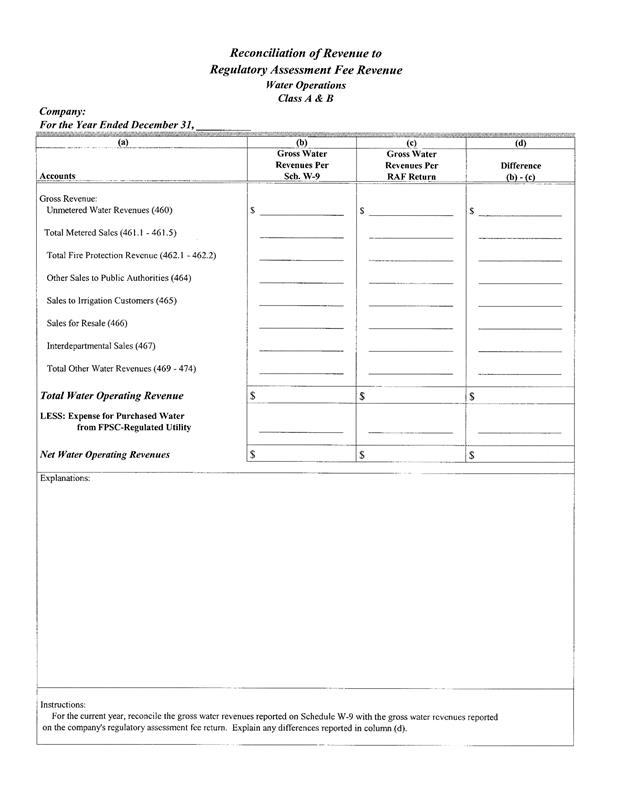
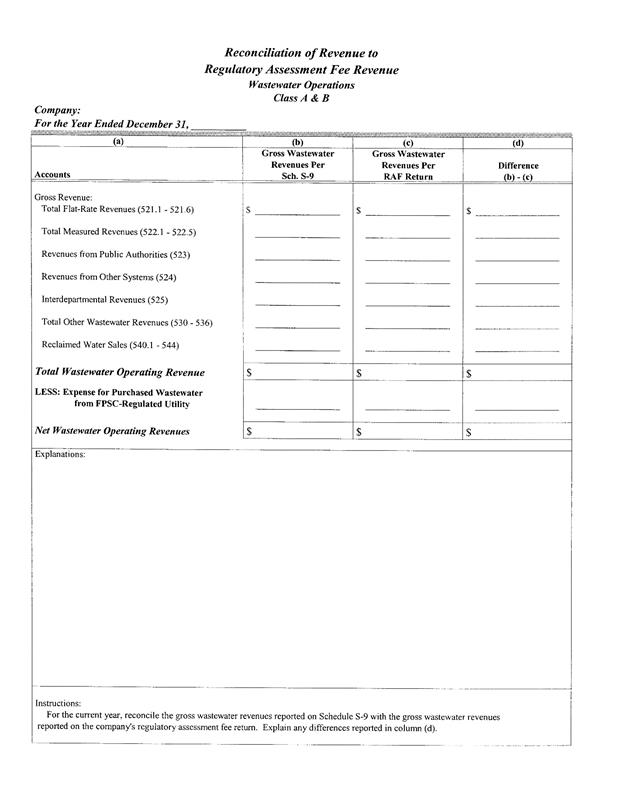
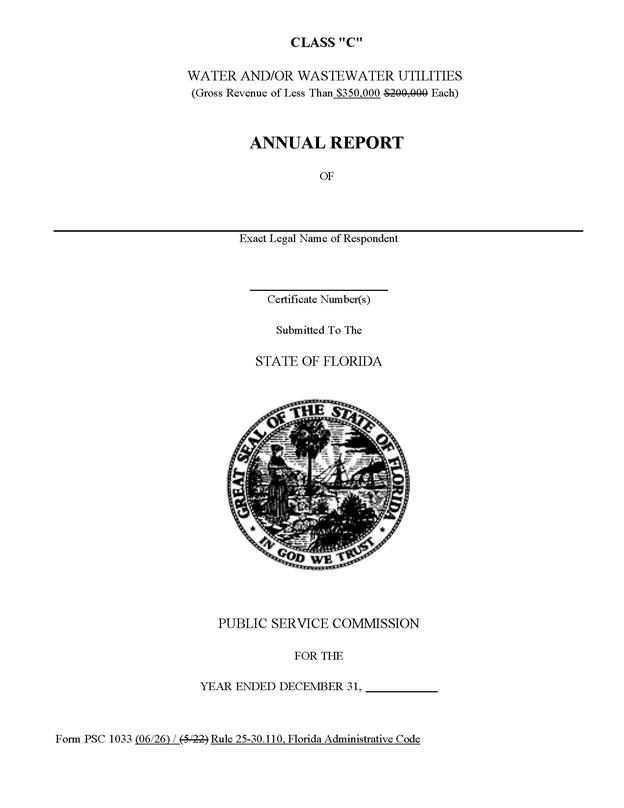
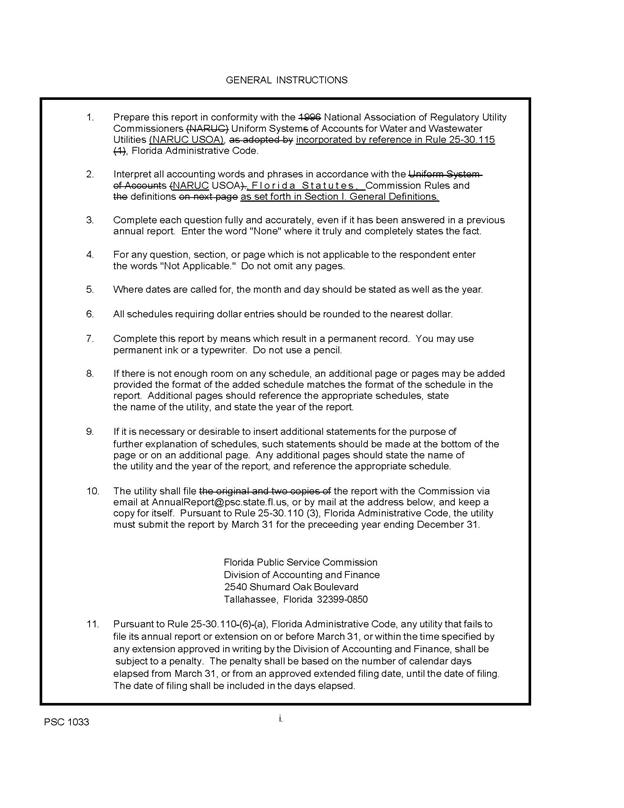
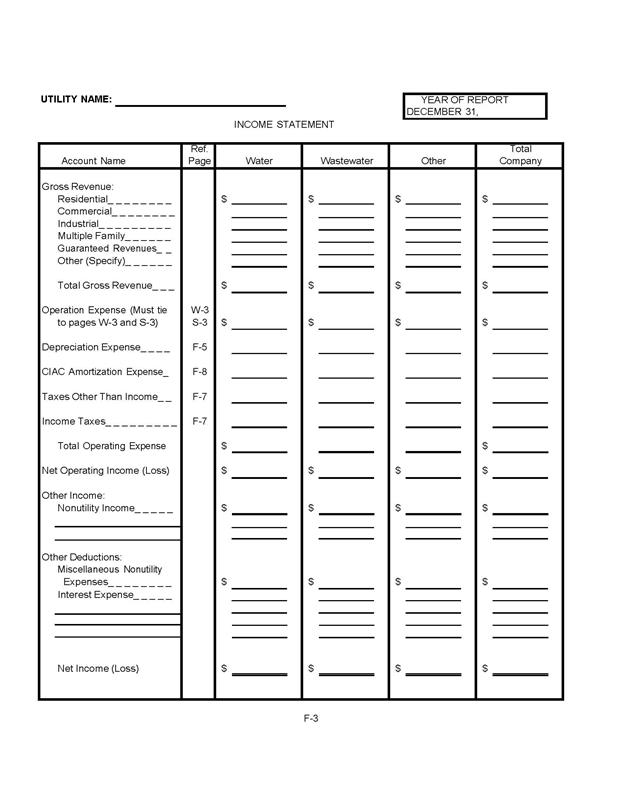
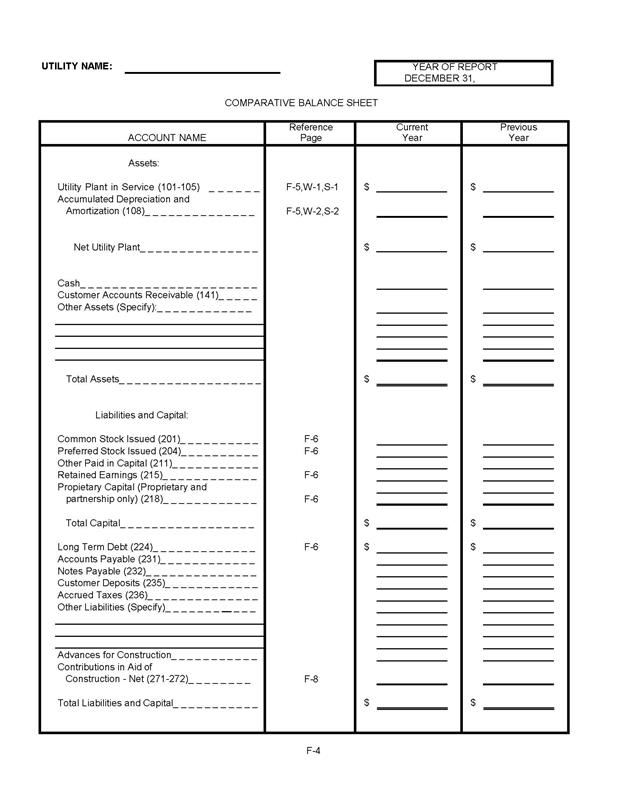
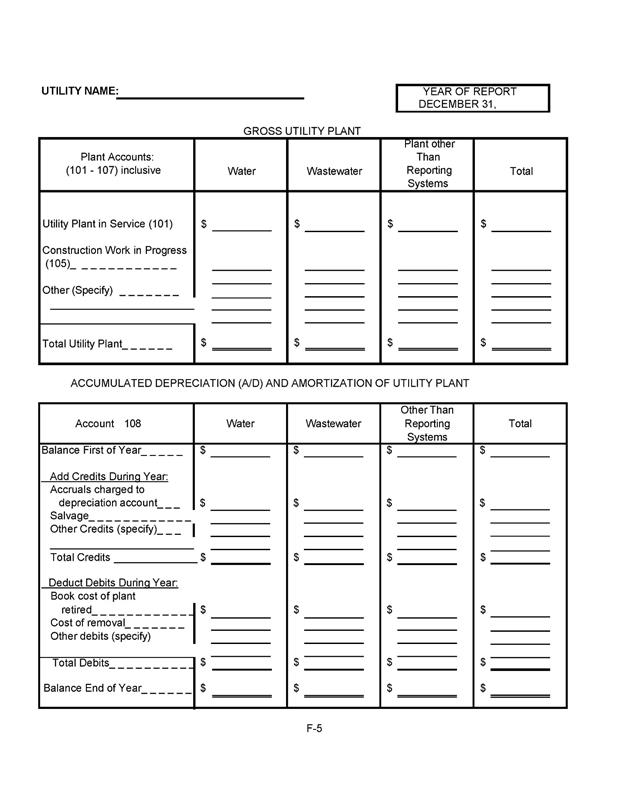
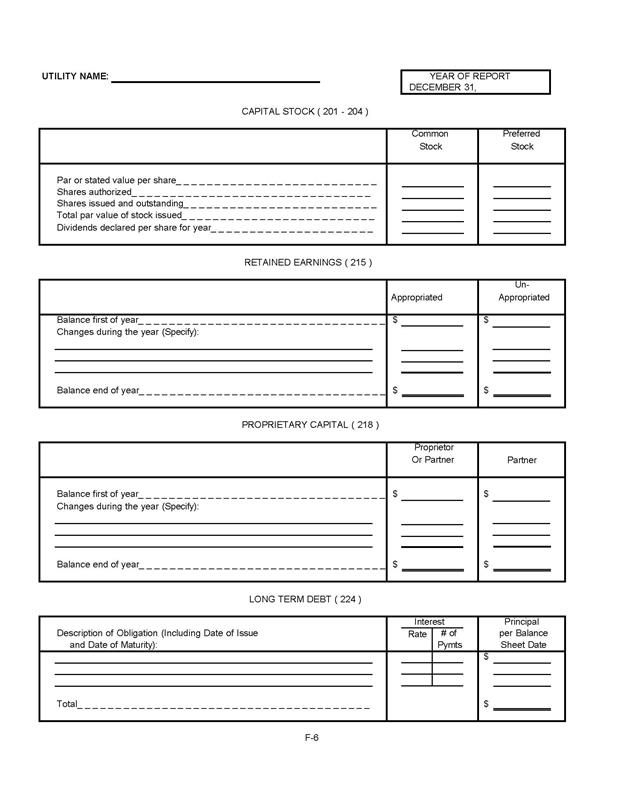
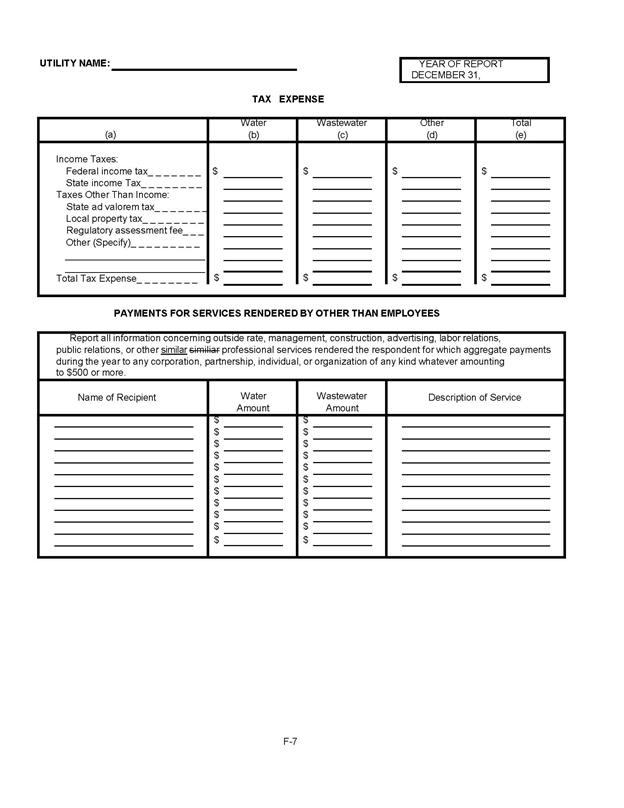
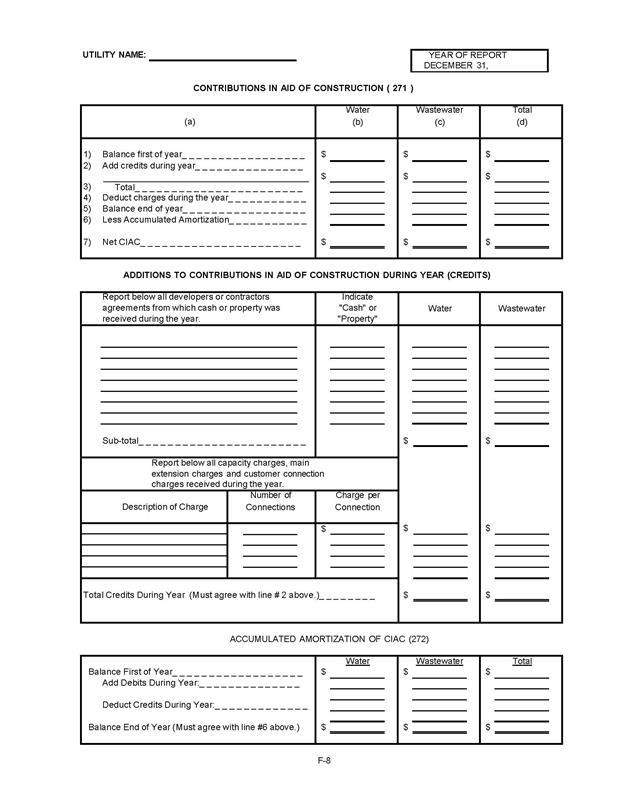
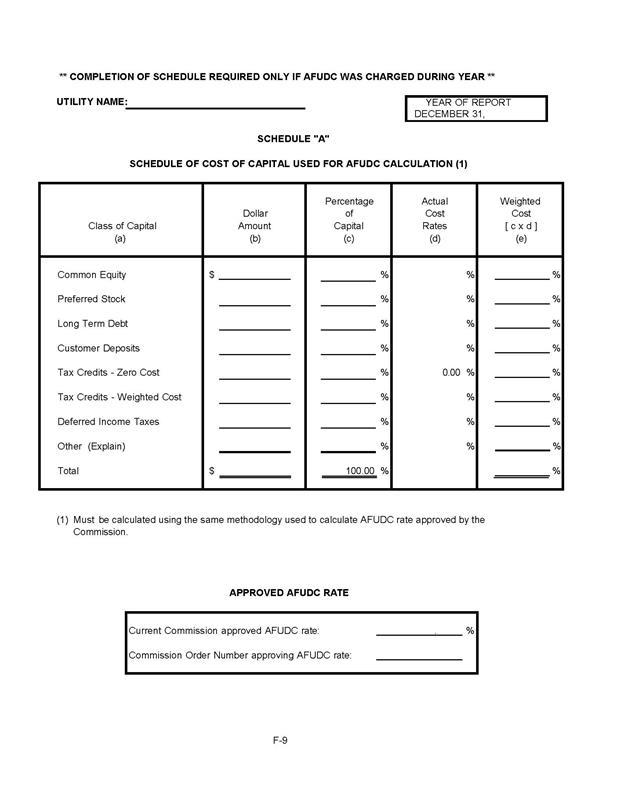
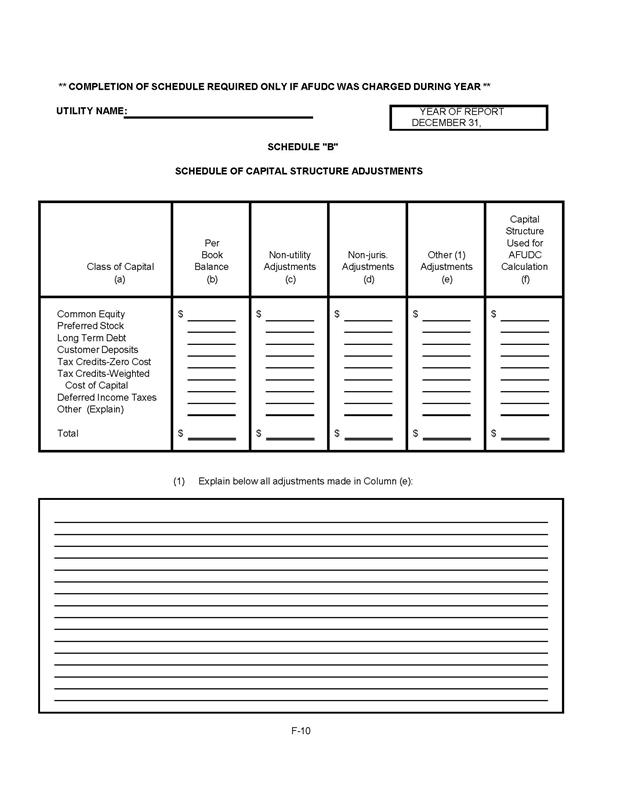
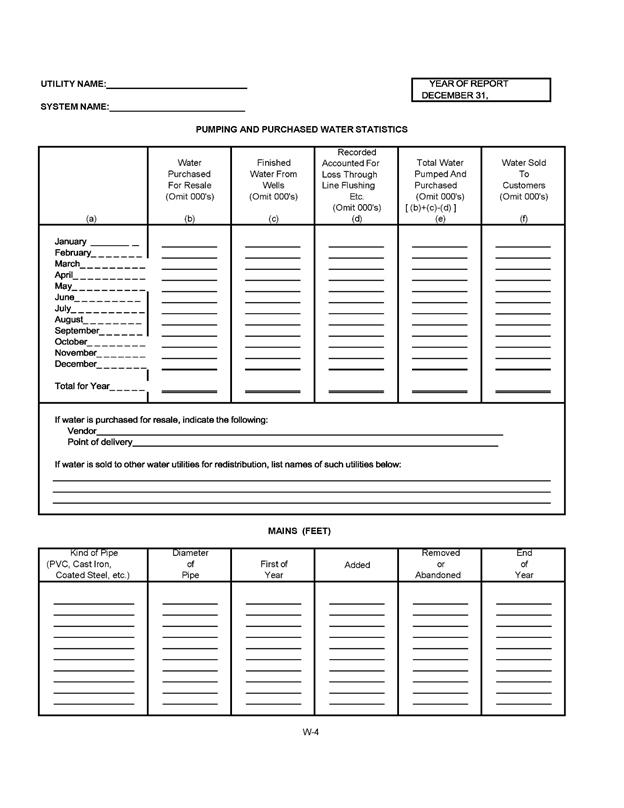
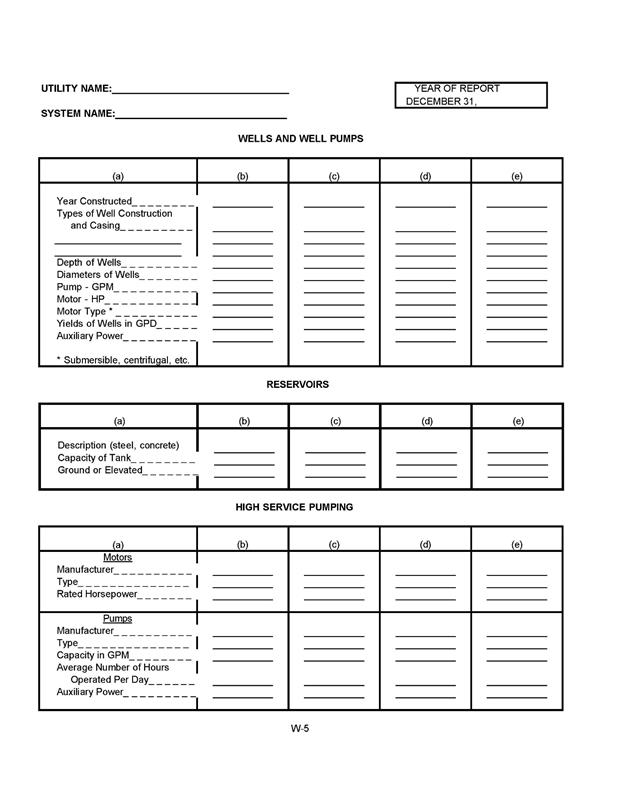
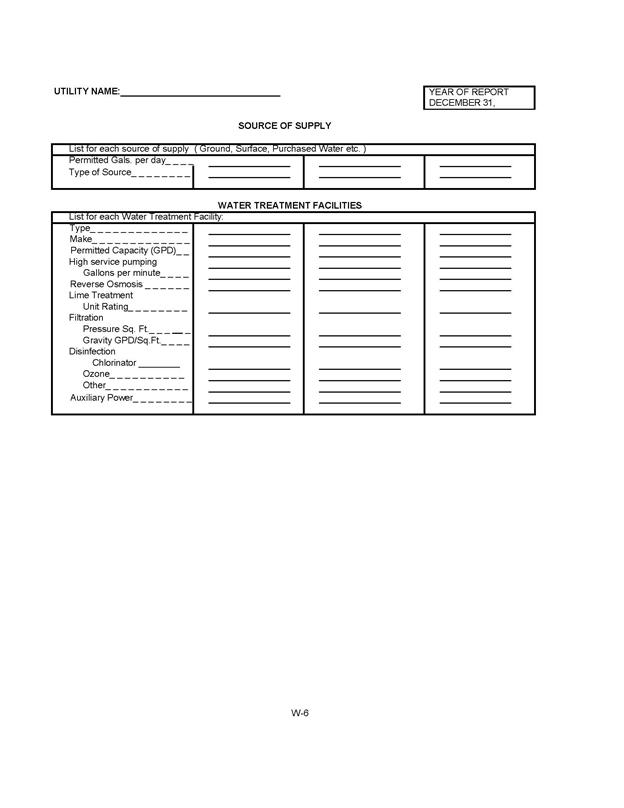
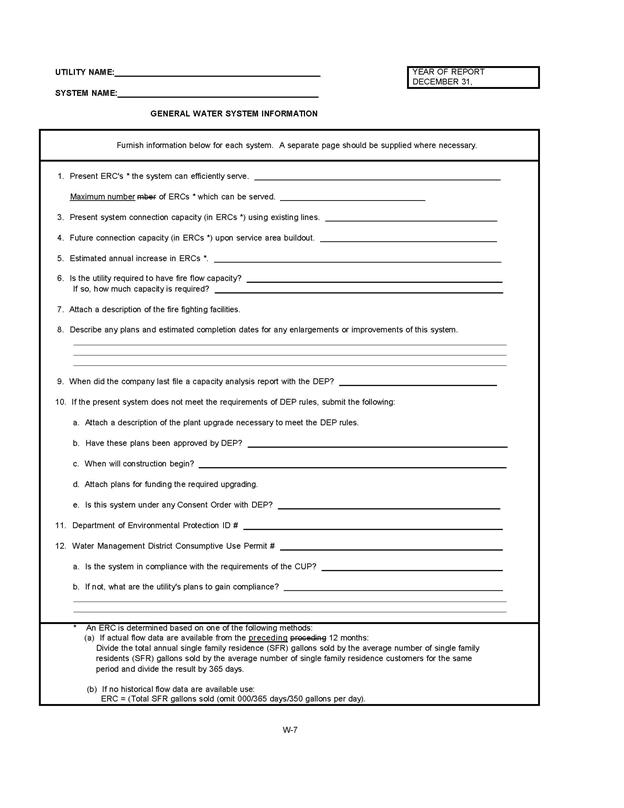
Additionally, two forms incorporated by reference in Rule 25-30.110, F.A.C.,
have been updated to reflect the new gross revenue threshold (greater than
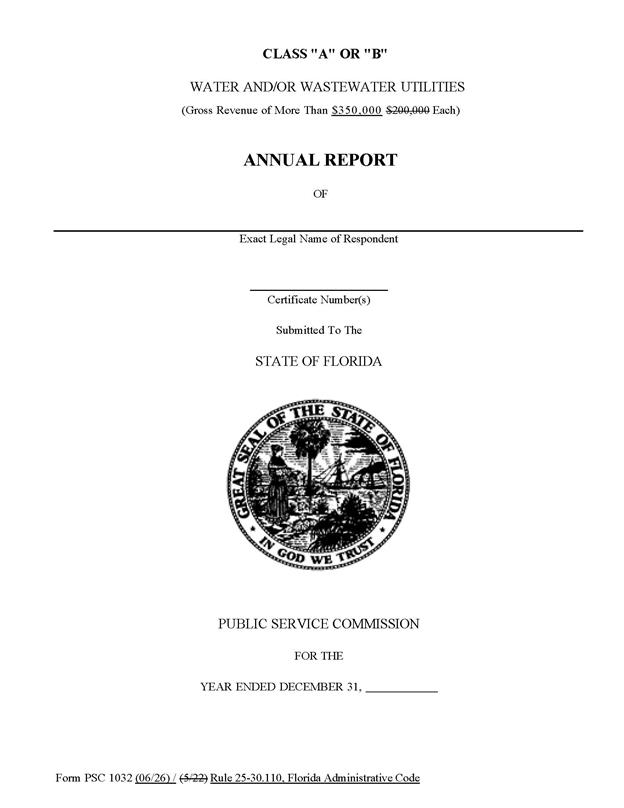
$350,000), per the updated NARUC USOA, for use of PSC Form 1032 for Class A and
B utility annual report filings, and extending the use of PSC Form 1033 for
Class C utility annual report filings of water and waste utilities below that
threshold amount. All proposed updated forms are appended in Attachment B.
Minor Violation Rules Certification
Pursuant to Section 120.695, F.S., the agency head must
certify for each rule filed for adoption whether any part of the rule is
designated as a rule the violation of which would be a minor violation.
Existing Rules 25-30.115, 25-30.033, 25-30.037, 25-30.0372, 25-30.110,
25-30.140, 25-30.433, and 25-30.445, F.A.C., are currently on the Commission’s
list of minor violation rules because violation of the rules would not result
in economic or physical harm to a person or have an adverse effect on the
public health, safety or welfare or create a significant threat of such harm.
The amendments to the rules would not change their status as a minor violation
rule. If the Commission proposes the amendment of these rules, then pursuant to
Section 120.695, F.S., the Commission should certify that Rules 25-30.115,
25-30.033, 25-30.037, 25-30.0372, 25-30.110, 25-30.140, 25-30.433, and
25-30.445, F.A.C., are rules for which a violation would constitute a minor
violation.
However, Rule 25-30.444, F.A.C., Utility Reserve Fund, is
not currently on the Commission’s minor violation list because violation of the
rule would result in economic harm to a person, or would create a significant
threat of such harm. Utility Reserve Funds draw money from customers for future
infrastructure projects; therefore, any violation that results in mismanagement
of these funds would be detrimental to customers. Thus, staff recommends that
the Commission certify that Rule 25-30.444, F.A.C., is not a rule for which a
violation would constitute a minor violation pursuant to Section 120.695, F.S.,
the amendments to that rule would not change the rule’s status as not being a
minor violation rule, and therefore should not be certified as such.
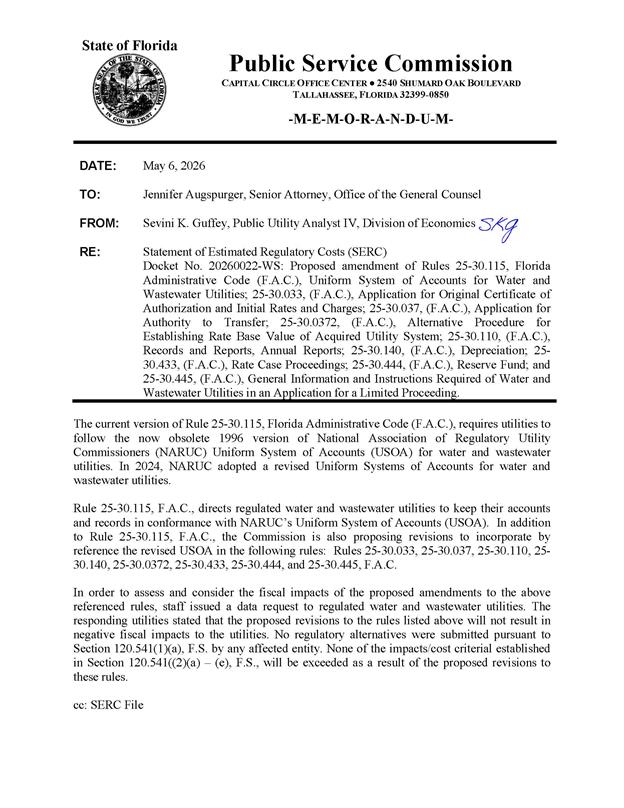
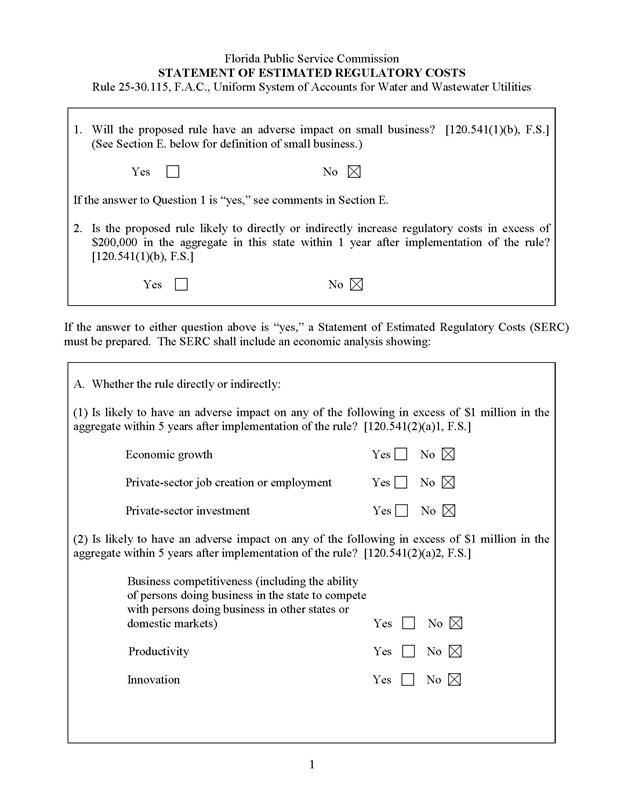
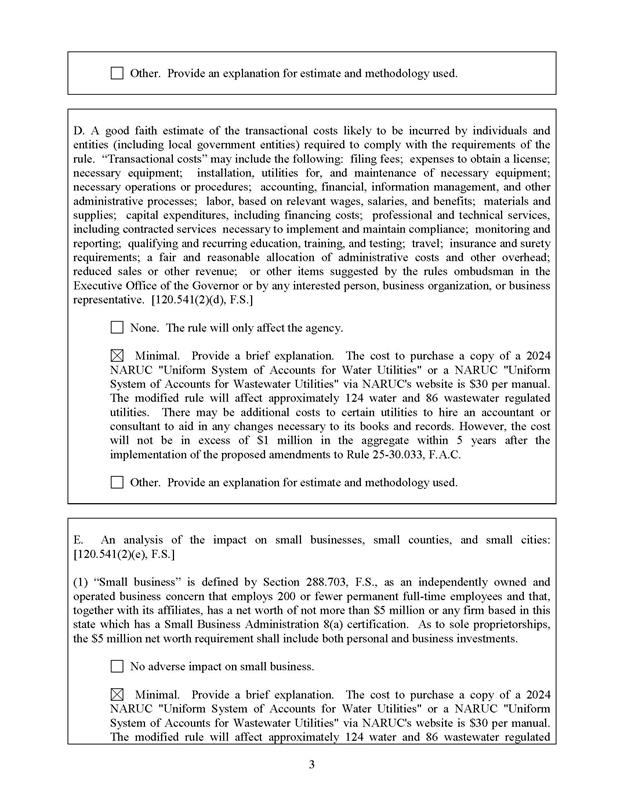
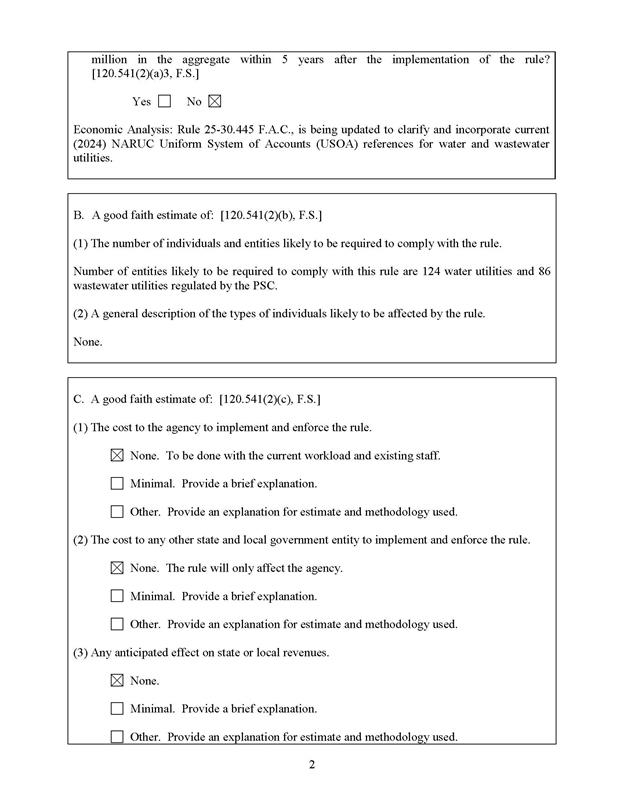
Statements of Estimated Regulatory Cost
Pursuant to Section 120.54, F.S., agencies are encouraged
to prepare a statement of estimated regulatory costs (SERC) before the
adoption, amendment or repeal of any rule. Agencies are required to prepare a
SERC for any rule that will have an adverse impact on small business or that is
likely to directly or indirectly increase regulatory costs in excess of
$200,000 in the aggregate within one year after implementation. The SERC
analysis includes whether the rule will, within five years of implementation,
have an adverse impact in excess of $1 million in the aggregate on economic
factors such as economic growth, private sector job creation or employment,
private sector investments, or business competitiveness, productivity or
innovation. If expected adverse impacts or regulatory costs exceed any of the
above criteria, a proposed rule may not take effect until it is ratified by the
Legislature.
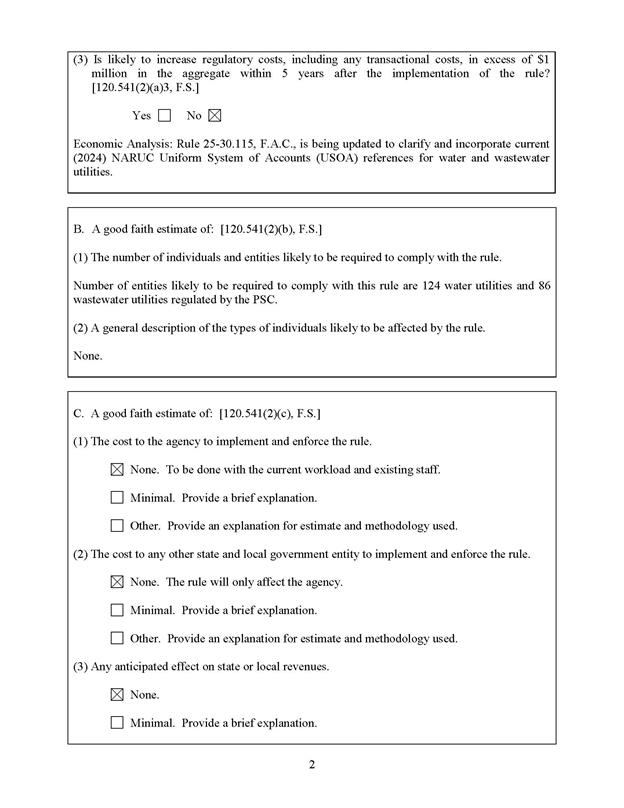
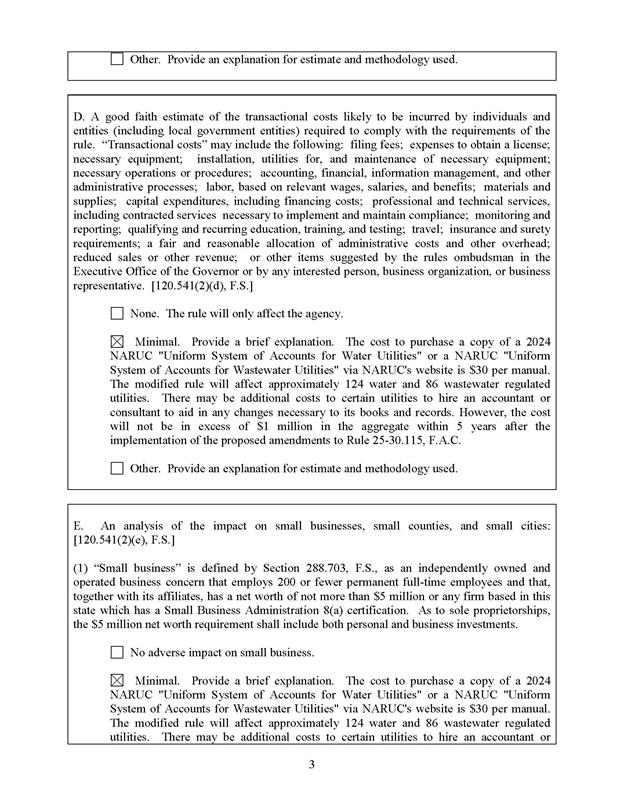
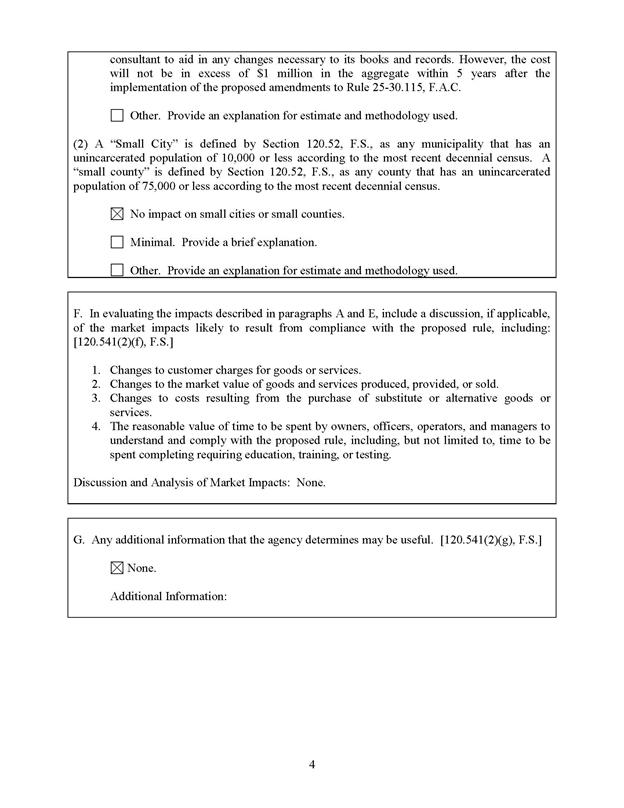
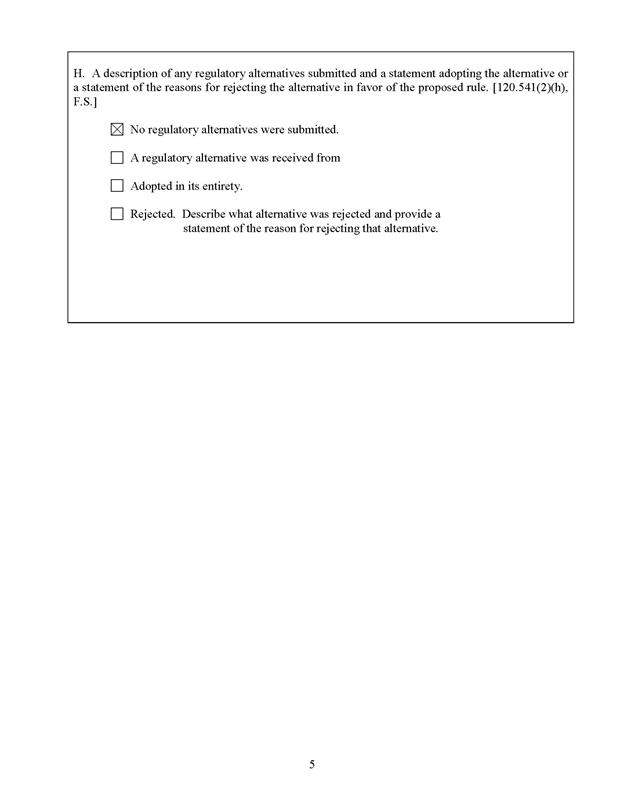
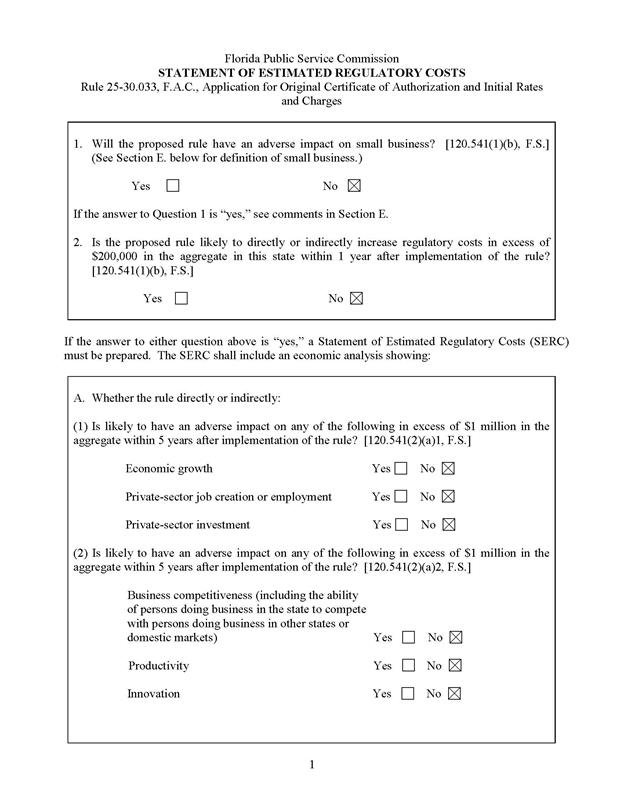
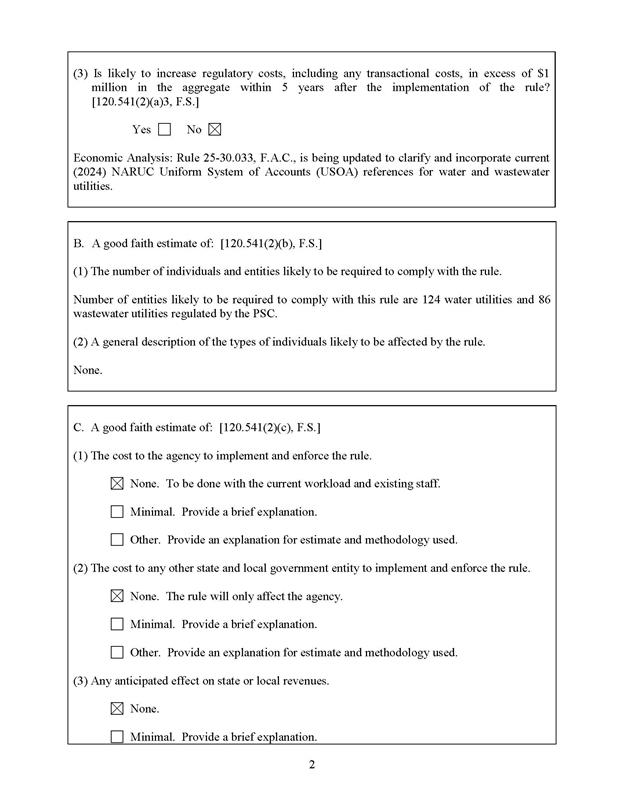
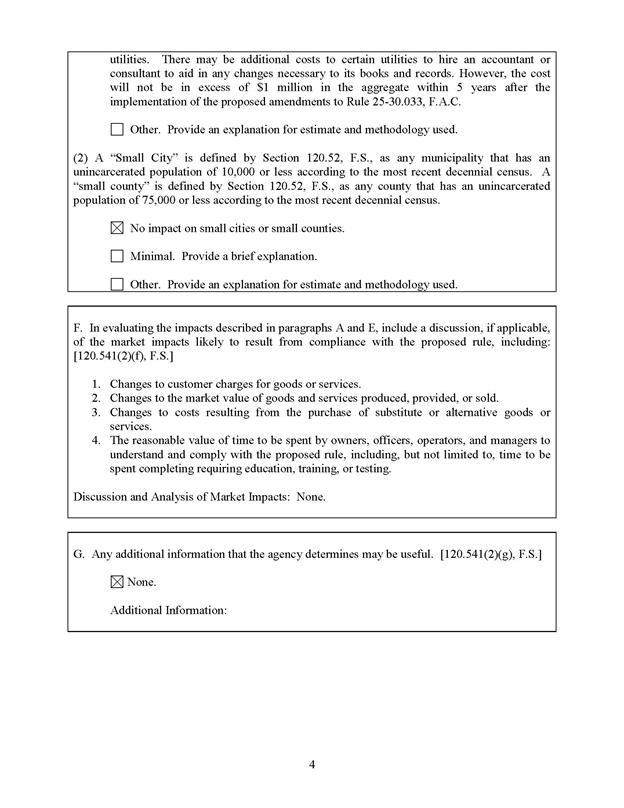
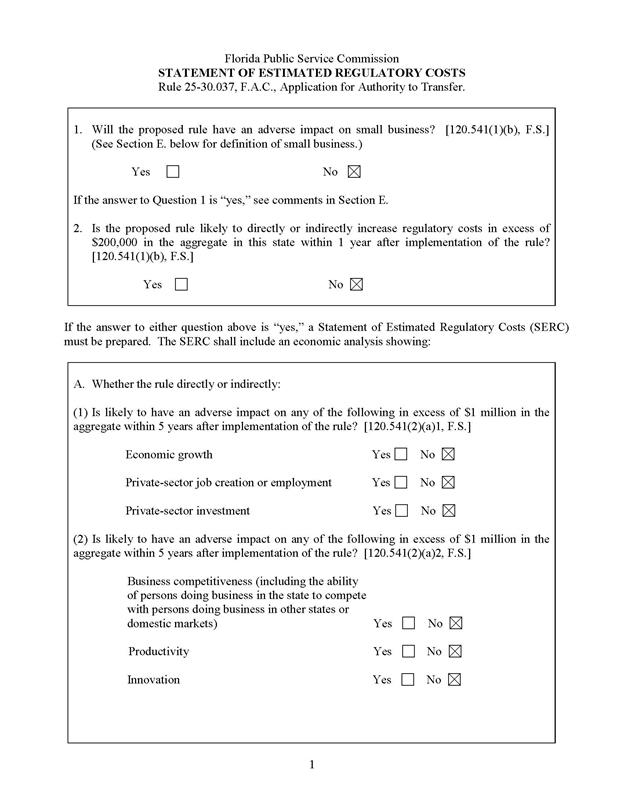
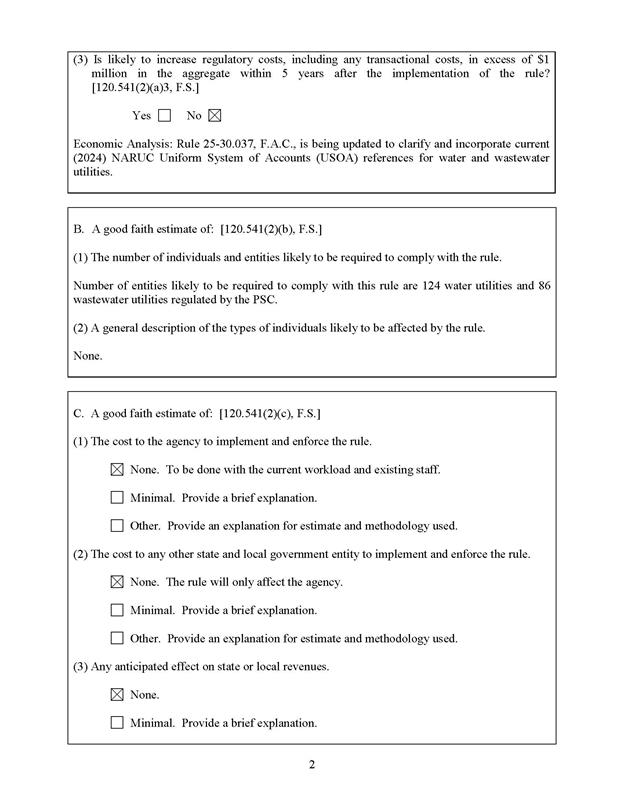
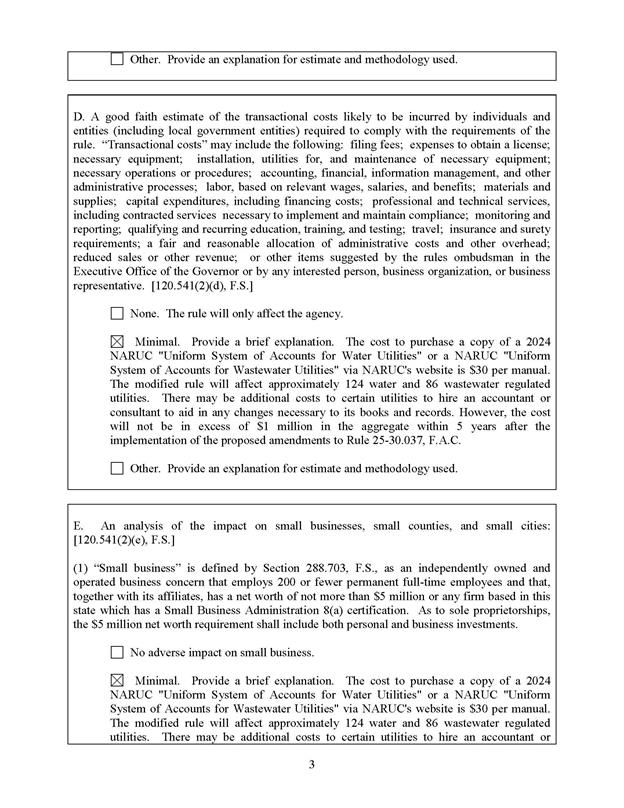
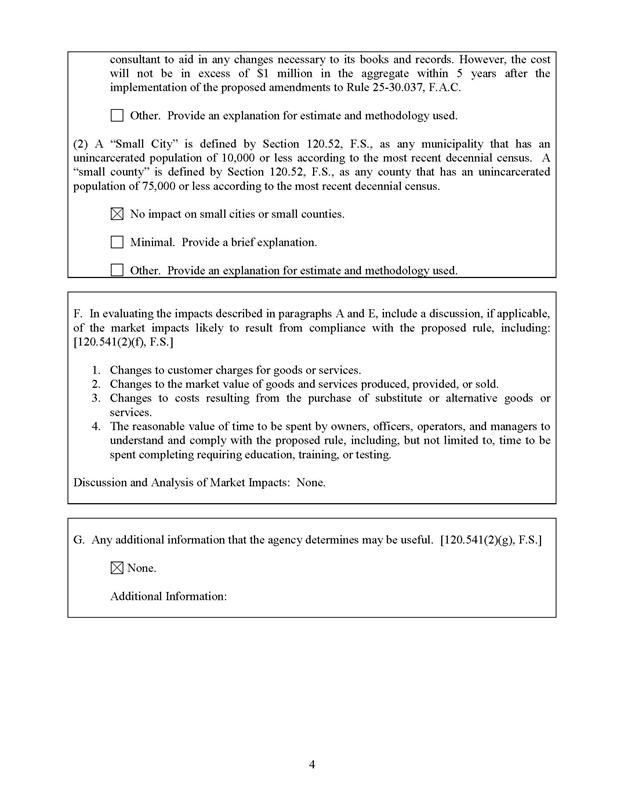
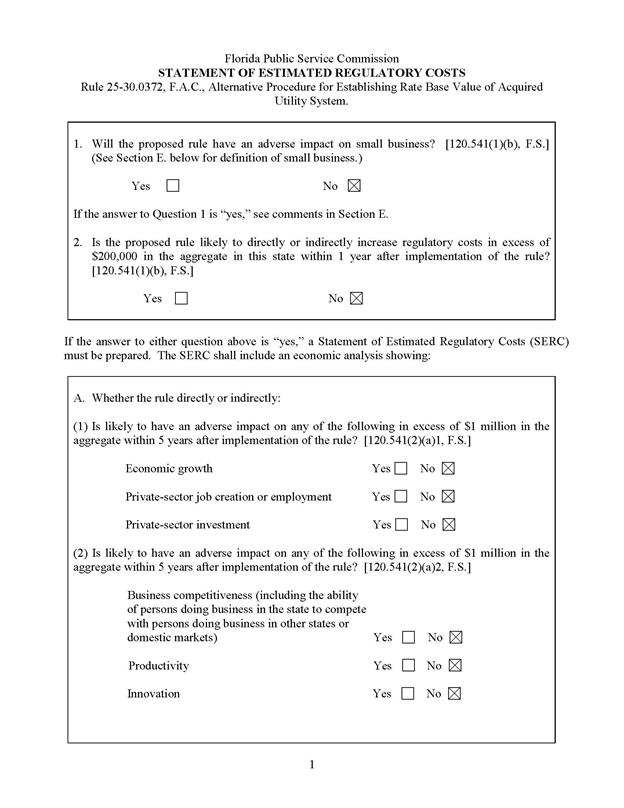
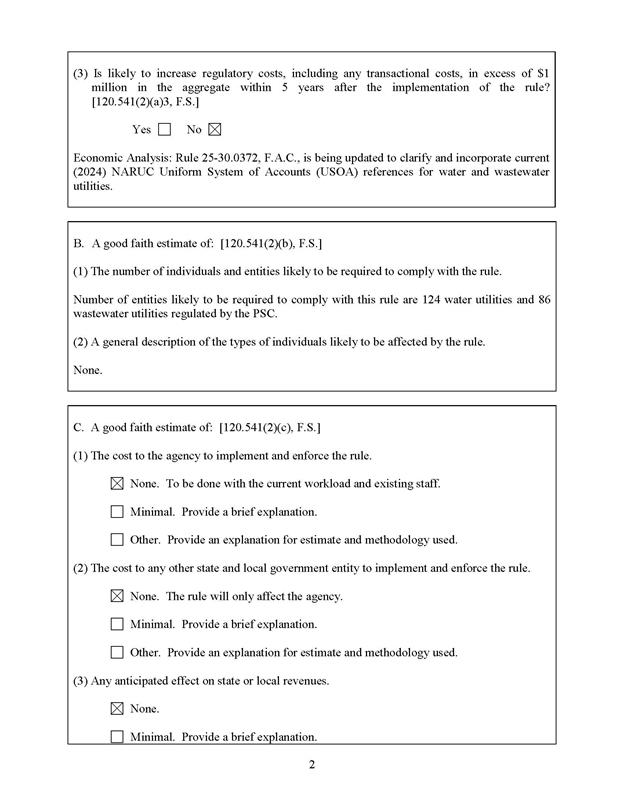
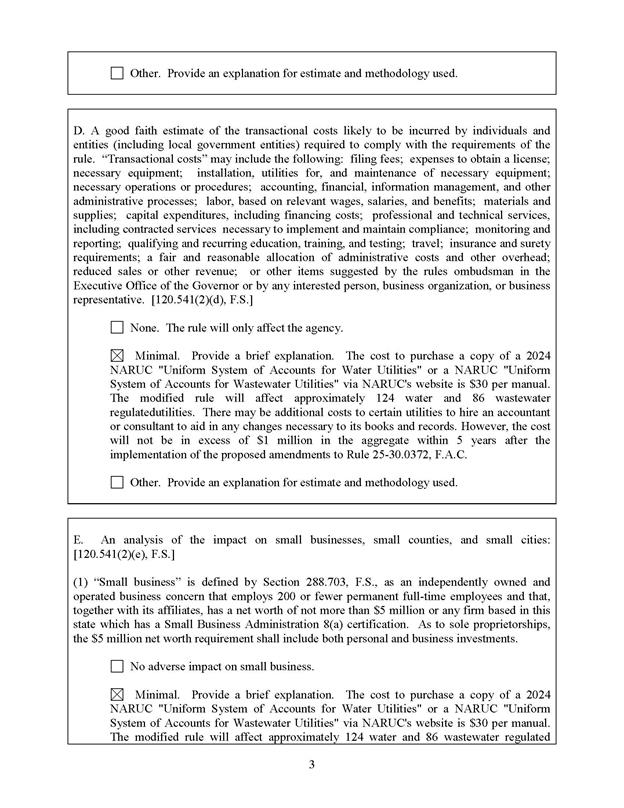
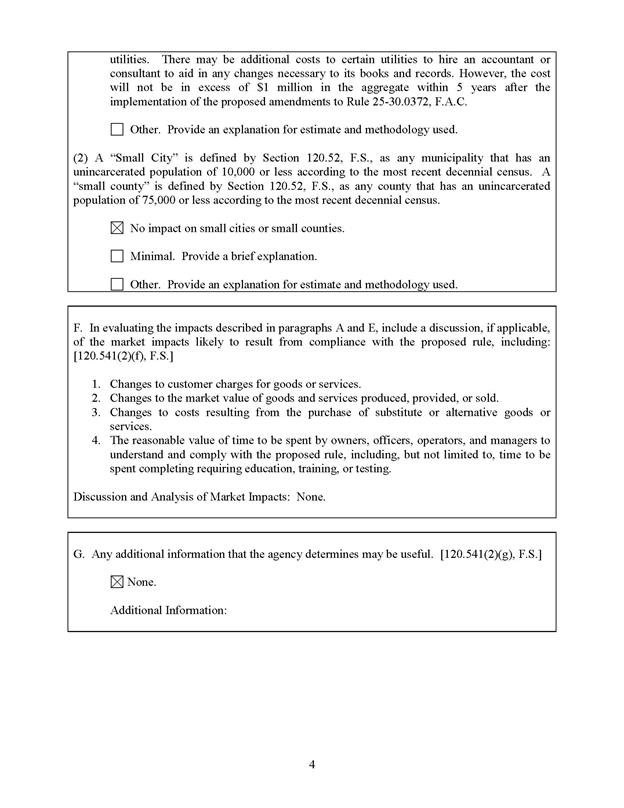
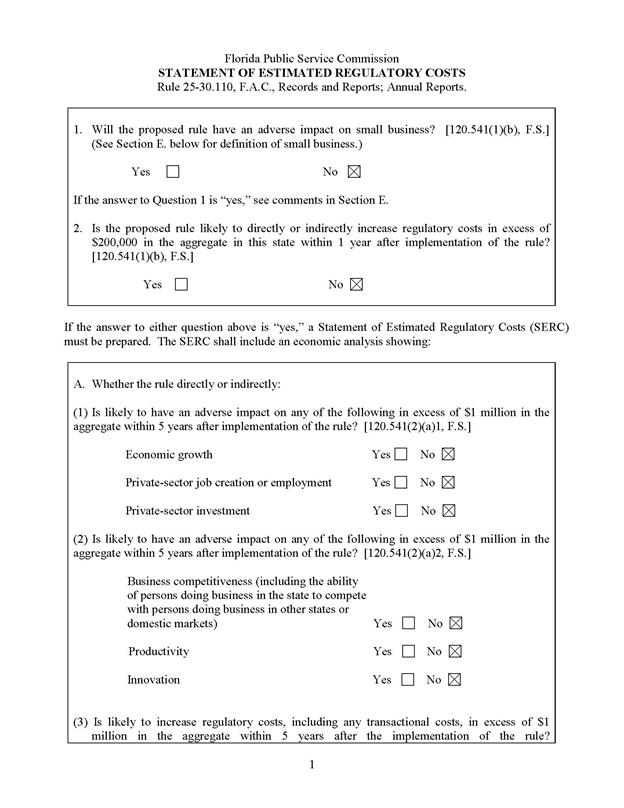
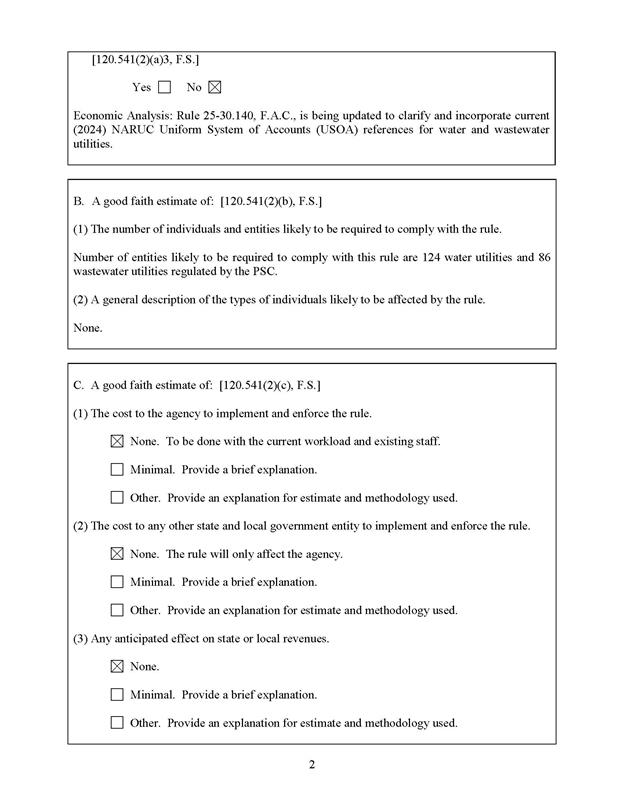
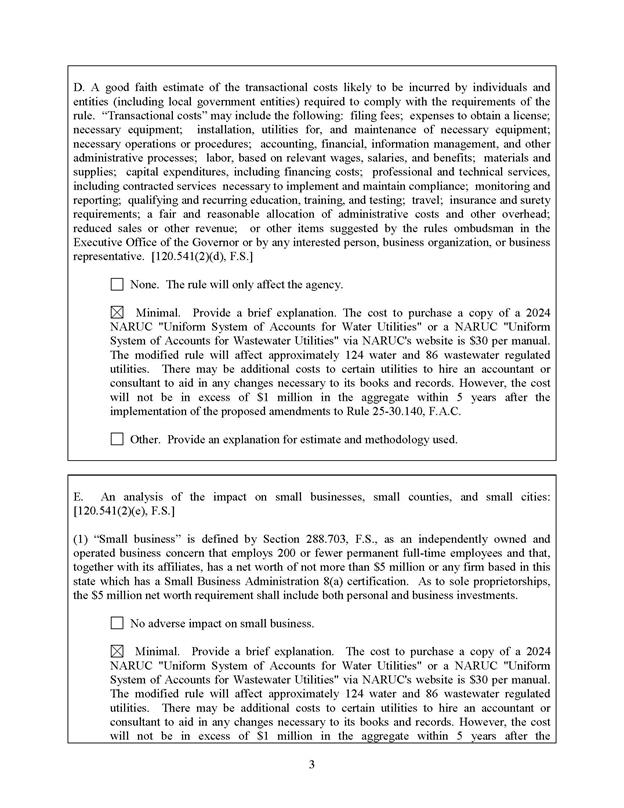
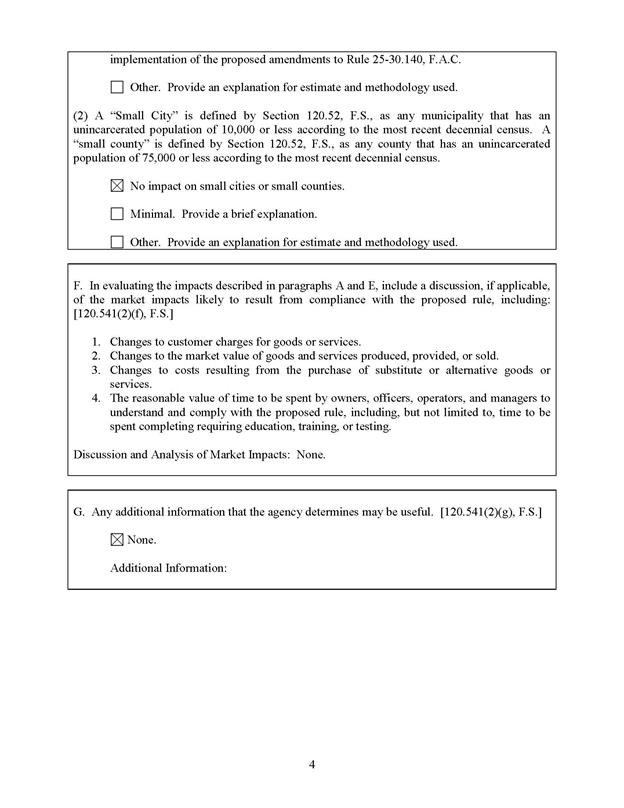
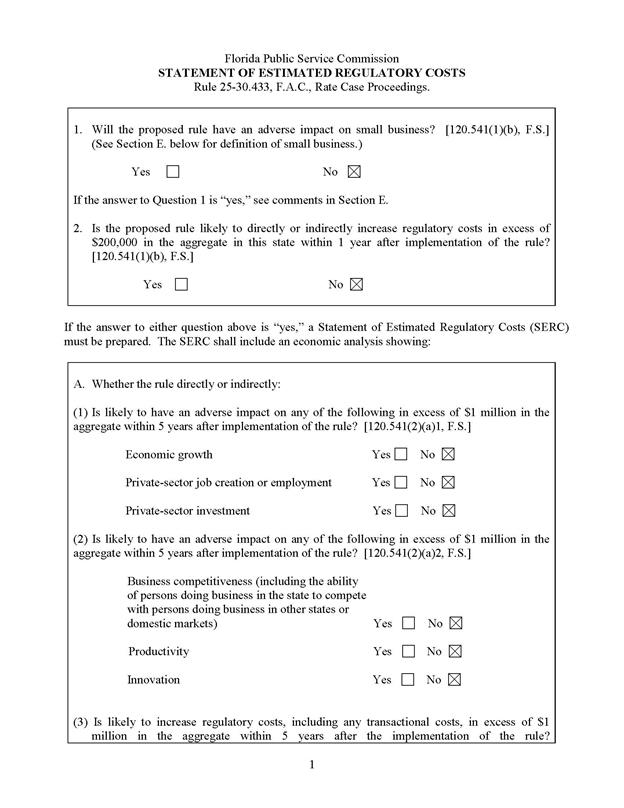
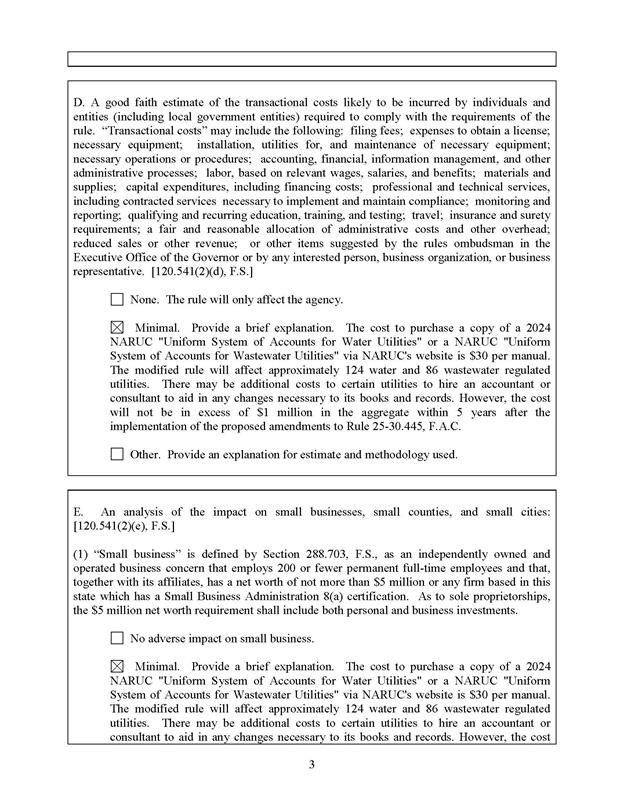
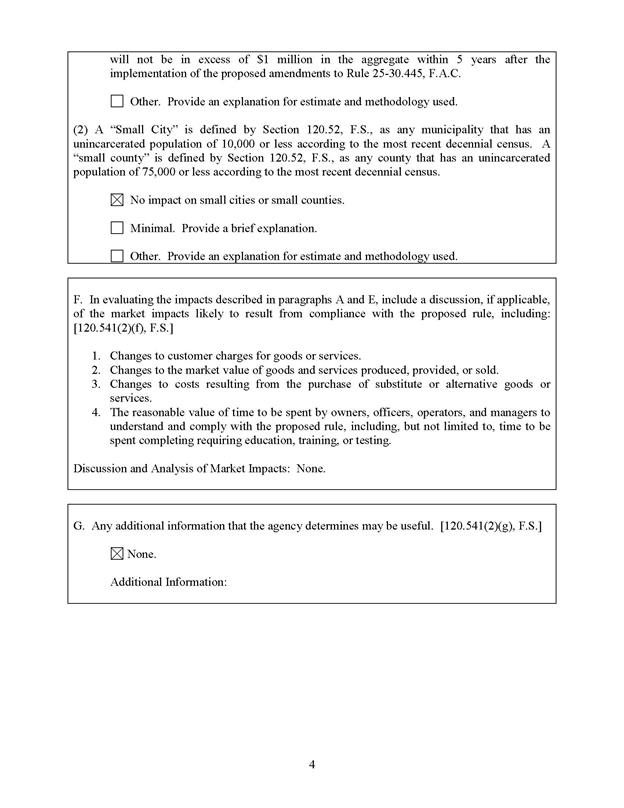
SERCs were prepared for each rule and are appended as
Attachment C. Each SERC concludes that the rule will not have an adverse impact
on small business and that the rule is not likely to directly or indirectly
increase regulatory costs in excess of $200,000 in the aggregate within one year
after implementation. Further, the SERCs conclude that the rules will not
likely have an adverse impact on economic growth, private sector job creation
or employment, private sector investment, or business competitiveness,
productivity or innovation in excess of $1 million in the aggregate within five
years of implementation. None of the adverse impact or regulatory cost criteria
set forth in Section 120.541(2)(a), F.S., will be exceeded as a result of the
recommended amendments to the rules and therefore legislative ratification
pursuant to Section 120.541(3), F.S., is not required. In addition, the SERCs
state that the rules will have no impact on small cities or counties and will
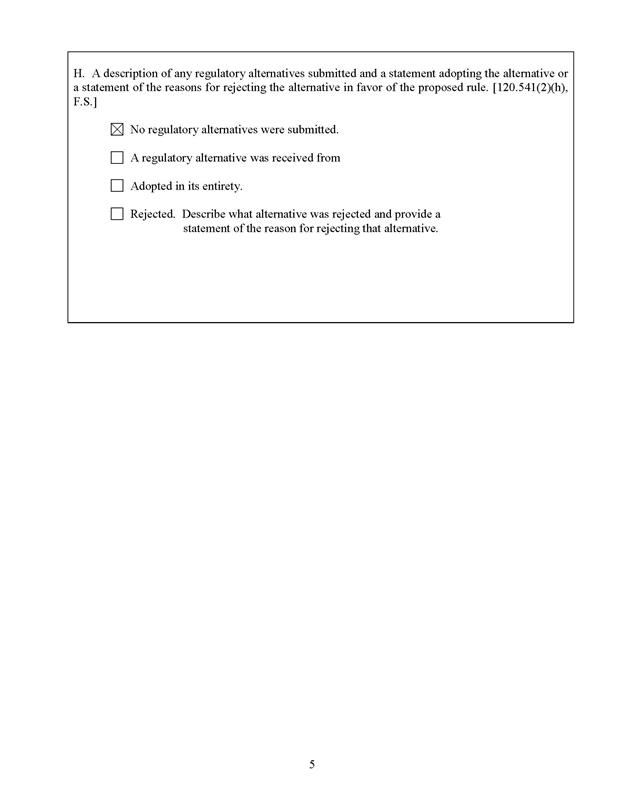
not increase the cost to the Commission to implement and enforce the rules. No
regulatory alternatives have been submitted pursuant to Section 120.541(1)(a),
F.S.
Conclusion
Based on the foregoing, staff recommends that the
Commission should propose the amendment of Rules 25-30.115, 25-30.033,
25-30.037, 25-30.0372, 25-30.110, 25-30.140, 25-30.433, 25-30.444, and
25-30.445, F.A.C., as set forth in Attachment A and that the Commission should
propose the amendment of the Commission forms as set forth in Attachment
B.
The Commission should also certify that Rules 25-30.115, 25-30.033,
25-30.037, 25-30.0372, 25-30.110, 25-30.140, 25-30.433, and 25-30.445, F.A.C.,
are rules for which a violation would constitute a minor violation. However,
Rule 25-30.444 is not a rule for which a violation would constitute a minor
violation and therefore should not be certified as such.
Issue 2:
Should this docket be closed?
Recommendation:
Yes. If no requests for hearing are made, no
comments from the Joint Administrative Procedures Committee (JAPC) are filed,
and no proposals for lower cost regulatory alternatives are submitted pursuant
to Section 120.541(1)(a), F.S., the rules should be filed for adoption with the
Department of State, and the docket should be closed. (Augspurger, Bloom)
Staff Analysis:
If no request for hearing is made, no comments from
JAPC are filed, and no proposals for a lower cost regulatory alternatives are
submitted pursuant to Section 120.541(1)(a), F.S., the rules should be filed
for adoption with the Department of State, and the docket should be closed.
DOCKET 20260022-WS
EXHIBIT A
TO
STAFF RECOMMENDATION
(PROPOSED AMENDED RULES)
25-30.115 Uniform System of Accounts for Water and
Wastewater Utilities.
Water
and wastewater utilities must shall, effective January 1, 2027,
1998, maintain their accounts and records in conformity with the 1996
NARUC National Association of Regulatory Utility Commissioners
“Uniform System Systems of Accounts for Water Utilities”
(adopted October 8, 2024; corrected January 24, 2025) and the “Uniform System
of Accounts for Wastewater Utilities” (adopted November 13, 2024; corrected
April 4, 2025 and August 27, 2025) (collectively, NARUC USOA), adopted
by the National Association of Regulatory Utility Commissioners, which
is incorporated by reference in this rule. All inquiries related to the
interpretation of the NARUC USOA these uniform systems of accounts
shall be submitted to the Commission’s Division of Accounting and Finance in
writing. Note: The National Association of Regulatory Utility Commissioners
published separate uniform systems of accounts for three classes of water and
wastewater utilities: Class A (defined as those having annual water or
wastewater operating revenues of $1,000,000 or more); Class B (defined as those
having annual water or wastewater operating revenues of $200,000 or more but
less than $1,000,000); Class C (defined as those having annual water or
wastewater revenues of less than $200,000). Copies of the NARUC USOA may
be inspected and examined at no cost at the Florida Public Service Commission,
2540 Shumard Oak Boulevard, Tallahassee, Florida 32399 or at the Florida
Department of State, R.A. Gray Building, 500 South Bronough Street,
Tallahassee, Florida 32399. Copies of the NARUC USOA these
systems of accounts may also be purchased online from the
NARUC Store at www.naruc.org.
the office of said Association, Publications, National
Association of Regulatory Utility Commissioners, 1101 Vermont Avenue, N.W.,
Suite 200, Washington, D.C. 20005, at (202)898-2200, or at
http://www.naruc.org/about.cfm?c=staff.
Rulemaking Authority
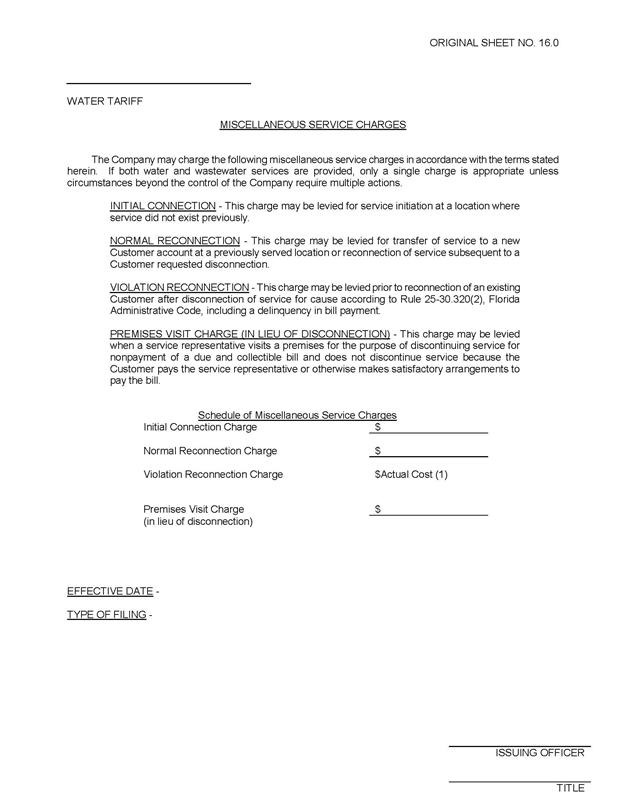
367.121(1)(b), (f) FS. Law Implemented 367.121(1)(b) FS. History–New 2-3-70,
Amended 9-12-74, 1-2-79, 8-21-79, 9-25-85, Formerly 25-10.04, 25-10.004,
Amended 8-17-96, __________.
25-30.033 Application for Original Certificate of
Authorization and Initial Rates and Charges.
(1) Each
applicant for an original certificate of authorization and initial rates and
charges must shall file with the Commission Clerk the information
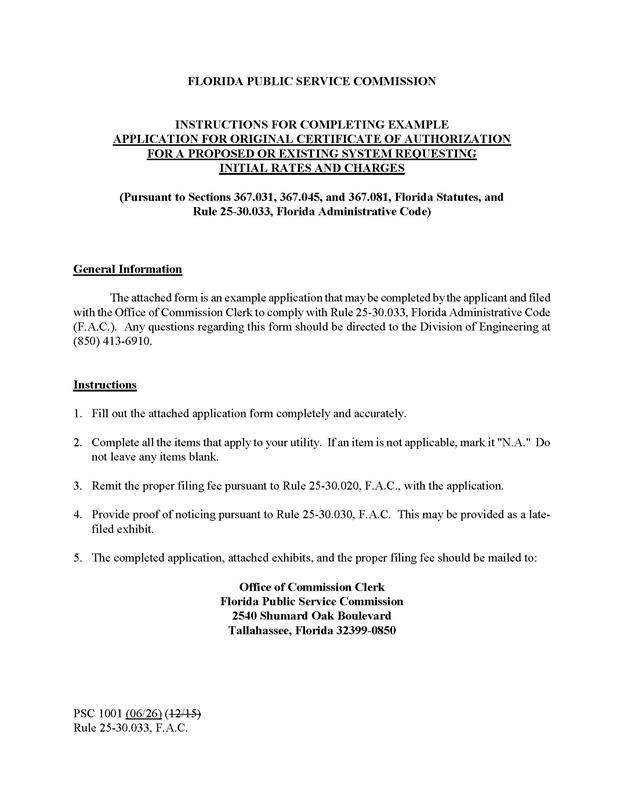
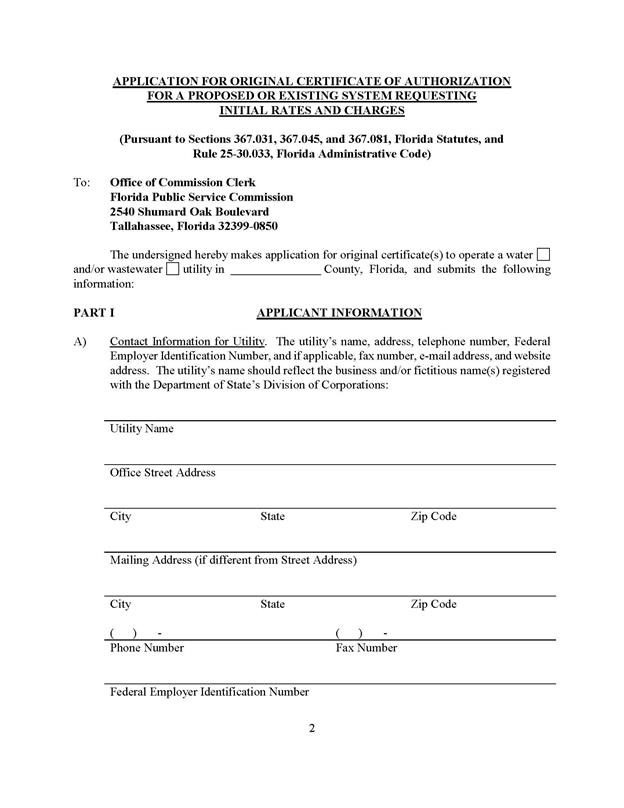
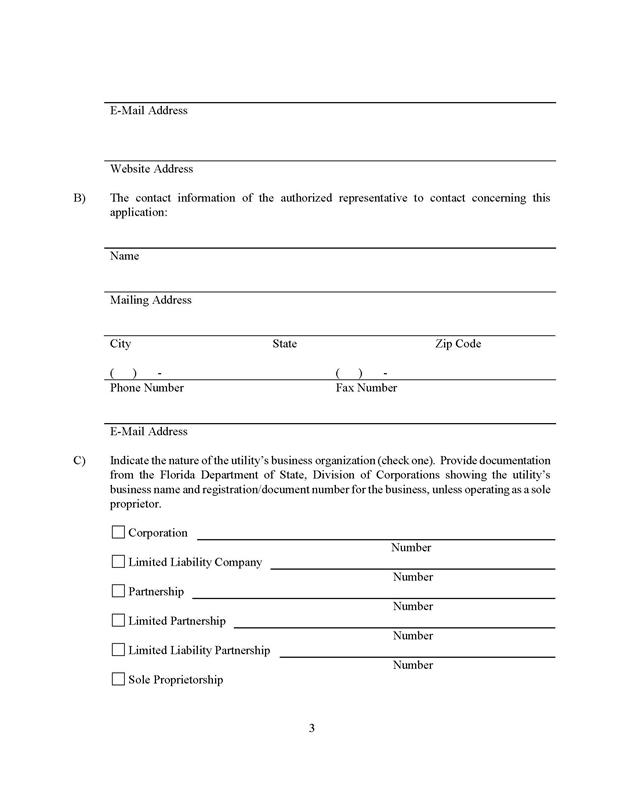
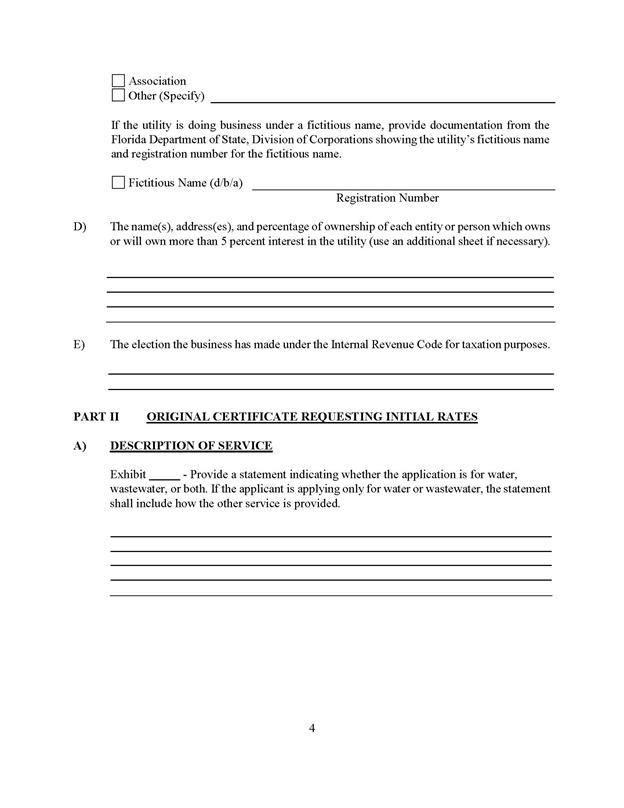
set forth in paragraphs (a) through (q). Form PSC 1001 (06/26) (12/15),
entitled “Application for Original Certificate of Authorization for a Proposed
or Existing System Requesting Initial Rates and Charges,” which is incorporated
by reference in this rule and is available at [hyperlink] http://www.flrules.org/Gateway/reference.asp?No=Ref-06237,
is an example application that may be completed by the applicant and filed with
the Office of Commission Clerk to comply with this subsection. This form is
also available on the Commission’s website Web-site at ,www.floridapsc.com.
(a) A filing fee
pursuant to paragraph 25-30.020(2)(a), F.A.C.;
(b) Proof of
noticing pursuant to Rule 25-30.030, F.A.C.;
(c) The
utility’s name, address, telephone number, Federal Employer Identification
Number, authorized representative, and, if available, email address and fax
number;
(d) The nature
of the utility’s business organization, i.e., corporation, limited liability
company, partnership, limited partnership, sole proprietorship, or association.
The applicant must provide documentation from the Florida Department of State,
Division of Corporations, showing:
1. The utility’s
business name and registration/document number for the business, unless
operating as a sole proprietor, and,
2. The utility’s
fictitious name and registration number for the fictitious name, if operating
under a fictitious name.;
(e) The name(s),
address(es), and percentage of ownership of each entity or person that owns or
will own more than 5 percent interest in the utility;
(f) The election
the business has made under the Internal Revenue Code for taxation purposes;
(g) A statement
indicating whether the application is for water, wastewater, or both. If the
applicant is applying for water or wastewater only, the statement must shall
include how the other service is provided;
(h) To
demonstrate the necessary financial ability of the applicant to provide service
to the proposed service area, the applicant must shall provide:
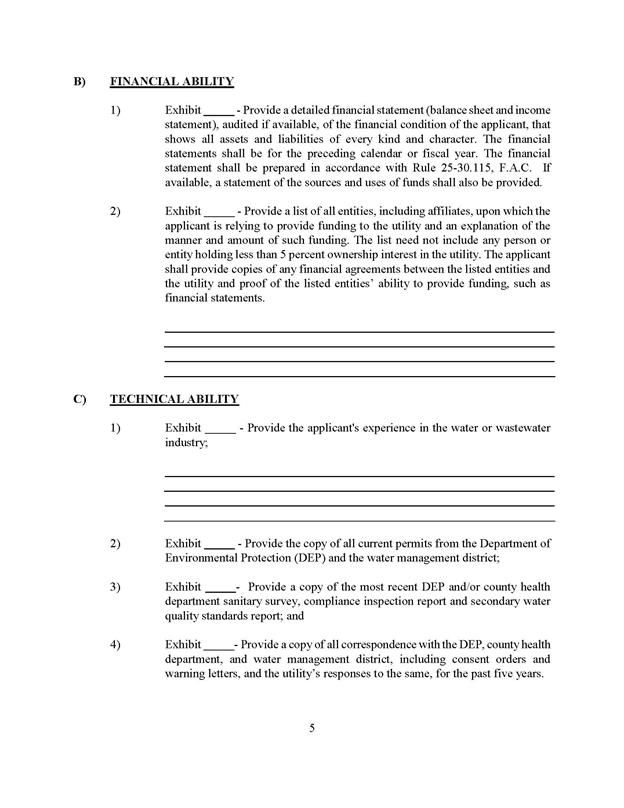
1. A detailed
financial statement (balance sheet and income statement), audited if available,
of the financial condition of the applicant, which shows all assets and
liabilities of every kind and character. The financial statements must shall
be for the preceding calendar or fiscal year. The financial statement must
shall be prepared in accordance with Rule 25-30.115, F.A.C. If
available, a statement of the sources and uses of funds must shall
also be provided; and,
2. A list of all
entities, including affiliates, upon which the applicant is relying to provide
funding to the utility and an explanation of the manner and amount of such
funding. The list need not include any person or entity holding less than 5
percent ownership interest in the utility. The applicant must shall
provide copies of any financial agreements between the listed entities and the
utility and proof of the listed entities’ ability to provide funding, such as
financial statements;
(i) To
demonstrate the technical ability of the applicant to provide service, the
applicant must shall provide:
1. A statement
of the applicant’s experience in the water or wastewater industry;
2. A copy of all
current permits from the Department of Environmental Protection (DEP) and the
water management district;
3. A copy of the
most recent DEP and/or county health department sanitary survey, compliance
inspection report, and secondary standards drinking water report; and,
4. A copy of all
correspondence with the DEP, county health department, and water management
district, including consent orders and warning letters, and the utility’s
responses to the same, for the past five years;
(j) To describe
the proposed service area, the applicant must shall provide:
1. A legal
description of the proposed service area in the format described in Rule
25-30.029, F.A.C.;
2. A detailed
system map showing the existing and proposed lines and treatment facilities,
with the territory proposed to be served plotted thereon, consistent with the
legal description provided in subparagraph (j)1. above. The map must shall
be of sufficient scale and detail to enable correlation with the description of
the territory proposed to be served; and,
3. An official
county tax assessment map, or other map showing township, range, and section
with a scale such as 1'' = 200' or 1'' = 400', with the proposed territory
plotted thereon, consistent with the legal description provided in subparagraph
(j)1. above;
(k) To
demonstrate the need for service in the proposed area, the applicant must
shall provide:
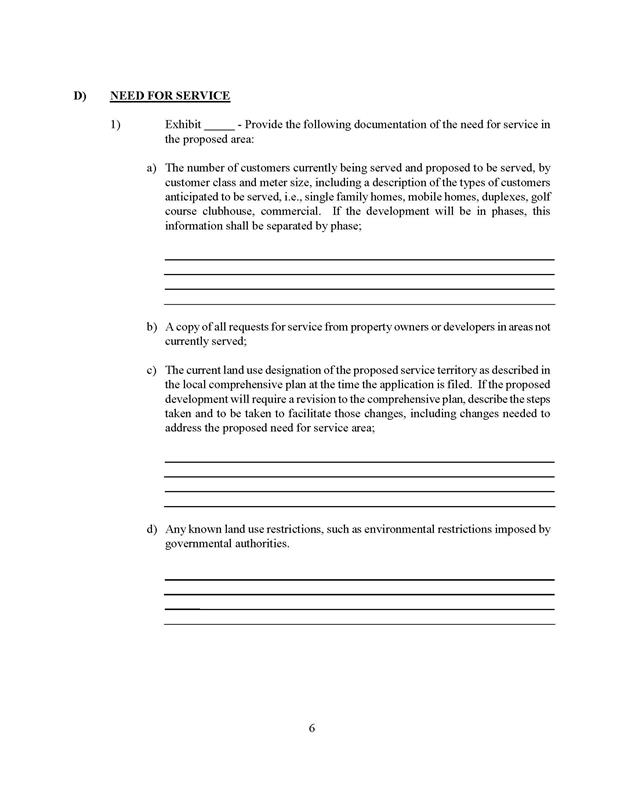
1. The number of
customers currently being served and proposed to be served, by customer class
and meter size, including a description of the types of customers currently
being served and anticipated to be served, i.e., single family homes, mobile
homes, duplexes, golf course clubhouse, or commercial. If the development will
be in phases, this information must shall be separated by phase;
2. A copy of all
requests for service from property owners or developers in areas not currently
served;
3. The current
land use designation of the proposed service territory as described in the
local comprehensive plan at the time the application is filed. If the proposed
development will require a revision to the comprehensive plan, describe the
steps taken and to be taken to facilitate those changes, including changes
needed to address the proposed need for service; and,
4. Any known
land use restrictions, such as environmental restrictions imposed by
governmental authorities;
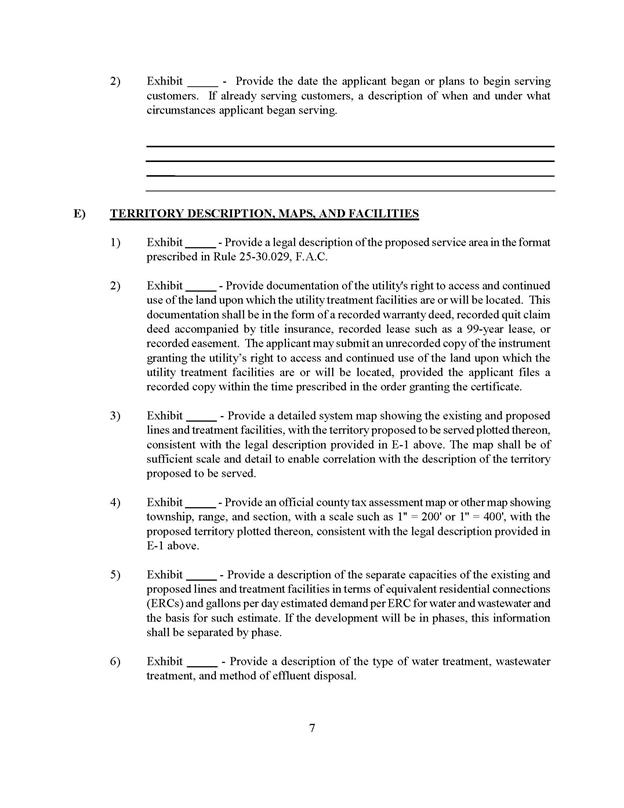
(l) The date
applicant began or plans to begin serving customers. If already serving
customers, a description of when and under what circumstances the applicant
began serving;
(m)
Documentation of the utility’s right to access and continued use of the land
upon which the utility treatment facilities are or will be located.
Documentation of continued use must shall be in the form of a
recorded warranty deed, recorded quit claim deed accompanied by title
insurance, recorded lease (such as a 99-year lease), or recorded
easement. To satisfy this requirement, the The applicant may
submit an unrecorded copy of the instrument granting the utility’s right to
access and continued use of the land upon which the utility treatment
facilities are or will be located, provided the applicant files a recorded copy
within the time required in the order granting the certificate;
(n) A
description of the separate capacities of the existing and proposed lines and
treatment facilities in terms of equivalent residential connections (ERCs) and
gallons per day estimated demand per ERC for water and wastewater and the basis
for such estimate. If the development will be in phases, this information must
shall be separated by phase;
(o) A
description of the type of water treatment, wastewater treatment, and method of
effluent disposal;
(p) To support
the proposed rates and charges, the applicant must shall provide:
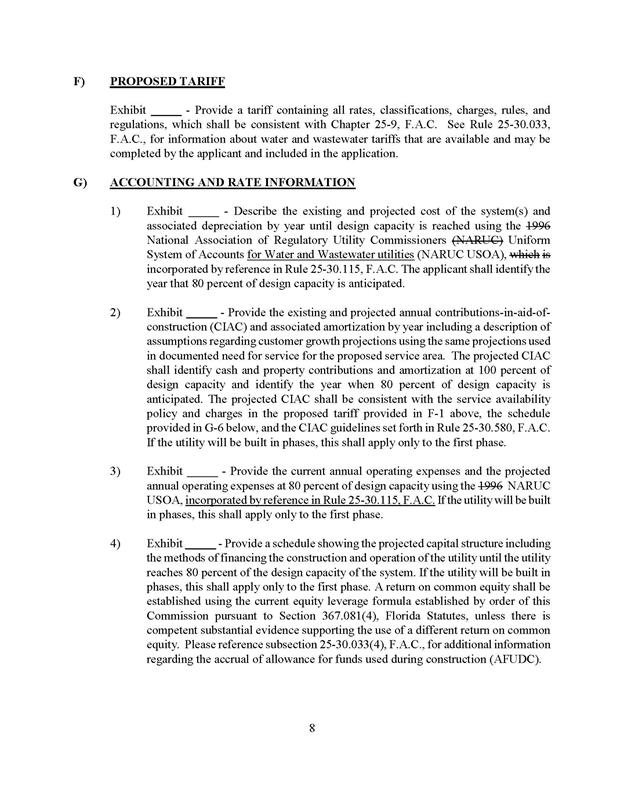
1. The existing
and projected cost of the system(s) and associated depreciation by year until
design capacity is reached using the NARUC USOA National Association of
Regulatory Utility Commissioners (NARUC) 1996 Uniform System of Accounts (USOA),
which is incorporated by reference in Rule 25-30.115, F.A.C. The
applicant must shall identify the year that 80 percent of design
capacity is anticipated. If the utility will be built in phases, this applies
shall apply only to the first phase;
2. The existing
and projected annual contributions-in-aid-of-construction (CIAC) and associated
amortization by year, including a description of the assumptions
regarding customer-growth projections, using the same projections
used in subparagraph (1)(k)1. above, for the proposed service area. The
projected CIAC must shall identify cash and property
contributions and amortization at 100 percent of design capacity and identify
the year when 80 percent of design capacity is anticipated. The projected CIAC must
shall be consistent with the service-availability policy and the
charges in the proposed tariff provided in paragraph (q), below, the
schedule provided in subparagraph (1)(p)6., below, and the CIAC
guidelines in Rule 25-30.580, F.A.C. If the utility will be built in phases,
this applies shall apply only to the first phase;
3. A schedule
showing the projected capital structure including the methods of financing the
construction and operation of the utility until the utility reaches 80 percent
of the design capacity of the system. If the utility will be built in phases,
this applies shall apply only to the first phase;
4. The current
annual operating expenses and the projected annual operating expenses at 80
percent of design capacity using the NARUC USOA, incorporated by reference
in Rule 25-30.115, F.A.C. If the utility will be built in phases, this applies
shall apply only to the first phase;
5. A schedule
showing how the proposed rates were developed;
6. A schedule
showing how the proposed service availability policy and charges were
developed, including meter installation, main extension, and plant capacity
charges, and proposed donated property; and,
7. A schedule
showing how the customer deposits and miscellaneous service charges were
developed, including initial connection, normal reconnection, violation
reconnection, and premises visit fees, consistent with Rules 25-30.311 and
25-30.460, F.A.C..; and,
(q) A tariff containing
all rates, classifications, charges, rules, and regulations which must shall
be consistent with Chapter 25-9, F.A.C. Form PSC 1010 (06/26) (12/15),
entitled “Water Tariff,” which is incorporated by reference in this rule
and is available at [hyperlink] http://www.flrules.org/Gateway/reference.asp?No=Ref-06247, and Form PSC 1011 (06/26) (12/15),
entitled “Wastewater Tariff,” which is incorporated by reference in this
rule and is available at [hyperlink] http://www.flrules.org/Gateway/reference.asp?No=Ref-06248,
are example tariffs that may be completed by the applicant and included in the
application. These forms may also be obtained from the Commission’s website at,
www.floridapsc.com.
(2) The base
facility and usage rate structure, (as defined in subsection
25-30.437(5), F.A.C.,) must shall be utilized for
metered service, unless an alternative rate structure is supported by the
applicant and authorized by the Commission.
(3) A return on
common equity must shall be established using the current equity
leverage formula established by order of this Commission pursuant to Section
367.081(4), F.S., unless there is competent substantial evidence supporting the
use of a different return on common equity.
(4) Utilities
obtaining original certificates of authorization pursuant to this rule are
authorized to accrue allowance for funds used during construction (AFUDC) for
projects found eligible pursuant to subsection 25-30.116(1), F.A.C.
(a) The
applicable AFUDC rate will shall be determined as the utility’s
projected weighted cost of capital as demonstrated in its application for
original certificate and initial rates and charges.
(b) A discounted
monthly AFUDC rate calculated in accordance with subsection 25-30.116(3),
F.A.C., will shall be used to iensure that the
annual AFUDC charged does not exceed authorized levels.
(c) The date the
utility begins shall begin to charge the AFUDC rate must shall
be the date the certificate of authorization is issued to the utility so that
such rate can apply to the initial construction of the utility facilities.
Rulemaking Authority
350.127(2), 367.121, 367.1213 FS. Law Implemented 367.031, 367.045, 367.1213
FS. History–New 1-27-91, Amended 11-30-93, 1-4-16,. _____.
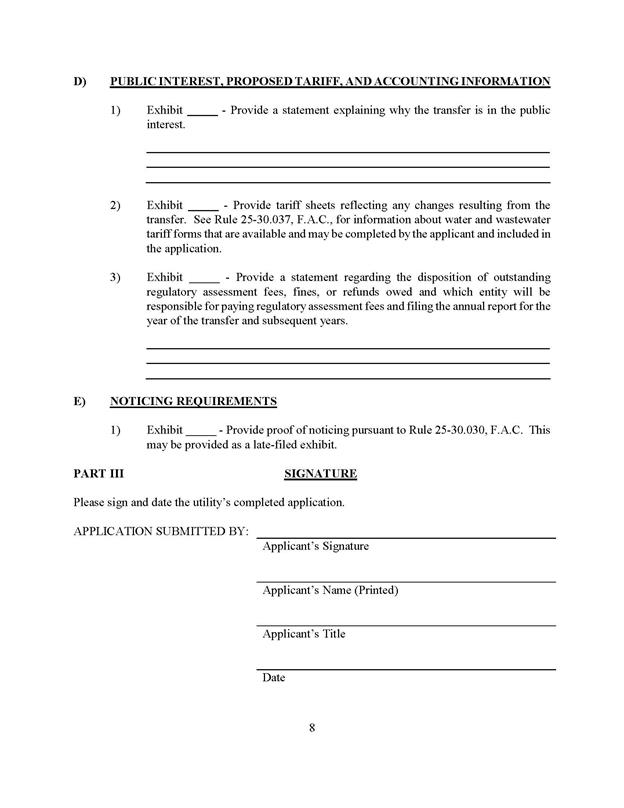
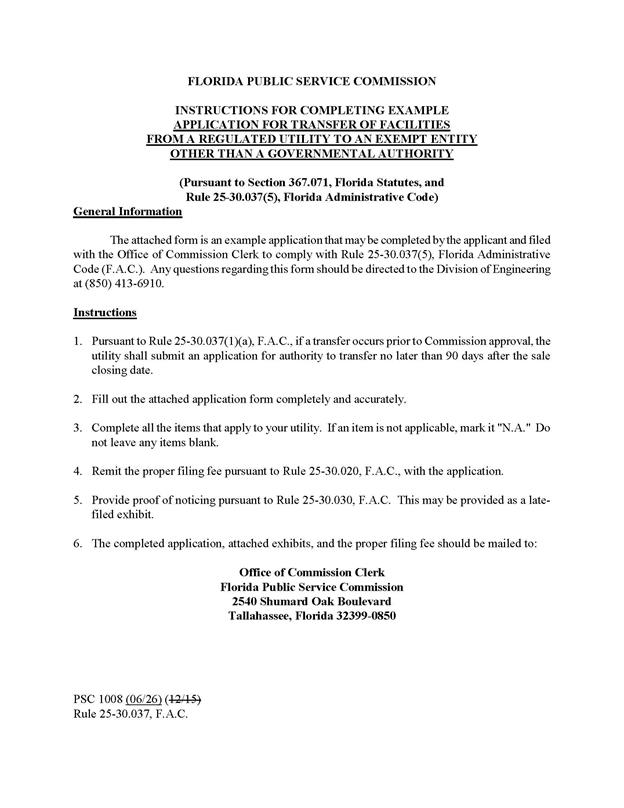
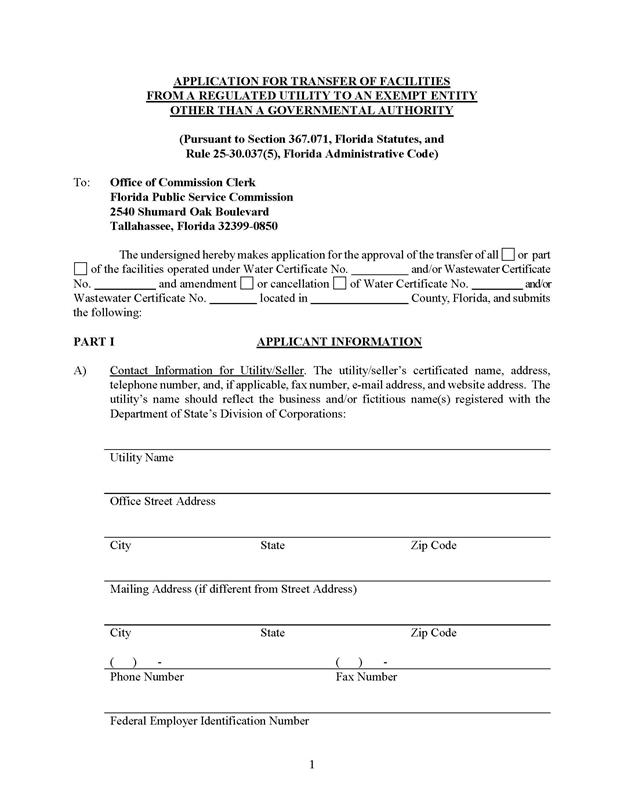
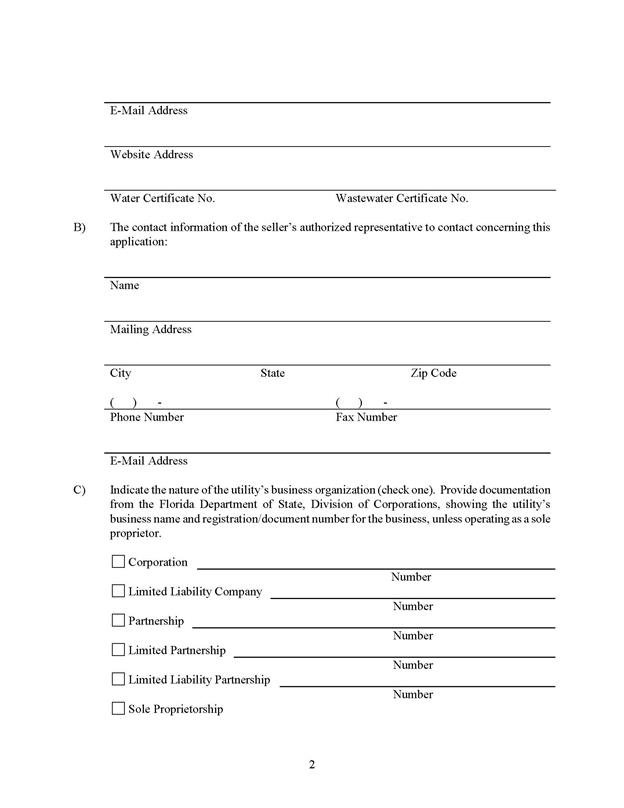
25-30.037 Application for Authority to Transfer.
(1) This rule
applies to any application for the transfer of an existing water or wastewater
utility, regardless of whether service is currently being provided. The
application for transfer may result in the transfer or cancellation of the
seller’s existing certificate, amendment of the buyer’s existing certificate or
granting of an original certificate to the buyer, or a transfer of majority
organizational control of the utility.
(a) If a
transfer occurs prior to Commission approval, the utility must shall
submit an application for authority to transfer no later than 90 days after the
sale closing date.
(b) When a
utility applies for any of the following transfer authorizations by the
Commission, it must shall provide its application as prescribed
in the appropriate subsection below:
1. A transfer of
a regulated utility to another regulated utility must shall be
pursuant to subsection (2), below;
2. A transfer of
an exempt entity to a regulated utility must shall be pursuant to
subsection (3), below;
3. A transfer of
a utility in a nonjurisdictional county to a regulated utility that results in
a system whose service transverses county boundaries must shall
be pursuant to subsection (3), below;
4. A change of
majority organizational control of a regulated utility must shall
be pursuant to subsection (4), below; or
5. A transfer of
a regulated utility to an exempt entity other than a governmental authority must
shall be pursuant to subsection (5), below.
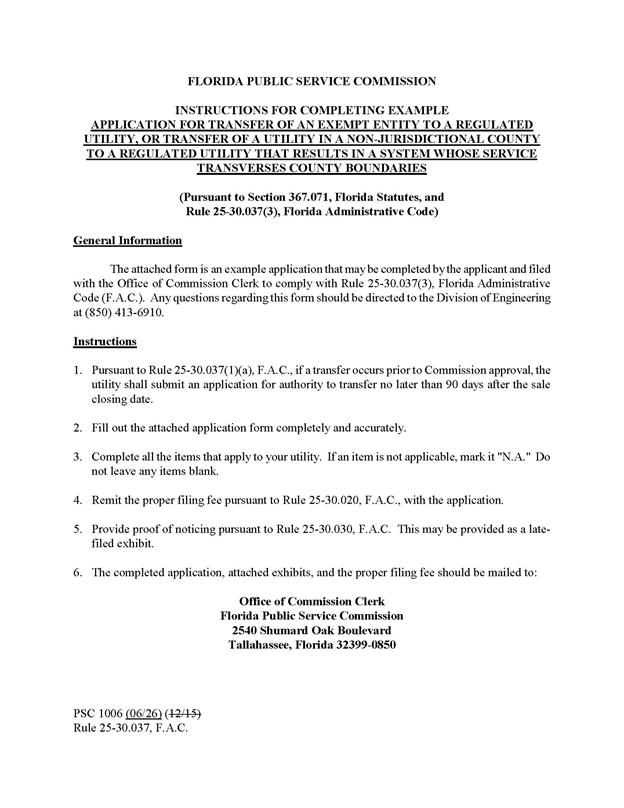
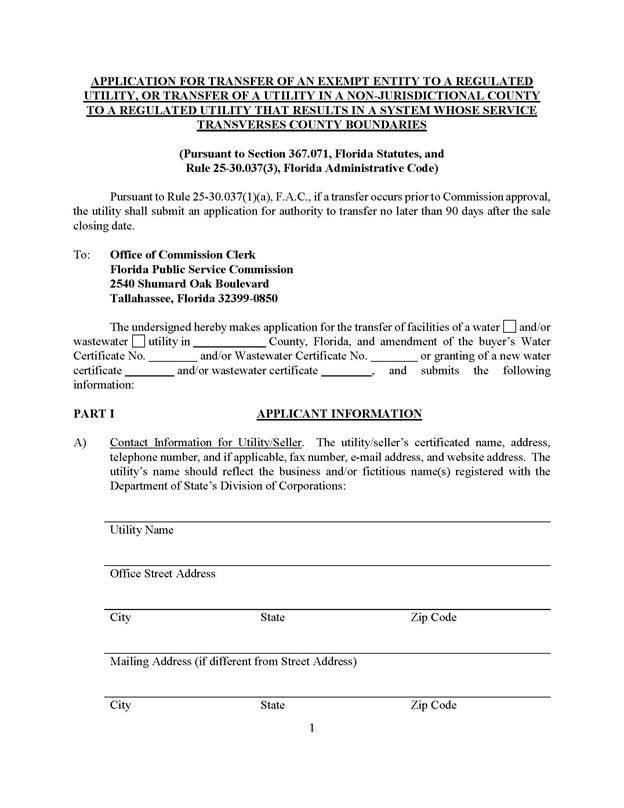
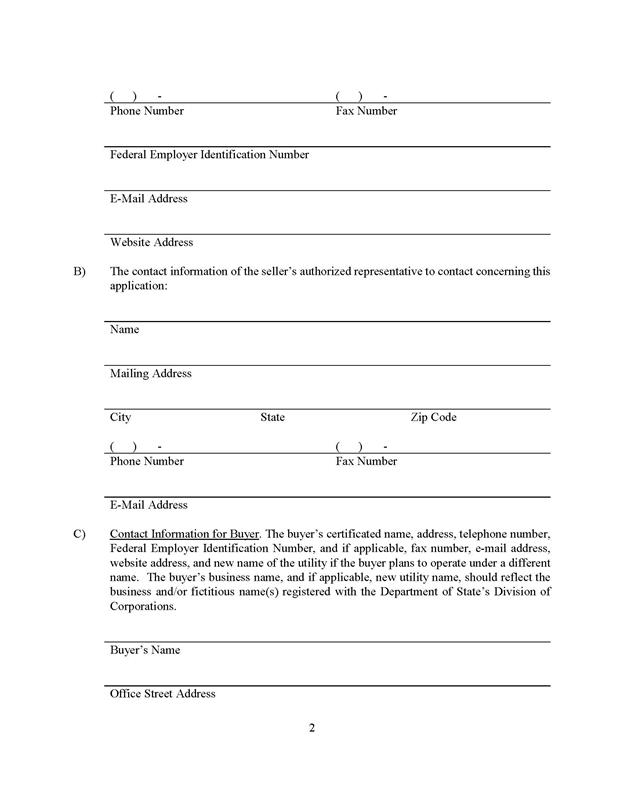
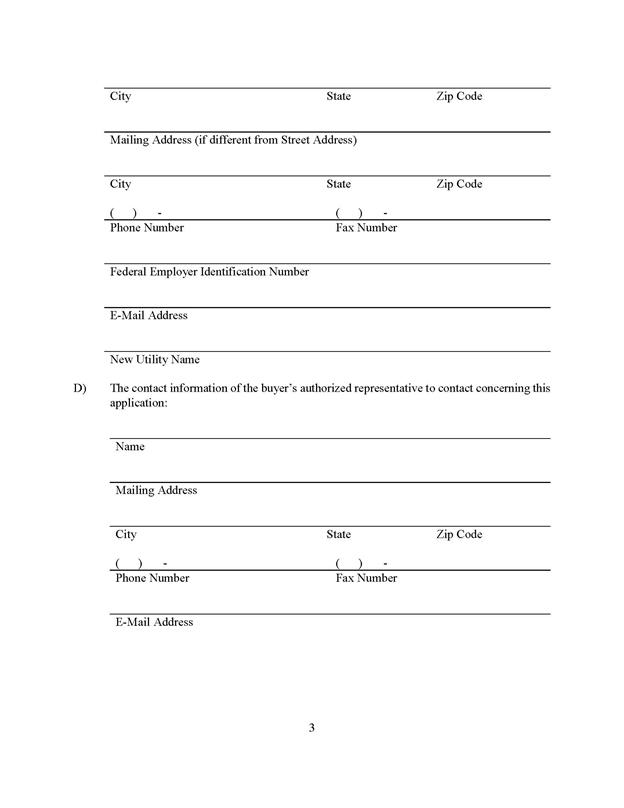
(c) Form PSC
1005 (06/26) (12/15), entitled “Application for Transfer of
Certificates or Facilities from a Regulated Utility to Another Regulated
Utility,” which is incorporated by reference in this rule and which
is available at [hyperlink] http://www.flrules.org/Gateway/reference.asp?No=Ref-06242,
Form PSC 1006 (06/26) (12/15), entitled “Application for Transfer
of an Exempt Entity to a Regulated Utility or Transfer of a Utility in a
Non-jurisdictional County to a Regulated Utility That Results in a System Whose
Service Transverses County Boundaries,” which is incorporated by
reference in this rule and which is available at [hyperlink] http://www.flrules.org/Gateway/reference.asp?No=Ref-06243,
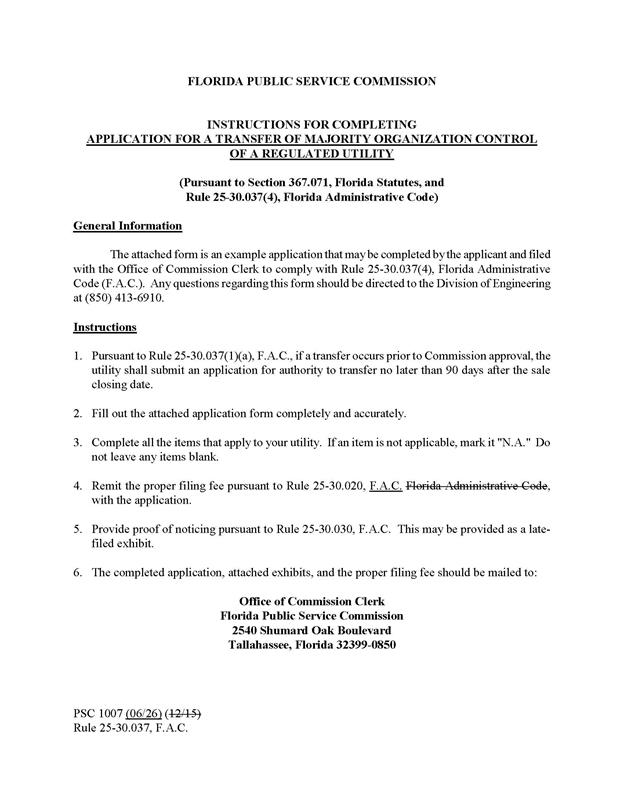
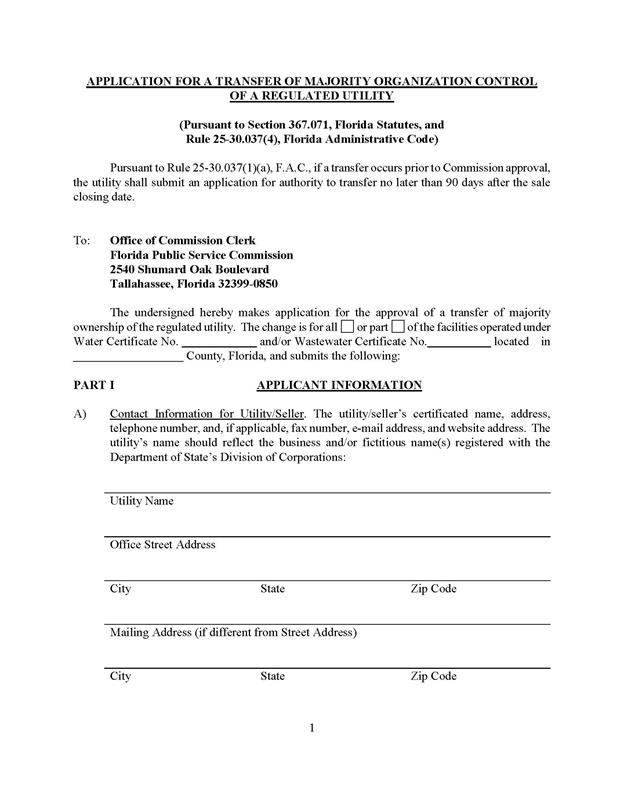
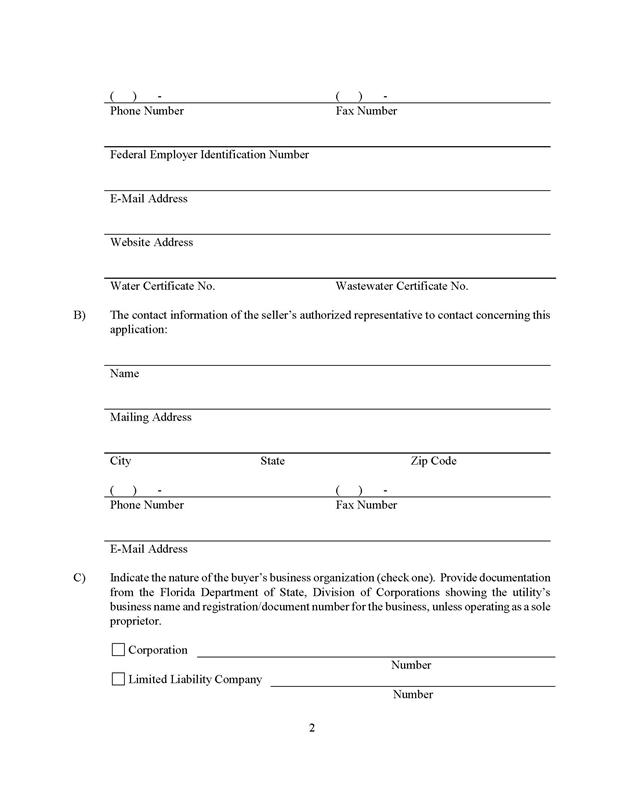
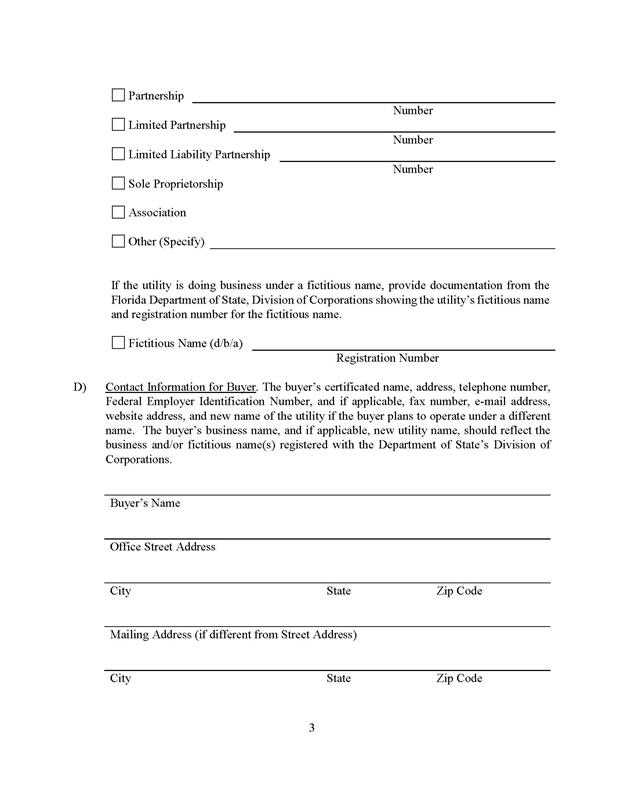
Form PSC 1007 (06/26) (12/15), entitled “Application for a
Transfer of Majority Organizational Control of a Regulated Utility,” which
is incorporated by reference in this rule and which is available at [hyperlink]
http://www.flrules.org/Gateway/reference.asp?No=Ref-06244,
and Form PSC 1008 (06/26) (12/15), entitled “Application for
Transfer of Facilities from a Regulated Utility to an Exempt Entity Other Than
a Governmental Authority,” which is incorporated by reference in this
rule and which is available at [hyperlink] http://www.flrules.org/Gateway/reference.asp?No=Ref-06245,
are example applications that may be completed by the applicant and filed with
the Office of Commission Clerk to comply with subsection (2), (3), (4), or (5),
below, respectively. These forms may also be obtained from the Commission’s
website, at www.floridapsc.com.
(2) Transfer
of a regulated utility to another regulated utility. Each applicant for
transfer of certificate of authorization, facilities or any portion thereof
from a regulated utility to another regulated utility must shall
file with the Commission Clerk the information set forth in paragraphs (a)
through (v), below.
(a) A filing fee
pursuant to paragraph 25-30.020(2)(c), F.A.C.;
(b) Proof of
noticing pursuant to Rule 25-30.030, F.A.C.;
(c) The
certificated name, address, telephone number, certificate number(s), authorized
representative, and, if available, the email address and fax number of
the utility/seller;
(d) The complete
name, address, telephone number, Federal Employer Identification Number,
authorized representative and, if available, the email address and fax
number of the buyer(s) and the new name of the utility if the buyer plans to
operate under a different name;
(e) The name,
address, telephone number, and if available, the email address and fax
number of the person in possession of the books and records when the
application is filed;
(f) The nature
of the buyer’s business organization, i.e., corporation, limited liability
company, partnership, limited partnership, sole proprietorship, or association.
The buyer must provide documentation from the Florida Department of State,
Division of Corporations, showing:
1. The
utility’s/buyer’s business name and registration/document number for the
business, unless operating as a sole proprietor, and,
2. The
utility’s/buyer’s fictitious name and registration number for the fictitious
name, if operating under a fictitious name;
(g) The name(s),
address(es) and percentage of ownership of each entity or person that owns or
will own more than a 5 percent interest in the utility;
(h) The date and
state of incorporation or organization of the buyer;
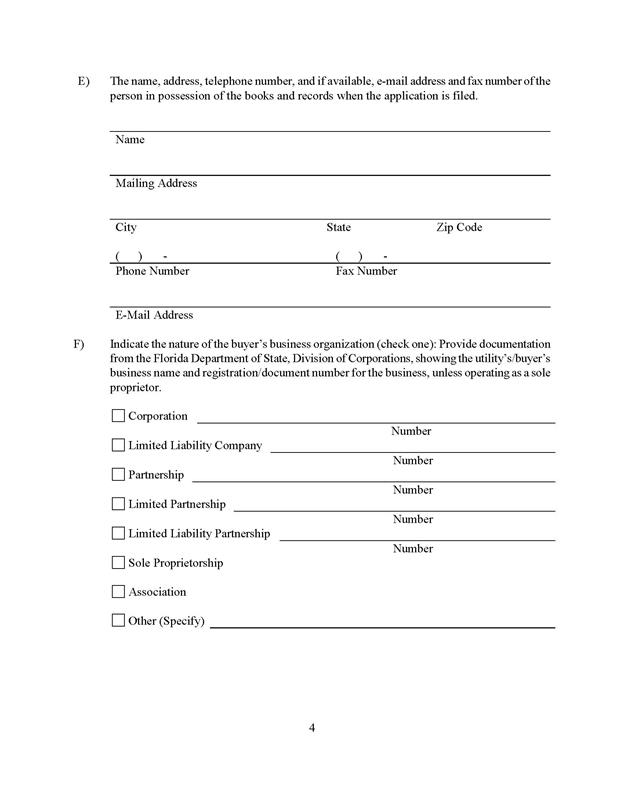
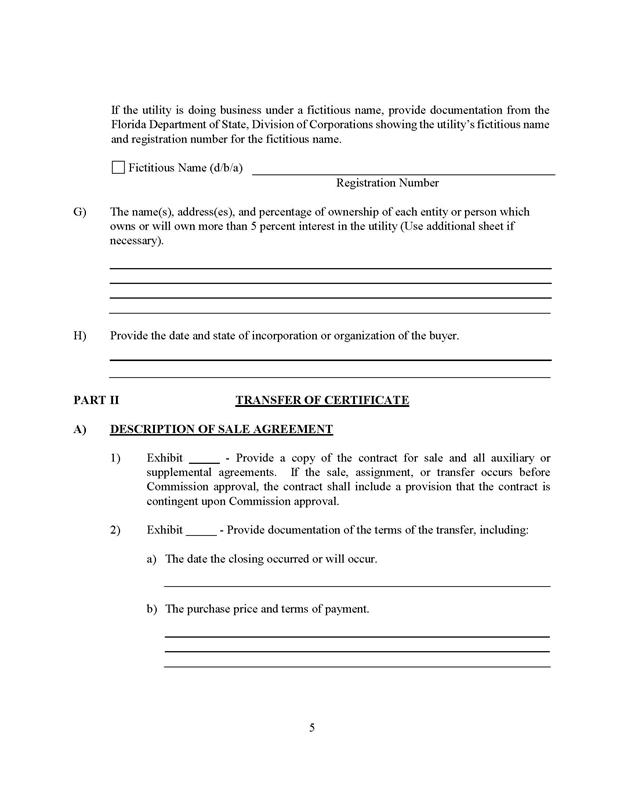
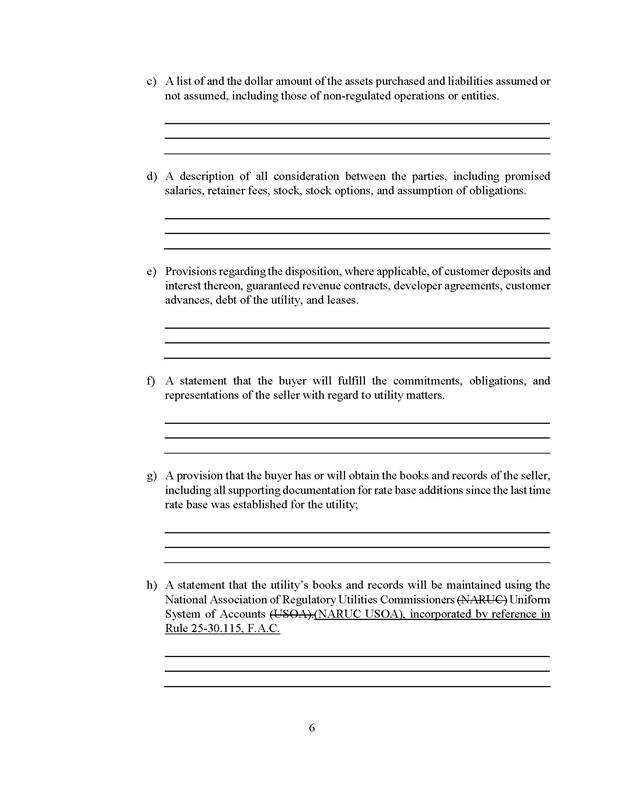
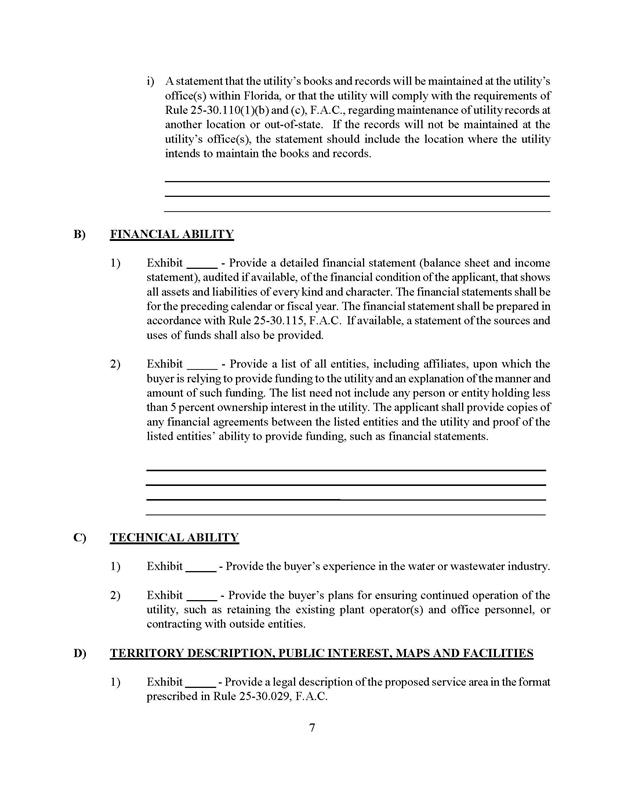
(i) A copy of
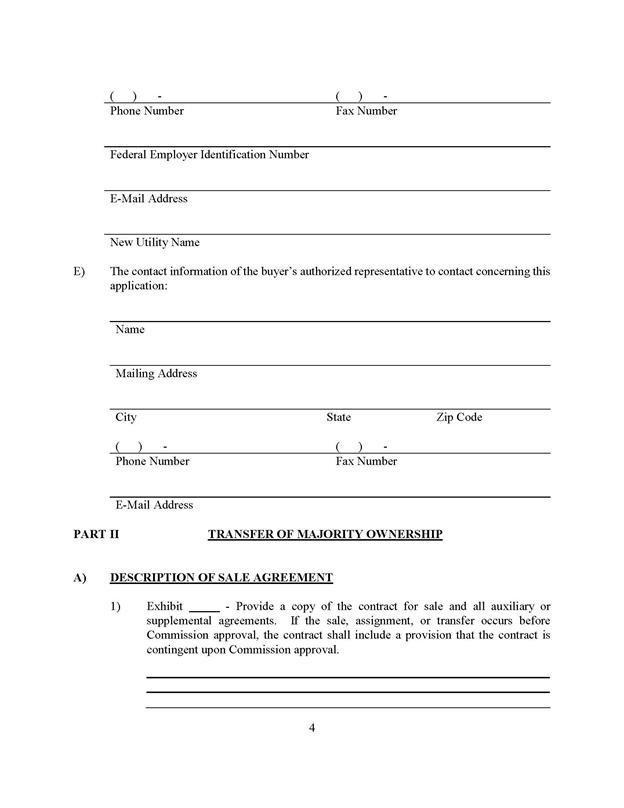
the contract for sale and all auxiliary or supplemental agreements. If the
sale, assignment, or transfer occurs prior to Commission approval, the contract
must shall include a provision stating that the contract is
contingent upon Commission approval;
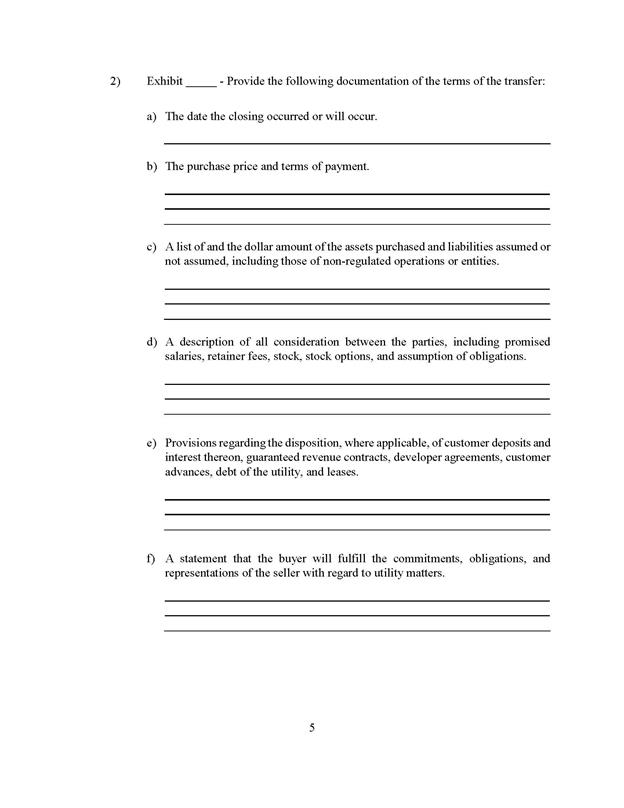
(j) The buyer
must provide the following documentation of the terms of the transfer:
1. The date the
closing occurred or will occur;
2. The purchase
price and terms of payment;
3. A list of and
the dollar amount of the assets purchased and liabilities assumed or not
assumed, including those of nonregulated operations or entities;
4. A description
of all consideration between the parties, including promised salaries, retainer
fees, stock, stock options, and assumption of obligations;
5. Provisions
for the disposition, where applicable, of customer deposits and interest
thereon, guaranteed revenue contracts, developer agreements, customer advances,
debt of the utility, and leases;
6. A statement
that the buyer will fulfill the commitments, obligations and representations of
the seller with regard to utility matters;
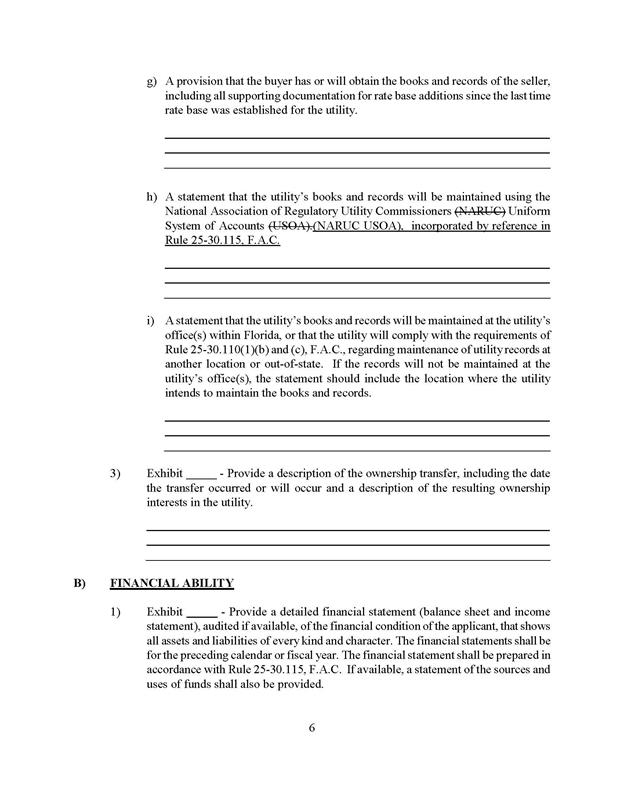
7. A statement
that the buyer has or will obtain the books and records of the seller,
including all supporting documentation for rate base additions since the last
time rate base was established for the utility;
8. A statement
that the utility’s books and records will be maintained using the NARUC USOA 1996
National Association of Regulatory Utilities Commissioners (NARUC) Uniform
System of Accounts (USOA), incorporated by reference in Rule 25-30.115,
F.A.C.; and,
9. A statement
that the utility’s books and records will be maintained at the utility’s
office(s) within Florida, or that the utility will comply with the requirements
of paragraphs 25-30.110(1)(b) and (c), F.A.C., regarding maintenance of utility
records at another location or out-of-state. If the records will be maintained
at the utility’s office(s), the statement should include the location where the
utility intends to maintain the books and records;
(k) A statement
explaining why the transfer is in the public interest;
(l) To
demonstrate the financial ability of the buyer to maintain and operate the acquired
utility, the buyer must shall provide:
1. A detailed
financial statement (balance sheet and income statement), audited if available,
of the financial condition of the applicant, that shows all assets and
liabilities of every kind and character. The financial statements must shall
be for the preceding calendar or fiscal year. The financial statement must
shall be prepared in accordance with Rule 25-30.115, F.A.C. If
available, a statement of the sources and uses of funds must shall
also be provided; and,
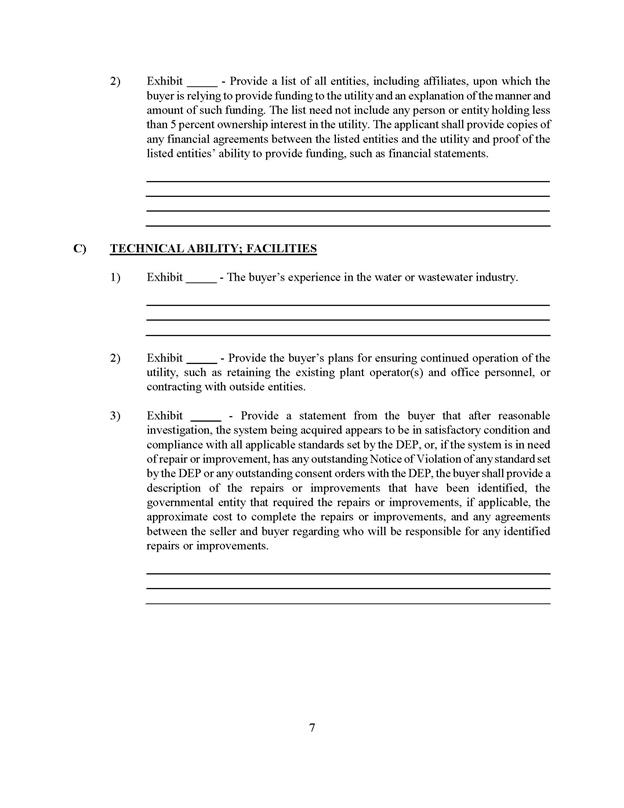
2. A list of all
entities, including affiliates, upon which the buyer is relying to provide
funding to the utility and an explanation of the manner and amount of such
funding. The list need not include any person or entity holding less than 5
percent ownership interest in the utility. The applicant must shall
provide copies of any financial agreements between the listed entities and the
utility and proof of the listed entities’ ability to provide funding, such as
financial statements;
(m) To
demonstrate the technical ability of the buyer to provide service, the buyer must
shall provide:
1. An
explanation of the buyer’s experience in the water or wastewater industry; and,
2. The buyer’s
plans for ensuring continued operation of the utility, such as retaining the
existing plant operator(s) and office personnel, or contracting with outside
entities;
(n) A legal
description of the proposed service area in the format prescribed in Rule
25-30.029, F.A.C.;
(o) The proposed
net book value of the system as of the date of the proposed transfer, and a statement
setting out the reasons for the inclusion of an acquisition adjustment, if one
is requested. If rate base has been established by this Commission, the
buyer must provide the docket, and the order number and.
In addition, provide a schedule of all subsequent changes to rate base;
(p) A statement
from the buyer that it has obtained or will obtain copies of all of the federal
income tax returns of the seller from the date the utility was first
established or the rate base was last established by the Commission, whichever
is later. If the tax returns have not been obtained, the buyer must provide
a description of the steps taken to obtain the tax returns;
(q) A statement
from the buyer that after reasonable investigation, the system being acquired
appears to be in satisfactory condition and in compliance with all applicable
standards set by the Department of Environmental Protection (DEP) or, if the
system is in need of repair or improvement, has any outstanding Notice of
Violation of any standard set by the DEP or any outstanding consent orders with
the DEP, the buyer must shall provide a description of the
repairs or improvements that have been identified, the governmental authority
that required the repairs or improvements, if applicable, the approximate cost
to complete the repairs or improvements, and any agreements between the seller
and buyer regarding who will be responsible for any identified repairs or
improvements;
(r) The
applicant must shall provide the following documents:
1. A copy of the
utility’s current permits from the DEP and the water management district;
2. A copy of the
most recent DEP and/or county health department sanitary survey, compliance
inspection report, and secondary standards drinking water report;
3. A copy of all
of the utility’s correspondence with the DEP, county health department, and
water management district, including consent orders and warning letters, and
the utility’s responses to the same, for the past five years; and,
4. A copy of all
customer complaints that the utility has received regarding DEP secondary water
quality standards during the past five years;
(s)
Documentation of the utility’s right to access and continued use of the land
upon which the utility treatment facilities are located. Documentation of
continued use must shall be in the form of a recorded warranty
deed, recorded quit claim deed accompanied by title insurance, recorded lease
such as a 99-year lease, or recorded easement. To comply with this
requirement, tThe applicant may submit an unrecorded copy of
the instrument granting the utility’s right to access and continued use of the
land upon which the utility treatment facilities are or will be located,
provided that the applicant files a recorded copy within the time required in
the order granting the transfer;
(t) A statement
regarding the disposition of outstanding regulatory assessment fees, fines, or
refunds owed and which entity will be responsible for paying regulatory
assessment fees and filing the annual report for the year of the transfer and
subsequent years;
(u) Tariff
sheets reflecting any changes resulting from the transfer. Form PSC 1010 (06/26)
(12/15), entitled “Water Tariff,” and Form PSC 1011 (06/26)
(12/15), entitled “Wastewater Tariff,” which are incorporated by
reference in Rule 25-30.033, F.A.C., are example tariffs that may be completed
by the applicant and included in the application.
These forms are also available on the Commission’s website at,
www.floridapsc.com; and,
(v) If the buyer
owns other water or wastewater utilities that are regulated by the Commission,
provide a schedule reflecting any economies of scale that are anticipated to be
achieved within the next three years and the effect on rates for existing
customers served by both the utility being purchased and the buyer’s other
utilities.
(3) For tTransfer
of an exempt entity to a regulated utility, or transfer of a utility in a
nonjurisdictional county to a regulated utility that results in a system whose
service transverses county boundaries,. eEach
applicant must shall file with the Commission the information set
forth in paragraphs (a) through (f), below:.
(a) A combined
filing fee pursuant to paragraphs 25-30.020(2)(b) and (c), F.A.C.;
(b) Proof of
noticing pursuant to Rule 25-30.030, F.A.C.;
(c) The
requirements of paragraphs (2)(c), through (d), (e), (f), (g),
(h), (i), (j), (k), (l), (m), (n), (o), (p), (q), (r), (s), (t), (u), and
(v), above;
(d) The
requirements of paragraphs 25-30.036(2)(h) and (i), F.A.C.;
(e) An
explanation of when and under what authority the current rates and charges of
the exempt entity or utility in a nonjurisdictional county were established, if
applicable; and,
(f) An
explanation of how the seller is either exempt pursuant to Section 367.022,
F.S., or is a utility in a nonjurisdictional county.
(4) A
transfer of majority organizational control of a regulated utility. Each
applicant for a transfer of majority organizational control must shall
file with the Commission the information set forth in paragraphs (a) through
(d), below:.
(a) A filing fee
pursuant to paragraph 25-30.020(2)(c), F.A.C.;
(b) Proof of
noticing pursuant to Rule 25-30.030, F.A.C.;
(c) The
requirements of paragraphs (2)(c), (d), (f), (i), (j), (k), (l), (m), (q), (t)
and (u), above; and,
(d) A
description of the ownership transfer, including the date the transfer occurred
or will occur and a description of the resulting ownership interests in the
utility.
(5) A
transfer of a regulated utility to an exempt entity other than a governmental
authority. Each applicant for a transfer of ownership of a regulated
utility to an exempt entity other than a governmental authority must shall
file with the Commission Clerk the information set forth in paragraphs (a)
through (e), below:.
(a) A filing fee
pursuant to paragraph 25-30.020(2)(c), F.A.C.;
(b) Proof of
noticing pursuant to Rule 25-30.030, F.A.C.;
(c) The
requirements of paragraphs (2)(c), (d), (k), (l), (m), and (r), above;
(d)
Documentation of the following terms of the transfer:
1. A copy of the
contract for sale and all auxiliary or supplemental agreements. If the sale,
assignment, or transfer occurs prior to Commission approval, the contract must
shall include a provision stating that the contract is contingent upon
Commission approval;
2. The closing
date;
3. A statement
regarding the disposition of customer deposits and interest thereon; and,
4. A statement
regarding the disposition of any outstanding regulatory assessment fees, fines,
refunds, or annual reports; and,
(e) An
explanation of how the buyer is exempt pursuant to Section 367.022, F.S.
Rulemaking Authority
350.127(2), 367.121, 367.1213 FS. Law Implemented 367.071, 367.1213 FS.
History–New 1-27-91, Amended 11-30-93, 1-4-16,. ________.
25-30.0372 Alternative Procedure for Establishing Rate
Base Value of Acquired Utility System.
(1) Definition. For the purposes of this rule, “Licensed
Appraiser,” as referenced in Section 367.0811(4)(a), F.S., means a person who meets
all the following criteria:
(a) Has certification as an Accredited Senior Appraiser
by the American Society of Appraisers (ASA), designation as a Certified
Valuation Analyst by the National Association of Certified Valuators and
Analysts (NACVA), designation as a Certified Business Appraiser by the
Institute of Business Appraisers (IBA), or designation as Accredited in
Business Valuation by the American Institute of Certified Public Accountants
(AICPA), and
(b) Is in good standing with the ASA, NACVA, IBA,
or AICPA.
(2) Appraisals.
(a) Each appraisal must assess the value of the utility
system being acquired according to its intended use.
(b) The Executive Director of the Florida Public Service
Commission, or their designee, will randomly select choose
the three licensed appraisers from the list of licensed appraisers
referenced in paragraph (2)(d) of this rule using computationally-generated
random numbers. No two of the selected appraisers may be employed by the
same entity.
(c) The licensed engineer who performs the engineering
assessment required by Section 367.0811(4)(b), F.S., may not also serve as a
licensed appraiser on the same acquisition transaction.
(d) The list of licensed appraisers required by Section
367.0811(4)(a), F.S., can be found at www.floridapsc.com/appraiserlist or
obtained from the Office of the Commission Clerk, Florida Public Service
Commission, 2540 Shumard Oak Boulevard, Tallahassee, Florida 32399-0850.
(e) A licensed appraiser will be included on the
Commission’s list of approved licensed appraisers by submitting all of the
following by email to appraiserlist@psc.state.fl.us or by mail to
the Office of the Commission Clerk, Florida Public Service Commission, 2540
Shumard Oak Boulevard, Tallahassee, FL 32399-0850:
1. The licensed appraiser’s name, mailing address,
telephone number, and email address;
2. The name of any company with which the licensed
appraiser is employed or associated; and
3. Proof of the information required by subsection (1)
above;. and
4. The expiration date of the certification or
designation required by paragraph (1)(a) above.
(f) It is the responsibility of the licensed appraiser to
ensure that correct and updated information remains on file with the
Commission. The licensed appraiser must submit updated information by email
to appraiserlist@psc.state.fl.us, or by mail to the Office of the
Commission Clerk, Florida Public Service Commission, 2540 Shumard Oak
Boulevard, Tallahassee, FL 32399-0850, within 30 days of any change of
information. If the Commission determines that a person no longer meets the
requirements to be a licensed appraiser on the Commission’s list, that person
will be removed from the list. Upon request and upon providing proof that the
requirements listed in subsection (1) above are met, a person will be added
back to the list.
(g) The licensed appraiser can be removed from the list
by submitting a request for removal in writing by email to
appraiserlist@psc.state.fl.us or by mail to the Office of the Commission
Clerk, Florida Public Service Commission, 2540 Shumard Oak Boulevard,
Tallahassee, FL 32399-0850.
(3) Petition. Section 367.0811(5), F.S., sets forth the
filing requirements a petition to establish the rate base value must contain.
(a) The petition may be filed concurrent with the
application to transfer the certificate(s) of authorization, but must be filed
no later than 6 months after the issuance of the final order approving the
transfer of the certificate(s) of authorization or the closing date of the
sale. Commission staff will review the petition and within 30 days of receipt
of the petition will notify the acquiring utility whether the petition is
complete or identify the information required by Section 367.0811(5), F.S.,
which is missing from the petition. If an amended petition is filed, Commission
staff will review the amended petition and within 30 days of receipt of the
amended petition will notify the acquiring utility whether the amended petition
is complete or identify the information required by Section 367.0811(5), F.S.,
which is missing from the amended petition. This process will continue until
Commission staff determines the petition satisfies the requirements of Section
367.0811(5), F.S. The date a petition is complete under Section 367.0811(6), F.S.,
is the date that all documents required by Section 367.0811(6), F.S. have been
filed.
(b) If the assessment of tangible assets required by
Section 367.0811(4)(b), F.S., identifies deficiencies, the 3-year plan required
by Section 367.0811(5)(d), F.S., must include the following, if existing,
regarding the system being acquired:
1. A copy of the most recent DEP and/or county health
department sanitary survey, compliance inspection report, primary and secondary
standards drinking water report; and
2. A copy of all correspondence with the DEP, county
health department, and water management district, including consent orders and
warning letters, and the utility’s responses to the same, for the past five
years.
(c) Form PSC 1035 (03/24), entitled “Water and/or
Wastewater Cumulative Present Value of the Revenue Requirements for Alternate
Rate Base Worksheet” (CPVRR), which is incorporated by reference in this
rule and available at may be obtained from http://www.flrules.org/Gateway/reference.asp?No=Ref-16589, must be included in the petition to show
the 5-year projected rate impact required by Section 367.0811(5)(e), F.S. The
form can also be found at www.floridapsc.com, or obtained from the
Office of the Commission Clerk, Florida Public Service Commission, 2540 Shumard
Oak Boulevard, Tallahassee, Florida 32399-0850.
(d) The 5-year rate impact required by Section
367.0811(5)(e), F.S., must also include the following for each year for residential
and general service customers, and the CPVRR must support the projections for
the following:
1. Base facility charge,
2. Gallonage charge, and
3. Billing determinants.
(e) The information filed under Section 367.0811(5)(e),
F.S., must include the acquiring utility’s proposed journal entries anticipated
to result from the acquisition, including tax entries and account numbers in
conformance with the 1996 NARUC USOA Uniform System of
Accounts, which is incorporated by reference in Rule 25-30.115,
F.A.C.
(f) For purposes of determining whether the petition must
include a rate stabilization plan under Section 367.0811(5)(h), F.S.,
“significant individual increase in rates” means a rate increase during any
twelve consecutive months of the 5-year projected rate impact period that is in
excess of 15 percent over the current rates of the utility system being
acquired.
(4) General filing instruction. Prepared direct testimony
and exhibits for each witness testifying on behalf of the acquiring utility
must be filed at the time the petition is filed.
(5) Notice. At the time the petition is filed with the
Commission, the acquiring utility must provide a draft notice for review by
Commission staff. Commission staff will review the draft notice within 7 days.
Once staff has approved the notice, the acquiring utility must provide notice by
U.S. Mail regular mail to the Office of Public Counsel and by either
U.S. Mail regular mail or personal service to each customer and
owner of property located within the service area for both the acquiring
utility and the utility being acquired, to the extent the utilities’ customers
are within the Commission’s jurisdiction. The notice required by this rule may
be combined with the notice of Application for Authority to Transfer issued
pursuant to Rule 25-30.030, F.A.C., or for existing customers, the notice may
be included in their next bill. The notice must contain:
(a) Title: Notice of Utility’s Petition to Establish Rate
Base Value Using Alternative Procedure;
(b) A statement that the utility has filed a petition
with the Commission to establish rate base value of acquired utility system
using the alternative procedure set forth in Section 367.0811, F.S.;
(c) The date the petition was filed with the Commission;
(d) The docket number associated with the petition;
(e) A statement of the 5-year projected rate impact or
the anticipated effect of the requested rate base on rates for the next five
years;
(f) A statement that the utility’s petition is available
on the Commission’s website;
(g) The acquiring utility’s address, telephone number,
and business hours; and
(h) A statement that any customer substantially affected
by the petition may file a motion to intervene in accordance with Rule
28-106.205, F.A.C.
Rulemaking Authority
367.0811(11), FS. Law Implemented 367.0811, FS. History–New 5-15-24, Amended
________.
25-30.110 Records and Reports; Annual Reports.
(1) Records.
(a) Each utility
must preserve its records in accordance with the National Association of
Regulatory Utility Commissioners “Regulations to Govern the Preservation of
Records of Electric, Gas and Water Utilities” as issued by the National
Association of Regulatory Utility Commissioners, as (revised October
2007), which is incorporated by reference into this rule. “Regulations
to Govern the Preservation of Records of Electric, Gas and Water Utilities” is
copyrighted and may be inspected and examined at no cost at the Florida
Public Service Commission, 2540 Shumard Oak Boulevard, Tallahassee, Florida
32399-0850 or at the Florida Department of State, R.A. Gray Building,
500 South. Bronough Street, Tallahassee, Florida 32399. A copy may also
be purchased obtained from the NARUC Store at www.naruc.org. National Association of
Regulatory Utility Commissioners, 1101 Vermont Avenue, N.W., Suite 200,
Washington, D.C. 20005.
1. Those
utilities that choose to convert documents from their original media form must
retain the original source documents as required by paragraph (1)(a) of this
rule, for a minimum of three years, or for any lesser period of time
specified for that type of record in the “Regulations to Govern the Preservation
of Records of Electric, Gas and Water Utilities,” after the date the document
was created or received by the utility. This paragraph does not require the
utility to create paper copies of documents where the utility would not
otherwise do so in the ordinary course of its business. Upon a showing by a
utility that it employs a storage and retrieval system that consistently
produces clear, readable copies that are substantially equivalent to the
originals, and clearly reproduces handwritten notations on documents, the
utility does not have to meet the requirement to retain documents in their
original form.
2. The utility
must maintain written procedures governing the conversion of source documents
to a storage and retrieval system, which procedures ensure the authenticity of
documents and the completeness of records. Records maintained in the storage
and retrieval system must be easy to search and easy to read.
(b) Unless
otherwise authorized by the Commission, each utility must maintain its records
at the office or offices of the utility within this state and must keep those
records open for inspection during business hours by Commission staff.
(c) Any utility
that keeps its records outside the state must reimburse the Commission for the
reasonable travel expense incurred by each Commission representative during any
review of the out-of-state records of the utility or its affiliates. Reasonable
travel expenses are those travel expenses that are equivalent to travel
expenses paid by the Commission in the ordinary course of its business.
1. The utility
must remit reimbursement for out-of-state travel expenses within 30 days from
the date the Commission mails the invoice.
2. The
reimbursement requirement in paragraph (1)(c) is not applicable for the following:
a. A utility
that makes its out-of-state records available at the utility’s office located
in Florida or at another mutually agreed upon location in Florida within 10
working days from the Commission’s initial request. If 10 working days is not reasonable
because of the complexity and nature of the issues involved or the volume and
type of material requested, the Commission will establish a different time
frame for the utility to bring records into the state. For individual data
requests made during an audit, the response time frame established in Rule
25-30.145, F.A.C., will control; or
b. A utility
whose records are located within 50 miles of the Florida state line.
(2) In General.
Each utility must furnish to the Commission the results of any required tests
and summaries of any required records. The utility must also furnish the
Commission with any information concerning the utility’s facilities or
operation that the Commission requests and requires for determining rates or
judging the practices of the utility. All such data, unless otherwise
specified, must be consistent with and reconcilable with the utility’s annual
report to the Commission.
(3) Annual
Reports: Filing Extensions. Each utility must file with the Commission annual
reports on the applicable form in subsection (4) of this rule. The obligation
to file an annual report for any year will apply to any utility which is
subject to this Commission’s jurisdiction as of December 31 of that year,
whether or not the utility has actually applied for or been issued a
certificate.
(a) The
Commission will, by January 15 of each year, email a blank copy of the
appropriate annual report form to each utility company. A utility may request a
hard copy of the forms in subsection (4) of this rule from the Commission’s
Division of Accounting and Finance. The failure of a utility to receive a
report form will not excuse the utility from its obligation to timely file the
annual report. The annual reports must be filed with the Commission, either by
mail or by email, on or before March 31 for the preceding year ending December
31. Annual reports filed by email must be sent to AnnualReport@psc.state.fl.us.
Annual reports filed by mail must be sent to the Florida Public Service Commission, Division of Accounting and Finance,
2540 Shumard Oak Boulevard, Tallahassee, FL 32399-0850. to the
Commission’s Division of Accounting and Finance in Tallahassee.
(b) Annual
reports are considered filed if they are properly addressed and emailed or
mailed with sufficient postage and postmarked, by no later than the due
date. For annual reports sent by registered mail, the date of the registration
is the postmark date. For annual reports sent by certified mail, the date on
the receipt is the postmark date. The postmark is evidence that an annual
report was mailed delivered. However, Iif a
utility’s annual report is not actually received by the Commission’s
Division of Accounting and Finance in Tallahassee, that utility must resend it
upon request, despite any prior presumption of delivery.
(c) A utility
may file a written request for an extension of time to file its annual report
with the Commission’s Division of Accounting and Finance no later than March
31. One extension of 30 days will be automatically granted upon request. A
request for a longer extension must be accompanied by a statement of good
cause, such as financial hardship, severe illness, or significant weather
events such as hurricanes, but good cause does not include reasons such as
management oversight or vacation time, and must specify the date by which the
report will be filed.
(4) Annual
Reports; Contents. The appropriate annual report form required from each
utility will be determined by using the same three classes of utilities used by
the National Association of Regulatory Utility Commissioners for publishing
its system of accounts: Class A (those having annual water or wastewater
operating revenues of $1,750,000 $1,000,000 or more); Class B
(those having annual water or wastewater revenues of $350,000 $200,000,
or more, but less than $1,750,000 $1,000,000); and Class
C (those having annual water or wastewater revenues of less than $350,000
$200,000). The class to which a utility belongs will be determined by
using the higher of the average of its annual water or wastewater operating
revenues for each of the last three preceding years.
(a) Class A and
B utilities must file the annual report on Commission Form PSC-1032 (06/26)
(5/22), entitled “Class A or B Water and/or Wastewater Utilities (Gross
Revenues of $350,000 $200,000 and more),” which is
incorporated by reference into this rule and available at may
be obtained from [hyperlink] http://www.flrules.org/Gateway/reference.asp?No=Ref-15172.
(b) Class C
utilities must file the annual report on Commission Form PSC 1033 (06/26)
(5/22), entitled “Class C Water and/or Wastewater Utilities (Gross
Revenues of less than $350,000 $200,000 each),” which is
incorporated by reference into this rule and available at may
be obtained from [hyperlink] http://www.flrules.org/Gateway/reference.asp?No=Ref-15174.
(c) The
foregoing forms can be obtained from the Commission’s Division of Accounting
and Finance.
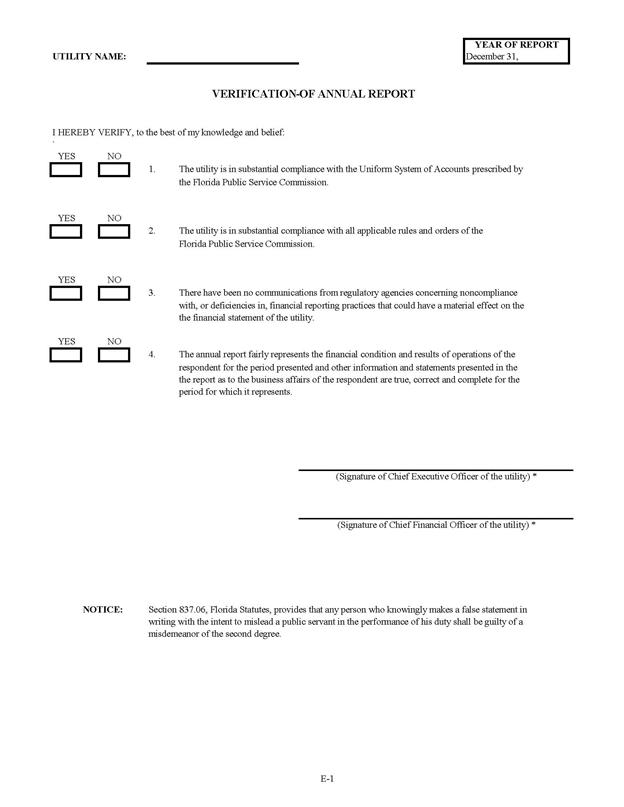
(5) As part of
the annual report, each utility must verify the following in writing by the
utility’s chief executive officer and chief financial officer:
(a) Whether the
utility is in substantial compliance with the NARUC USOA, Uniform
System of Accounts as prescribed by incorporated by reference in
Rule 25-30.115, F.A.C.;
(b) Whether the
utility is in substantial compliance with all applicable rules and orders of
the Florida Public Service Commission;
(c) Whether there
have been any written communications from regulatory agencies concerning
noncompliance with, or deficiencies in, financial reporting practices that
could have a material effect on the financial statements;
(d) Whether the
financial statements and related schedules fairly present the financial
condition and results of operations for the period presented and whether other
information and statements presented as to the business affairs of the
respondent are true, correct, and complete for the period which they represent.
(6) Delinquent
Reports.
(a) Any utility
that fails to file its annual report or extension on or before March 31, or
within the time specified by any extension approved in writing by the
Commission’s Division of Accounting and Finance, will be subject to a penalty.
The penalty will be based on the number of calendar days elapsed from March 31,
or from an approved extended filing date, until the date of filing. The date of
filing will be included in the days elapsed.
(b) The penalty
for delinquent reports will accrue based on the utility’s classification
established under subsection (4) of this rule, in the following manner for each
day the report is delinquent:
1. $25.00 per
day for Class A utilities;
2. $13.50 per
day for Class B utilities; and,
3. $3.00 per day
for Class C utilities.
(c) If a utility
does not timely file its annual report, in addition to the penalty determined
by paragraph (6)(b) of this rule, interest on the penalty will also be assessed
from the date the annual report was due, up to and including the date the
penalty is paid. Such interest is based on the AA non-financial 30-day
commercial paper rate published by the Board of Governors of the Federal
Reserve System on its website. Interest will be compounded monthly.
(7) Incomplete
Reports.
(a) The
Commission’s Division of Accounting and Finance will provide written
notification to a utility if its report does not contain information required
by subsection (4) of this rule. The utility must file the missing information
no later than 30 days after the date on the face of the notification. If the
utility fails to file the information within that period, the report will be
deemed delinquent and the utility will be subject to a penalty as provided
under paragraphs (6)(a) and (b) of this rule, except that the penalty will be
based on the number of days elapsed from the date the information is due to the
date it is actually filed. The date of filing will be included in the elapsed
days.
(b) A report is
incomplete if any of the schedules required by the following forms of this rule
are not completed:
1. Form PSC 1032
(06/26) (5/22) for Class A and B utilities;
2. Form PSC 1033
(06/26) (5/22) for Class C utilities.
(c) An
incomplete report will remain incomplete until the missing information is filed
with the Commission’s Division of Accounting and Finance on the appropriate
Commission form.
(8) Incorrect
Filing. If a utility files an incorrect annual report it will be considered
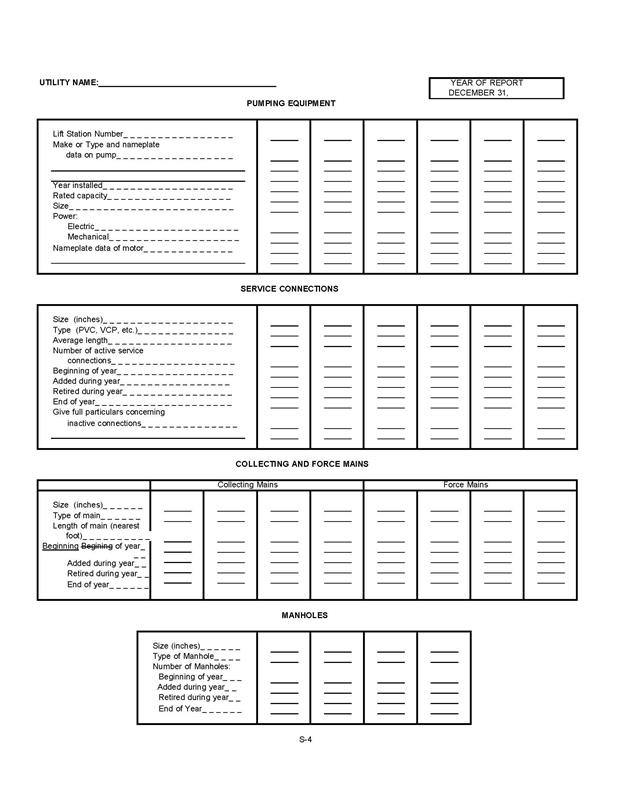
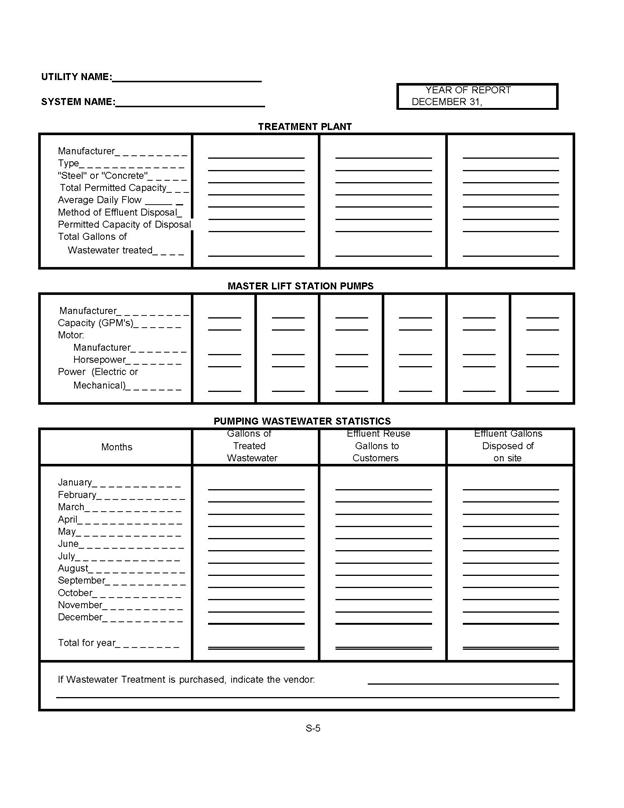
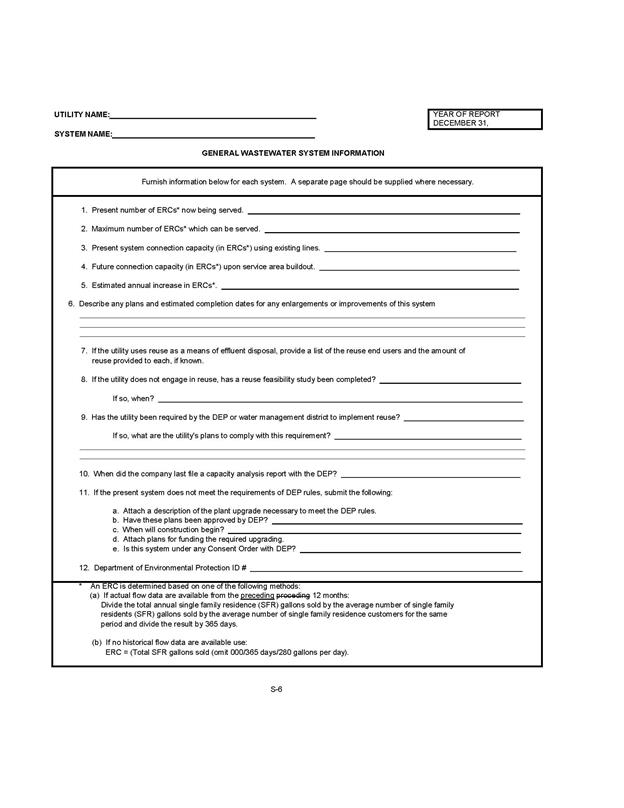
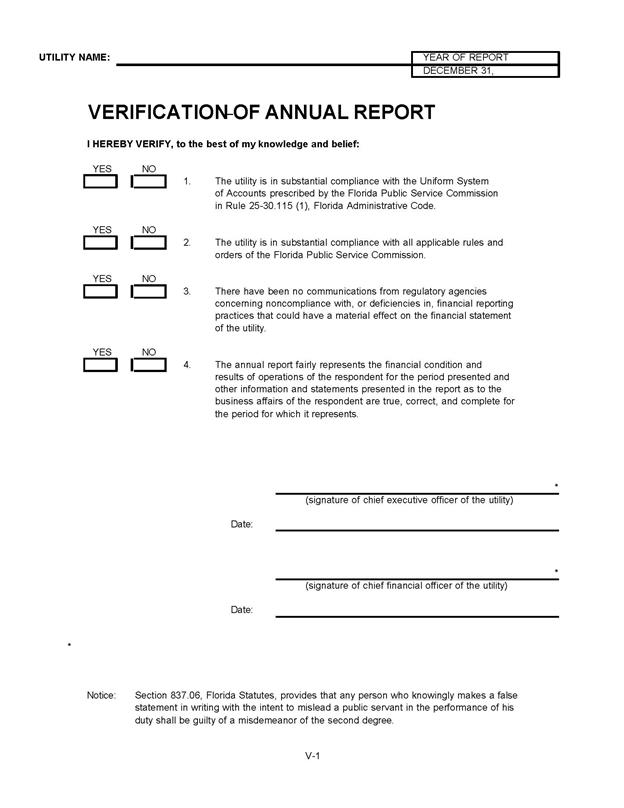
delinquent and subject to a penalty on the same basis as a utility that fails
to timely file an annual report. The classification determining the applicable
penalty, as prescribed by paragraphs (6)(a) and (b) of this rule, will be
determined by the latest annual revenue figures available for the utility. The
failure of a utility to receive a report form for the correct class of utility
will not excuse the utility from its obligation to timely file the annual
report for the correct class of utility.
Rulemaking Authority
350.127(2), 367.121 FS. Law Implemented 367.121, 367.156(1), 367.161 FS.
History–New 9-12-74, Amended 1-18-83, 2-25-85, 10-27-85, Formerly 25-10.25,
25-10.025, Amended 11-10-86, 12-22-86, 3-11-91, 11-13-95, 5-1-96, 12-14-99,
2-15-23, ____.
25-30.140 Depreciation.
(1) For the purpose
of the rule, the following definitions apply:
(a) Account –
Water and wastewater plant accounts are defined in the NARUC USOA, Uniform
System of Accounts adopted by which are incorporated by reference in
Rule 25-30.115, F.A.C.
(b) Amortization
– The gradual extinguishment of an amount in an account by distributing such
amount over a fixed period.
(c) Asset – Any
owned physical object (tangible) or right (intangible) having economic value to
its owner.
(d) Average
Remaining Life – The future expected service in years of the surviving plant at
a given age.
(e) Average
Service Life – The period of service that can be reasonably expected from the
plant type in question. It is measured by the period of time the subject plant
and its associated investment is included on the company’s books as in service
to the public. The average service life will typically be less than the
potential physical life due to factors such as governmental requirements,
growth or adverse operating conditions.
(f) Average Service
Life Depreciation Rate ‑ The depreciation rate based on the expected
average service to be experienced by the investment or account in question.
A.S.L. Rate = 100% ‒ Average Net Salvage %
Average Service Life
(g)
Capitalization – Measures of the propriety of capitalization versus expensing
as follows:
1. The addition
of any retirement unit, or
2. Any replacement with a retirement
unit that materially enhances the value, use, life expectancy, strength or
capacity of the asset prior to replacement must shall be
capitalized.
3. The cost of
incidental repairs that neither materially add to the value of the property nor
appreciably prolong its life and that were made to keep the property in an
ordinary efficient operating condition must shall be accounted
for as a maintenance expense.
(h) Cost of
removal – The cost of demolishing, dismantling, tearing down or otherwise
removing utility plant, including the cost of transportation and handling
incidental thereto.
(i) Continuing
Property Record (CPR) – A perpetual collection of records required by the NARUC
USOA, incorporated by reference in Rule 25-30.115, F.A.C., Uniform
System of Accounts showing the detailed original costs, quantities, and
locations of plant in service. Generally, a CPR should contain 1) an inventory
of property record units which can be readily checked for proof of physical
existence, 2) the association of costs with such property record units to
ensure accurate accounting for retirements, and 3) the dates of installation
and removal of plant to provide data for use in connection with depreciation
studies.
(j) Depreciation
– As applied to depreciable utility plant, the loss in service value not
restored by current maintenance incurred in connection with the consumption or
prospective retirement of utility plant in the course of service from causes
that are known to be in current operation and against which the utility is not
protected by insurance. Among the causes to be given consideration are wear and
tear, decay, action of the elements, inadequacy, obsolescence, changes in the
art, changes in demand and requirements of public authorities. The intent of
depreciation per this rule is to provide for recovery of invested capital and
to match this recovery as nearly as possible to the useful life of the
depreciable investment.
(k) Depreciation
Accounting – The process of charging the book cost of depreciable property,
adjusted for net salvage, to operations over the associated useful life.
(l) Depreciation
Expense – The periodic charge to expense to allocate the original cost of a
depreciable group of assets over the life of those assets.
(m) Depreciable
Group – A homogeneous grouping of assets expected to experience similar life
and salvage patterns. Unless otherwise ordered by the Commission, depreciable
groups are the accounts defined in the NARUC USOA, Uniform System of
Accounts adopted by incorporated by reference in Rule
25-30.115, F.A.C.
|
Water
|
Wastewater
|
|
Source of Supply
|
Collection Plant
|
|
(Accounts 304 to 311 and 339)
|
(Accounts 354, 355 and 360 to 367)
|
|
|
Pumping Plant
|
|
|
(Accounts 354, 355, 370, 371)
|
|
Water Treatment Plant
|
Treatment & Disposal Plant
|
|
(Accounts 304, 310, 311, 320, and 339)
|
(Accounts 354 and 380 to 389)
|
|
|
Reclaimed Water Treatment Plant
|
|
Transmission & Distribution Plant
|
(Accounts 354, 355, 371, 374, 380, 381, 389)
|
|
(Accounts 304, 310, 311 and 330 to 339)
General Plant
|
Reclaimed Water Distribution Plant
(Accounts 354, 355, 366, 367, 371, 375, 389)
|
|
(Accounts 304 and 340 to 348)
|
General Plant
|
|
|
(Accounts 354 and 390 to 398)
|
(n) Function –
defined as follows:
(o) Group
Depreciation – An accounting procedure under which depreciation charges are
accrued on the basis of the original cost of all property included in each
depreciable group. Under the group concept, no attempt is made to keep track of
the accumulated provision for depreciation applicable to individual assets of
property, in view of the many items making up a utility system. The group
approach recognizes that some assets within the group may live longer or
shorter than the average life of the group but the group is expected to live
the average service life. Every item in the group is assumed to be fully
depreciated at retirement.
(p) Mortality
Data – See plant activity data.
(q) Net Salvage
– The salvage value of property retired less the cost of removal. This is
expressed as a percent of retirements in the depreciation rate formula.
(r) Original
Cost – The cost of acquiring an asset and placing it into service for first
utility use. This includes the direct costs of acquiring the asset and the cost
of labor, materials, and associated costs of installation to prepare the asset
for first utility use. The cost is used in the computation of depreciation
expense. In the event that an asset is acquired that is already in public
service, the original historic cost of the asset should be recorded in plant in
service, and the historic accumulated depreciation should be charged to the
accumulated depreciation account. In the event the historic cost of an asset
that is already in utility service cannot be determined, an independent
engineer’s evaluation based on an original cost study may be used.
(s) Plant
Activity Data – Annual additions, retirements, adjustments or transfers, sales
or purchases, and investment balances at end of year.
(t) Property
Retired – As applied to utility plant, property that has been removed, sold, abandoned,
destroyed or which has been withdrawn from service for any cause.
(u) Remaining
Life Depreciation Rate – The depreciation rate based on the average remaining
portion of the service life expected to be experienced by the investment or
account in question and on the net unrecovered capital for that investment or
account.
R.L. Rate = 100%
‒ Accumulated Reserve % ‒ Future Net Salvage %
Average Remaining Life
The average remaining life for an account or sub-account is a
function of known planned retirement or of the average age of that account and
its appropriate mortality table.
(v) Replacing or
Replacement – The construction or installation of utility plant in place of
property retired, together with the removal of the property retired.
(w) Reserve –
The accumulated provision for depreciation. The accumulated depreciation
reserve is the net of depreciation accruals (expenses) and retired investment
with related gross salvage and cost of removal as well as any appropriate
adjustments or transfers.
(x) Reserve
Activity Data – Annual depreciation expense, retirements, transfers or
adjustments, gross salvage realized, cost of removal, and end of year balance
for the accumulated provision for depreciation.
(y) Retirement
Units – Those items of utility plant which, when retired with or without
replacement, are accounted for by crediting the book cost to the utility plant
account in which it is included.
(z) Salvage
Value – The amount received for property retired, less any expenses incurred in
connection with the sale or in preparing the property for sale or, if retained,
the amount at which the material recoverable is chargeable to materials and
supplies or other appropriate account.
(aa)
Straight-Line Method – A depreciation method by which the service value of a
depreciable group is charged to depreciation expense (or a clearing account)
and credited to the accumulated provision for depreciation account through
equal annual charges over the service life of the group.
(bb) Unit
Depreciation – An accounting procedure under which the original cost,
depreciation expense, and accumulated provision for depreciation, and all
associated activity are maintained for each individual asset. Service life and
salvage parameters are estimated for each individual asset with a depreciation
rate designed to recover each asset’s original cost over its related life. If
the asset lives longer than its expected life, depreciation expense stops
accruing when the asset is fully recovered. If the asset retires earlier than its
expected service life, the associated unrecovered amount is immediately
written-off as a loss.
(cc) Unrecovered
Amount – Original cost less the accumulated provision for depreciation less
expected net salvage.
(2) The average
service life and salvage components for each class of utility are as follows:
(a) Water System
Guideline Average Service Lives.
|
|
|
Large
|
Small
|
Small
|
|
|
|
|
Utility
|
Utility
|
Utility
|
|
|
|
|
(Class
|
(Class
|
Function
|
Net
|
|
Account
|
Description
|
A&B)
|
C)
|
Composite3
|
Salvage %4
|
|
1. Intangible Plant
|
|
|
|
|
|
|
351
|
Organization
|
40
|
40
|
|
|
|
352
|
Franchise Cost
|
405
|
405
|
|
|
|
2. Source of Supply
|
|
|
|
28
|
|
|
304
|
Structures & Improvements
|
321
|
271
|
|
|
|
|
Wood
|
28
|
25
|
|
|
|
|
Masonry
|
30
|
27
|
|
|
|
|
Reinforced Concrete
|
40
|
37
|
|
|
|
|
Steel Building
|
40
|
35
|
|
|
|
|
Tanks or Sheds
|
25
|
20
|
|
|
|
|
Fiberglass
|
20
|
18
|
|
|
|
305
|
Collecting and Impounding Reservoirs
|
50
|
40
|
|
|
|
306
|
Lake, River and Other Intakes
|
40
|
40
|
|
|
|
307
|
Wells and Springs
|
|
|
|
|
|
|
Drilled & Cased Well
|
30
|
27
|
|
|
|
|
(Floridan or Non-Corrosive)
|
|
|
|
|
|
|
Shallow Well (Sand
|
20
|
18
|
|
|
|
|
Aquifer or Corrosive
|
|
|
|
|
|
|
Water)
|
|
|
|
|
|
308
|
Infiltration Galleries
|
|
|
|
|
|
|
and Tunnels
|
40
|
N/A
|
|
|
|
309
|
Supply Mains
|
35
|
32
|
|
|
|
310
|
Power Generation Equipment
|
20
|
17
|
|
|
|
311
|
Pumping Equipment
|
201
|
171
|
|
|
|
|
Pumping Equipment Electric
|
20
|
15
|
|
|
|
|
Pumping Equipment Chemical
|
8
|
6
|
|
|
|
339
|
Other Miscellaneous Equipment
|
18
|
15
|
|
|
|
3. Water Treatment Plant
|
|
|
|
21
|
|
|
304
|
Structures and
|
|
|
|
|
|
|
Improvements (see
|
|
|
|
|
|
|
“Source of Supply”
|
|
|
|
|
|
|
for subcategory lives)
|
321
|
271
|
|
|
|
310
|
Power Generation Equipment
|
20
|
17
|
|
|
|
311
|
Pumping Equipment
|
201
|
171
|
|
|
|
|
Pumping Equipment-Electric
|
20
|
15
|
|
|
|
|
Pumping Equipment-Chemical
|
8
|
6
|
|
|
|
320
|
Water Treatment Equipment
|
221
|
171
|
|
|
|
|
Chlorination Equipment
|
10
|
7
|
|
|
|
|
Membrane Elements
|
5
|
5
|
|
|
|
|
Other Mechanical Equipment
|
25
|
20
|
|
|
|
339
|
Other Miscellaneous Equipment
|
18
|
15
|
|
|
|
4.Transmission &
Distribution Plant
|
|
|
|
36
|
|
|
304
|
Structures &
|
|
|
|
|
|
|
Improvements (See
|
|
|
|
|
|
|
“Source of Supply”
|
|
|
|
|
|
|
for subcategory lives)
|
321
|
271
|
|
|
|
310
|
Power Generation Equipment
|
20
|
17
|
|
|
|
311
|
Pumping Equipment
|
201
|
171
|
|
|
|
|
Pumping Equipment – Electric
|
20
|
15
|
|
|
|
|
Pumping Equipment – Chemical
|
8
|
6
|
|
|
|
330
|
Distribution
|
|
|
|
|
|
|
Reservoirs & Stand
|
|
|
|
|
|
|
Pipes
|
371
|
331
|
|
|
|
|
Steel Pneumatic Tank
|
35
|
30
|
|
|
|
|
Concrete Ground
|
|
|
|
|
|
|
Storage Reservoir
|
40
|
37
|
|
|
|
331
|
Transmission & Distribution Mains
|
431
|
381
|
|
|
|
|
Galvanized Steel pipe & Fittings
|
35
|
33
|
|
|
|
|
Black Steel Pipe
|
20
|
18
|
|
|
|
|
Plastic Pipe2
|
45
|
40
|
|
|
|
|
Asbestos – Cement
|
40
|
35
|
|
|
|
|
Cast Iron or Ductile Iron
|
40
|
35
|
|
|
|
|
Valves & Valve Boxes
|
25
|
20
|
|
|
|
|
Fire Mains
|
33
|
30
|
|
|
|
333
|
Services2
|
40
|
35
|
|
|
|
334
|
Meters and Meter Installations
|
20
|
17
|
|
|
|
335
|
Hydrants
|
45
|
40
|
|
|
|
336
|
Backflow Prevention Devices
|
15
|
10
|
|
|
|
339
|
Other Plant and Miscellaneous
Equipment
|
25
|
20
|
|
|
|
5. General Plant
|
|
|
|
|
|
|
304
|
Structures & Improvements
|
401
|
351
|
|
|
|
|
Wood Building
|
35
|
30
|
|
|
|
|
Masonry Building
|
40
|
35
|
|
|
|
|
Reinforced Concrete Building
|
40
|
37
|
|
|
|
|
Steel Building
|
40
|
35
|
|
|
|
|
Tanks or Sheds
|
25
|
20
|
|
|
|
340
|
Office Furniture & Equipment
|
15
|
15
|
|
|
|
|
Computers
|
6
|
6
|
|
|
|
341
|
Transportation Equipment
|
6
|
6
|
|
10
|
|
342
|
Stores Equipment
|
18
|
N/A
|
14 (composite of 342-348)
|
|
|
343
|
Tools, Shop & Garage Equipment
|
16
|
15
|
|
|
|
344
|
Laboratory Equipment
|
15
|
N/A
|
|
|
|
345
|
Power Operated Equipment
|
12
|
10
|
|
5
|
|
346
|
Communication Equipment
|
10
|
N/A
|
|
10
|
|
347
|
Miscellaneous Equipment
|
15
|
N/A
|
|
|
|
348
|
Other Tangible Plant
|
10
|
10
|
|
|
(b) Wastewater System Guideline Average Services Lives.
|
|
|
Large
|
Small
|
Small
|
|
|
|
|
Utility
|
Utility
|
Utility
|
|
|
|
|
(Class
|
(Class
|
Function
|
Net
|
|
Account
|
Description
|
A&B)
|
C)
|
Composite3
|
Salvage %4
|
|
1. Intangible Plant
|
|
|
|
|
|
|
351
|
Organization
|
40
|
40
|
|
|
|
352
|
Franchise Cost
|
405
|
405
|
|
|
|
2. Collection System
|
|
|
|
35
|
|
|
354
|
Structures &
|
|
|
|
|
|
|
Improvements Above
|
|
|
|
|
|
|
Grade
|
321
|
271
|
|
|
|
|
Wood
|
28
|
25
|
|
|
|
|
Masonry
|
30
|
27
|
|
|
|
|
Reinforced Concrete
|
38
|
35
|
|
|
|
|
Steel Below Grade
|
25
|
22
|
|
|
|
|
Concrete
|
35
|
32
|
|
|
|
|
Steel
|
22
|
20
|
|
|
|
|
Lift Stations
|
25
|
22
|
|
|
|
355
|
Power Generation Equipment
|
20
|
17
|
|
|
|
360
|
Collection Sewers-Force2
|
301
|
271
|
|
|
|
|
|
|
|
|
|
|
361
|
Collection Sewers-Gravity2
|
45
|
40
|
|
|
|
|
Manholes
|
30
|
27
|
|
|
|
362
|
Special Collecting
|
40
|
37
|
|
|
|
|
Structures
|
|
|
|
|
|
363
|
Services to Customers2
|
38
|
35
|
|
|
|
364
|
Flow Measuring Devices
|
5
|
5
|
|
|
|
365
|
Flow Measuring Installations
|
38
|
35
|
|
|
|
389
|
Other Miscellaneous Equipment
|
18
|
15
|
|
|
|
3. Pumping Plant
|
|
|
|
18
|
|
|
354
|
Structures & Improvements
|
321
|
271
|
|
|
|
355
|
Power Generating Equipment
|
20
|
17
|
|
|
|
370
|
Receiving Wells
|
30
|
25
|
|
|
|
371
|
Pumping Equipment
|
18
|
15
|
|
|
|
|
Pumping Equipment – Electric
|
18
|
15
|
|
|
|
|
Pumping Equipment – Chemical
|
7
|
5
|
|
|
|
389
|
Other Miscellaneous Equipment
|
18
|
15
|
|
|
|
4. Treatment and
Disposal Plant
|
|
|
|
18
|
|
|
354
|
Structures &
|
|
|
|
|
|
|
Improvements (see
|
|
|
|
|
|
|
“Collection System”
|
|
|
|
|
|
|
for subcategory lives)
|
321
|
271
|
|
|
|
355
|
Power Generating Equipment
|
20
|
17
|
|
|
|
371
|
Pumping Equipment
|
181
|
151
|
|
|
|
|
Pumping Equipment – Electric
|
18
|
15
|
|
|
|
|
Pumping Equipment – Chemical
|
7
|
5
|
|
|
|
380
|
Treatment & Disposal Equipment
|
181
|
151
|
|
|
|
|
Blowers, Motors,
|
|
|
|
|
|
|
Pumps Electric
|
|
|
|
|
|
|
Controls
|
15
|
12
|
|
|
|
|
Chlorination Equipment
|
10
|
7
|
|
|
|
|
Other Mechanical Equipment
|
23
|
18
|
|
|
|
381
|
Plant Sewers
|
35
|
32
|
|
|
|
382
|
Outfall Sewer Lines
|
30
|
30
|
|
|
|
389
|
Other Plant and Miscellaneous Equipment
|
18
|
15
|
|
|
|
5. ReclaimedWater
Treatment Plant
|
|
|
|
21
|
|
|
354
|
Structures &
Improvements (see “Collection System” for subcategory lives)
|
321
|
271
|
|
|
|
355
|
Power Generating Equipment
|
20
|
17
|
|
|
|
371
|
Pumping Equipment
|
181
|
151
|
|
|
|
|
Pumping Equipment – Electric
|
18
|
15
|
|
|
|
|
Pumping Equipment – Chemical
|
7
|
5
|
|
|
|
374
|
Reuse Distribution
|
|
|
|
|
|
|
Reservoirs
|
371
|
331
|
|
|
|
|
Steel Pneumatic Tank
|
35
|
30
|
|
|
|
|
Concrete Ground Storage Reservoir
|
40
|
37
|
|
|
|
380
|
Treatment & Disposal Equipment
|
181
|
151
|
|
|
|
|
Blowers, Motors, Pumps, Electric Controls
|
15
|
12
|
|
|
|
|
Chlorination Equipment
|
10
|
7
|
|
|
|
|
Other Mechanical Equipment
|
23
|
18
|
|
|
|
381
|
Plant Sewers
|
35
|
32
|
|
|
|
389
|
Other Plant and Miscellaneous Equipment
|
18
|
15
|
|
|
|
6. Reclaimed Water
Distribution Plant
|
|
|
|
36
|
|
|
354
|
Structures & Improvements (see “Collection System” for subcategory
lives)
|
321
|
271
|
|
|
|
355
|
Power Generating Equipment
|
20
|
17
|
|
|
|
366
|
Reuse Services
|
40
|
35
|
|
|
|
367
|
Reuse Meters and Meter Installation
|
20
|
17
|
|
|
|
371
|
Pumping Equipment
|
181
|
151
|
|
|
|
|
Pumping Equipment – Electric
|
181
|
15
|
|
|
|
|
Pumping Equipment – Chemical
|
7
|
5
|
|
|
|
375
|
Reuse Transmission &
Distribution System
|
431
|
381
|
|
|
|
|
Plastic Pipe2
|
45
|
40
|
|
|
|
|
Valves & Valve Boxes
|
25
|
20
|
|
|
|
|
Fire Mains
|
33
|
30
|
|
|
|
389
|
Other Plant and Miscellaneous Equipment
|
18
|
15
|
|
|
|
7. General Plant
|
|
|
|
|
|
|
354
|
Structures & Improvements
|
401
|
351
|
|
|
|
|
Reinforced Concrete Building
|
45
|
40
|
|
|
|
|
Masonry Building
|
40
|
35
|
|
|
|
|
Wood Building
|
35
|
30
|
|
|
|
|
Steel Building
|
40
|
35
|
|
|
|
|
Tanks or Sheds
|
25
|
20
|
|
|
|
390
|
Office Furniture & Equipment
|
15
|
15
|
|
|
|
|
Computers
|
6
|
6
|
|
|
|
391
|
Transportation Equipment
|
6
|
6
|
|
10
|
|
392
|
Stores Equipment
|
18
|
N/A
|
14 (composite
|
|
|
|
|
|
|
of 392-398)
|
|
|
393
|
Tools, Shop & Garage Equipment
|
16
|
15
|
|
|
|
394
|
Laboratory Equipment
|
15
|
N/A
|
|
|
|
395
|
Power Operated Equipment
|
12
|
10
|
|
5
|
|
396
|
Communication Equipment
|
10
|
N/A
|
|
10
|
|
397
|
Miscellaneous Equipment
|
15
|
N/A
|
|
|
|
398
|
Other Tangible Plant
|
10
|
10
|
|
|
(c) For the
purposes of paragraphs (2)(a) and (b), the following apply:
1. 1
Denotes composite life.
2. 2
Plastic pipe footnote – assumes use of AWWA standard pipe only. Assumes AWWA
DR18 used for all mains of 6'' or more.
3. 3
To be used only when acceptable company plant balances are not available for
developing composites using account lives.
4. 4
Net Salvage zero except as indicated.
5. 5 Franchise
costs must shall be amortized over a period of 40 years unless a
specific time period is designated in the utility franchise agreement.
(3)(a) Average
service life depreciation rates based on guideline lives and salvages must
shall be used in any Commission proceeding in which depreciation rates
are addressed, except for those utilities using depreciation rates in
accordance with the requirements listed in subsections (6) and (7) of this
rule. A utility must shall also implement the applicable
guideline rates for any new plant to be placed in service.
(b) A utility
may implement applicable guideline rates without specific approval by the
Commission. Guideline rates, if implemented for any account, must be
implemented for all accounts. If a utility implements applicable guideline
rates outside of a rate proceeding, the utility must shall
provide written notification to the Director of Economics within 30 days of
such implementation.
(c) If guideline
depreciation rates have been implemented, the rates must shall
not be changed unless approved by the Commission.
(4)(a) All Class
A and B utilities must shall maintain depreciation rates and
reserve activity data by account as prescribed by this Commission.
(b) All Class C
utilities must shall maintain depreciation rates and reserve
activity data by total depreciable plant, function or account as prescribed by
this Commission.
(5) Computation
of depreciation expense. Regulatory book depreciation expense must shall
be computed on a monthly basis in conformity with group depreciation accounting
procedures.
(6)(a) At the
time a utility applies for a change in its revenue rates and charges, it may
also petition for average service life depreciation rates different from those
in the above schedule if it can justify the service lives that the utility is
proposing in lieu of the guideline lives. That justification should be in the
form of historic data, technical information or utility planning for the
affected accounts or sub-accounts. Common causes of need for different depreciation
rates include composition of account, adverse environmental conditions, high
growth or regulatory changes.
(b)
A utility filing for such a revision of depreciation rates must shall
submit six copies of the filing to the office of the Office of Commission
Clerk.
(c) For each
account or function of depreciable plant addressed in the filing, the following
must shall be included:
1. A comparison
of current and proposed depreciation rates and service lives. The proposed
effective date of the new rates must shall be identified.
2. A comparison
of depreciation expenses resulting from current rates with those produced by
the proposed rates. Plant balances used in this calculation must shall
be those as of the effective date of the proposed rates.
3. A general
narrative defining the service environment of the applicant utility and the
factors (e.g., composition of account, growth, environmental conditions,
regulatory changes) leading to the present application for a revision in rates
in the affected accounts.
4. Any
statistics, data, analyses or calculations used in the development of the
proposed average service lives.
(7)(a) A Class
A, B, or C utility may apply for guidelines for a proposal for implementation
of remaining life depreciation rates if the utility has maintained both plant
activity data by account and accumulated provision for depreciation (reserve)
data by account, function or total depreciable plant generally in accord with
the Uniform System of Accounts for either at least ten years or since the
inception of the utility, whichever is less.
(b) To provide
time for study development, any application for remaining life guidelines
should be submitted at least six months before the filing for a test year in
connection with a request for a revenue rate increase.
(8) Prior to the
date of retirement of major installations, the Commission may approve capital
recovery schedules to correct associated calculated deficiencies in recovery
where a utility demonstrates that retirement of the installation or group of
installations is prudent and the associated investment will not be recovered by
the time of retirement through the normal depreciation process.
(9)(a) Beginning
with the year ending December 31, 2003, all Class A and B utilities must
shall maintain separate sub-accounts for: (1) each type of
Contributions-in-Aid-of-Construction (CIAC) charge collected including, but not
limited to, plant capacity, meter installation, main extension or system
capacity; (2) contributed plant; (3) contributed lines; and (4) other
contributed plant not mentioned previously. Establishing balances for each new
sub-account may require an allocation based upon historical balances. Each CIAC
sub-account must shall be amortized in the same manner that the related
contributed plant is depreciated. Separate sub-accounts for accumulated
amortization of CIAC must shall be maintained to correspond to
each sub-account for CIAC.
(b) Beginning
with the year ending December 31, 2003, for Class C utilities, where adequate CIAC
records are maintained in sub-accounts, by type of charge or contributed plant,
CIAC amortization rates must shall be applied separately to each
sub-account. Where CIAC records are not kept by sub-account, a composite
depreciation rate for total plant, excluding general plant, must shall
be applied to the entire CIAC account.
(c) Any
composite rate used must shall be recalculated each year based on
the applicable plant balances and depreciation rates.
Rulemaking Authority
350.127(2), 367.121(1) FS. Law Implemented 350.115, 367.081(2), 367.121(1) FS.
History–New 3-22-84, Formerly 25-10.32, 25-10.032, Amended 11-10-86, 5-8-88,
11-21-95, 12-4-03, 5-29-08, ______.
25-30.433 Rate Case Proceedings.
In a rate case
proceeding, the following provisions shall apply:.
(1) The
Commission in every rate case will shall make a determination of
the quality of service provided by the utility by evaluating the quality of
utility’s product (water) and the utility’s attempt to address customer
satisfaction (water and wastewater). In making this determination, the
Commission will shall consider:
(a) The most
recent chemical analyses for each water system as described in paragraph
25-30.437(3)(c), F.A.C.;
(b) Any
Department of Environmental Protection (DEP) and county health department
citations, violations and provisions of consent orders that relate to quality
of service;
(c) Any DEP and
county health department officials’ testimony concerning quality of service;
(d) Any
testimony, complaints and comments of the utility’s customers and others with
knowledge of the utility’s quality of service; and
(e) Any utility
testimony and responses to the information provided in paragraphs (1)(a)-(d),
above.
(2) In order to
ensure safe, efficient, and sufficient service to utility customers, the
Commission will shall consider whether the infrastructure and
operational conditions of the plant and facilities are in compliance with Rule
25-30.225, F.A.C. In making this determination, the Commission will shall
consider:
(a) Any
testimony of DEP and county health department officials;
(b) Inspections,
including sanitary surveys for water systems and compliance evaluation
inspections for wastewater systems,; and citations,
violations and consent orders issued to the utility;
(c) Any
testimony, complaints and comments of the utility’s customers and others with
knowledge of the infrastructure and operational conditions of the utility’s
plant and facilities; and,
(d) Any utility
testimony and responses to the information provided in paragraphs (2)(a)-(c),
above.
(3) Working
capital for Class A utilities must shall be calculated using the
balance sheet approach. Working capital for Class B and C utilities must
shall be calculated using the formula method (one-eighth of operation
and maintenance expenses).
(4) Used and
useful debit deferred taxes must shall be offset against used and
useful credit deferred taxes in the capital structure. Any resulting net debit
deferred taxes must shall be included as a separate line item in the
rate base calculation. Any resulting net credit deferred taxes must shall
be included in the capital structure calculation. No other deferred debits must
shall be considered in rate base when the formula method of working
capital is used.
(5) The averaging
method used by the Commission to calculate rate base and cost of capital will
shall be a 13-month average for Class A utilities and the simple
beginning and end-of-year average for Class B and C utilities.
(6) Non-used and
useful adjustments will shall be applied to the applicable
depreciation expense. Property tax expense on non-used and useful plant will
shall not be allowed.
(7) Charitable
contributions will shall not be recovered through rates.
(8) Income tax
expense will shall not be allowed for subchapter S corporations,
partnerships or sole proprietorships.
(9)
Non-recurring expenses will shall be amortized over a 5-year
period unless a shorter or longer period of time can be justified.
(10)
The amortization period for forced abandonment or the prudent retirement, in
accordance with the NARUC USOA, incorporated by reference in Rule 25-30.115,
F.A.C., National Association of Regulatory Utility Commissioners Uniform
System of Accounts, of plant assets prior to the end of their depreciable
life will shall be calculated by taking the ratio of the net loss
(original cost less accumulated depreciation and
contributions-in-aid-of-construction (CIAC) plus accumulated amortization of
CIAC plus any costs incurred to remove the asset less any salvage value) to the
sum of the annual depreciation expense, net of amortization of CIAC, plus an
amount equal to the rate of return that would have been allowed on the net
invested plant that would have been included in rate base before the abandonment
or retirement. This formula will shall be used unless the
specific circumstances surrounding the abandonment or retirement demonstrate a
more appropriate amortization period.
(11) A utility
is required to have the right of access and continued use of the land upon
which the utility treatment facilities are located. Documentation of continued
use must shall be in the form of a recorded warranty deed,
recorded quit claim deed accompanied by title insurance, recorded lease such as
a 99-year lease, or recorded easement.
(12) In establishing an
authorized rate of return on common equity, a utility, in lieu of presenting
evidence, may use the current leverage formula adopted by Commission order. The
equity return established must shall be based on the equity
leverage order in effect at the time the Commission decides the case.
(13) Nonutility
investment should be removed directly from equity when reconciling the capital
structure to rate base unless the utility can show, through competent evidence,
that to do otherwise would result in a more equitable determination of the cost
of capital for regulatory purposes.
(14) Interest
expense to be included in the calculation of income tax expense must shall
be the amount derived by multiplying the amount of the debt components of the reconciled
capital structure times the average weighted cost of the respective debt
components. Interest expense must shall include an amount for the
parent debt adjustment in those cases covered by Rule 25-14.004, F.A.C.
Interest must shall also be imputed on deferred investment tax
credits in those cases covered by 26 CFR Part 1, s. 1.46-6(b)(2)(i), (3) and
(4)(ii) issued (April 7, 2008), May 22, 1986, incorporated
by reference herein and which may be accessed at [hyperlink], and effective
for property constructed or acquired on or after August 15, 1971.
Rulemaking Authority
350.127(2), 367.0812(5), 367.0814, 367.121, 367.1213 FS. Law Implemented
367.081, 367.0812(1), 367.0814, 367.0822, 367.1213 FS. History–New 11-30-93,
Amended 12-14-93, 7-11-18, ______.
25-30.444 Utility Reserve Fund.
(1)
PROJECT ELIGIBILITY. The following considerations must shall be
applied in determining whether a future infrastructure repair or replacement
project of existing distribution and collection infrastructure that is nearing
the end of its useful life or is detrimental to water quality or reliability of
service is eligible for advance funding through a utility reserve fund and
whether a utility reserve fund is the most appropriate methodology to address
the requested project.
(a) The
following projects are shall be eligible for a utility reserve
fund:
1. Projects to
repair or replace existing utility infrastructure that is nearing the end of
its useful life or is detrimental to water quality or reliability of service
that is recorded in the National Association of Regulatory Utility
Commissioners (NARUC) Uniform System of Accounts (NARUC USOA),
water utility plant account numbers 304, 305, 306, 307, 308, 309, 310, 311,
320, 330, 331, 333, 334, 335, 336, and 339, and wastewater utility plant
account numbers 354, 355, 360, 361, 362, 363, 364, 365, 366, 367, 370, 371,
374, 375, 380, 381, 382, and 389, incorporated by reference in Rule
25-30.115, F.A.C.;,
2. Future
expenditures related to land or land rights recorded in NARUC USOA water
utility plant account number 303 or wastewater utility plant account number 353,
incorporated by reference in Rule 25-30.115, F.A.C., if the expenditure is
necessary to the successful completion of an eligible repair or replacement
project;,
3. Upgrades or
enhancements of existing facilities if it can be demonstrated that the upgrade
or enhancement is necessary to comply with federal, state, or local regulatory
requirements, or provides a more cost-effective or more reliable alternative
than an identical replacement, and that the upgrade or enhancement is not
designed solely to address future customer growth;,
4. Repair
projects that may be expensed rather than capitalized, as prescribed by
subparagraph 25-30.140(1)(g)3., F.A.C., if it can be demonstrated that the
repair expense is not already reflected in the utility’s current rates as an
annual or amortized annual expense, or that the annual repair and maintenance
expense allowance reflected in the utility’s current rates is insufficient to
cover the projected costs of the proposed repair project, or
5. If a project
includes both the repair or replacement of existing infrastructure and the expansion
or improvement of facilities to meet future customer growth, the portion of the
project that is related to the repair and replacement of existing
infrastructure is eligible if those costs can be identified and segregated from
the portion of the project related to the expansion or improvements designed to
meet future customer growth.
(b) The
following projects are shall not be eligible for a utility
reserve fund:
1. Projects to
repair or replace general plant that is not directly associated with the
physical operation of the utility’s water or wastewater systems that are
recorded in NARUC USOA water utility plant account numbers 340, 341, 342, 343,
344, 345, 346, 347, and 348, and wastewater utility plant account numbers 390,
391, 392, 393, 394, 395, 396, 397, and 398, incorporated by reference in
Rule 25-30.115, F.A.C.;,
2. Expenditures
related to NARUC USOA water utility plant accounts 301 and 302, and wastewater
utility plant accounts 351 and 352, incorporated by reference in Rule
25-30.115, F.A.C., which cover organization and franchise related
expenditures;,
3. Expenditures
related to land or land rights recorded in NARUC USOA water utility plant
account number 303 or wastewater utility plant account number 353, incorporated
by reference in Rule 25-30.115, F.A.C., if the expenditure is necessary
solely to meet future customer growth;, or
4. Capital
improvement projects to expand existing facilities or construct new facilities
solely to meet future customer growth.
(c) When
evaluating whether the utility’s request to create a utility reserve fund is
the most appropriate methodology to address the utility’s eligible future
infrastructure repair and replacement projects, the following additional
factors will be considered:
1. Whether the
anticipated completion date of the project allows sufficient time to accumulate
the funds necessary to fund the project;,
2. Whether the
anticipated completion date is within 24 months of the end of the historic test
year used in a jointly filed rate application, if applicable, thereby making
the project eligible for consideration as a pro forma project in the rate
proceeding pursuant to Section 367.081(2)(a)2., F.S.;,
3. Whether the
contributions-in-aid-of-construction that will result from the utility reserve
fund will cause the utility to exceed the service availability policy
guidelines provided in Rule 25-30.580, F.A.C.;,
4. Whether any
of the eligible projects included in the utility reserve fund will result in
the complete elimination of either the water or wastewater treatment process;,
5. Whether it
has been more than seven years since the utility’s last rate case, if the
request is filed as a stand-alone application or in conjunction with a limited
proceeding;, or
6. Whether the
total increase resulting from implementation of the utility reserve fund
surcharge will exceed the utility’s annual revenues for the most recent
12-month period or test year by more than 30 percent.
(2) UTILITY
RESERVE FUND FILING REQUIREMENTS. Each applicant that requests approval to
create a utility reserve fund must shall provide the following
information to the Commission. The request may be filed as a stand-alone
application or in conjunction with an application for rate increase filed
pursuant to Section 367.081(2)(a), 367.0814, or 367.0822, F.S. If the request
is filed in conjunction with an application for rate increase that also
requires the applicant’s general information, paragraphs (2)(a), (b), and (c),
may be omitted from the utility reserve fund portion of the joint application.
A utility that qualifies for staff assistance as provided by subsection
25-30.455(1), F.A.C., may also request assistance with the utility reserve fund
process.
(a) The
utility’s name as it appears on the utility’s certificate, address, telephone
number, and, if available, email address and fax number.
(b) The name(s),
address(es), and telephone number(s) of the person(s) that should be contacted
regarding this application.
(c) The address
within the service area where the application is available for customer
inspection during the time the rate application is pending.
(d) A statement
of the reason(s) why the utility is requesting approval of a utility reserve
fund.
(e) A capital
improvement plan that includes: a general description of the age and condition
of the utility’s facilities; a description of all infrastructure repair or
replacement projects that the utility anticipates will be necessary within the
next five years, at a minimum, even if some projects will not be included in
the utility reserve fund; and the following information for each infrastructure
repair or replacement project that the utility requests be included in the
utility reserve fund:
1. A description
of each plant asset that will be repaired or replaced, including the NARUC USOA
account number for each asset, incorporated by reference in Rule 25-30.115,
F.A.C.;,
2. The date each
asset was originally placed into service or an estimate of the age of the plant
asset(s) as reflected in the utility’s depreciation records if the original
service date is unknown;,
3. A detailed
description of the reason(s) each repair or replacement project is necessary to
maintain or improve the quality or reliability of the water or wastewater
service, including whether any asset will be replaced prior to the end of its
average service life as provided by Rule 25-30.140, F.A.C.;,
4. If the repair
or replacement project is required by a governmental or regulatory agency,
include a copy of the rule, regulation, order, or other regulatory directive
that requires the repair or replacement;,
5. The projected
cost to repair or replace each asset, and documentation that supports the
utility’s calculation of the projected cost. The utility must shall
make all reasonable efforts to obtain at least three comparative cost estimates
for each requested project. Acceptable forms of projected cost documentation
are: an estimate by a professional engineer or other person knowledgeable in
design and construction of water and wastewater plants; a bid from a vendor or
service provider that includes a description of all work to be completed and an
itemized list of all costs associated with the project; vendor information
regarding the purchase price of plant components that will be purchased
directly by the utility and labor estimates for work that will be performed on
the project by a utility employee or contractual service provider, along with a
statement that confirms that the employee’s or contractual service provider’s
work on the project is not included in their normal duties; or other
information that shows a detailed and verifiable estimate of the projected
cost. If the utility is unable to obtain three cost estimates for each project,
the utility must shall provide a statement explaining what steps
the utility took to obtain the estimates, why the utility was unable to obtain
three estimates, and any responses received from any contractors solicited;,
6. Detailed
specifications for each asset that can be used to verify the projected repair
or replacement cost, such as type, size, quantity, or quality of the materials
used to complete the repair or replacement of the asset. If the type, size,
quantity, or quality of the components used to make the repair or replacement
will be materially different than the plant asset(s) being repaired or
replaced, describe the specific differences and why the change is either
necessary or provides a better resolution for the repair or replacement;,
7. If the repair
or replacement will change the design of the system, include a statement
explaining how the design of the system will change and why the change is
either necessary or will provide a better resolution for the repair or
replacement;,
8. A description
of any alternatives to the proposed infrastructure repair or replacement
project that the utility considered, such as new technologies or
interconnection with another utility system, and why the proposed project was
determined to be the most cost-effective option or will provide a better
resolution for the repair or replacement;,
9. If the
infrastructure that is being replaced was subject to a non-used and useful
adjustment in the utility’s last rate proceeding, include a statement
explaining whether the utility considered reducing the size of the replacement
infrastructure to better match the utility’s capacity needs and the results of
that analysis;,
10. A
description of any expense increases or decreases that the utility anticipates
will occur following completion of the infrastructure repair or replacement
project; and,
11. The
projected timeline and anticipated completion date for the repair or
replacement project, including a detailed description of any target dates and
significant milestones if the project will be completed in multiple phases. If
the repair or replacement project is required by a governmental or regulatory
agency, include any specific deadlines that have been imposed by that agency,
and describe any penalties that will be incurred by the utility if the
deadlines are not met.
(f) A
description of any other funding sources that may be used for the project,
including a breakdown of the estimated project costs that will be funded with
the utility reserve fund, utility investment, and each available external
funding source, such as a bank loan, government loan, or government grant, as
applicable.
(g) A schedule
showing the calculation of the annualized revenues for the most recent 12-month
period using the rates in effect at the time the utility files its application
for approval to create a utility reserve fund, broken down by customer class
and meter size. This schedule may be omitted from the utility reserve fund
portion of the application if filed in conjunction with an application for a rate
proceeding that also requires an annualized revenue calculation.
(h) A schedule
showing the calculation of the proposed utility reserve fund surcharge based on
the number of bills by customer class and meter size for the most recent
12-month period, or test year if filed in conjunction with an application for a
rate proceeding.
(i) Revised
tariff sheets incorporating the utility reserve fund surcharge into the tariff.
The utility must shall show the utility reserve fund surcharge as
a separate charge in its tariff and on its customer bills.
(j) A statement
indicating whether the applicant will secure the utility reserve fund through
an interest-bearing escrow account or an irrevocable letter of credit. If the
utility’s request to create a utility reserve account is approved by the
Commission, the utility will be required to provide documentation showing that
the escrow account has been established or the irrevocable letter of credit has
been obtained prior to implementation of the utility reserve fund surcharge.
(k) A
description of the procedures that the utility will implement to segregate the
monies collected from the utility reserve fund surcharge on the utility’s books
and records. Separate accounting records must be maintained to record all transactions
associated with the collection, deposit, and use of monies designated for the
utility reserve fund. A separate bank account may be used to segregate the
utility reserve fund monies that are secured through an irrevocable letter of
credit but is not required.
(l) A statement
signed by an officer of the utility that the utility will comply with the
noticing requirements in Rule 25-30.4445, F.A.C., if the request is filed as a
stand-alone application, Rule 25-22.0407, F.A.C., if the request is filed in
conjunction with an application for a rate increase filed pursuant to Section
367.081(2)(a) or 367.0814, F.S., or Rule 25-30.446, F.A.C., if the request if
filed in conjunction with a limited proceeding filed pursuant to Section
367.0822, F.S.
(m) An Asset
Management Plan prepared by the Florida Rural Water Association may be provided
in lieu of a capital improvement plan in paragraph (2)(e).
(3) Reporting
Requirements. Any utility that receives approval from or is required by the
Commission to create a utility reserve fund must keep an accurate and detailed
account of all monies and report to the Commission all monies it receives from
the utility reserve fund surcharge. The reporting requirement must shall
begin when the utility’s reserve fund surcharge tariff becomes effective. The
utility must file periodic reports as follows:
(a) The utility must
shall file a report with the Commission Clerk’s office no later than the
20th of every month indicating the monthly and total amount of money deposited
into, and monthly and total amount of disbursements made from the utility
reserve fund as of the end of the preceding month. If the utility bills its
customers less frequently than once a month, this reporting requirement may be
modified to match the utility’s normal billing frequency. A copy of a bank
statement that separately identifies the utility reserve fund deposits and
disbursements may serve as the monthly report.
(b) At least
once every six months, the utility must shall also report the
status of all eligible projects included in the utility reserve fund for which
work was performed during the last six months, including the actual
start date, the estimated or actual completion date, the costs incurred during
the last six months, and the total cost for any projects completed during the
last six months.
(c) The reports must
shall continue as long as the utility reserve fund is in effect and
until all funds have been disbursed either to pay for completed eligible
projects or as refunds to customers.
(d) A request
for disbursement from the utility reserve fund escrow account or authorization
to use funds secured by an irrevocable letter of credit may be filed in
conjunction with the utility’s monthly or quarterly reports.
(e) The utility must
shall also separately identify the utility reserve fund in its annual
report filed with the Commission each year pursuant to Rule 25-30.110, F.A.C.
(f) The utility must
shall file an updated capital improvement plan with the Commission at
least once every three years for as long as the utility reserve fund remains
active.
(4) DISBURSEMENT
OF FUNDS. A utility requesting disbursement of funds from an escrow account or
authorization to use funds secured by an irrevocable letter of credit must
shall file the following information and supporting documentation:
(a) A statement
explaining why the disbursement is needed, including a description of the
completed project, or if a partial disbursement of funds is necessary prior to
completion of the full project, a description of the completed phase of the
project, purchase of materials, payments to contractors or vendors, or
construction draws, as applicable;
(b) The date the
project or phase of the project was completed and the replacement asset(s) was
placed in service, as applicable;
(c)
Documentation supporting the amount of the requested disbursement. Acceptable
forms of documentation are: invoices, receipts, contractor application and
request for payment forms, loan documents, documents showing proof of payment,
and other information that shows detailed and verifiable project costs and
payments;
(d)
Documentation showing that the completed work was inspected or approved by the
governmental or regulatory authority that required the repair or replacement
project, if applicable; and,
(e) Other
documentation that demonstrates the project was completed, such as photographs
of the completed work, may be submitted, but is not required.
(f) A utility
may request the disbursement of funds from a utility reserve fund to assist
with making an emergency repair or replacement of existing distribution and
collection infrastructure that is nearing the end of its useful life or is
detrimental to water quality or reliability of service that is critical to the
operation of the utility facilities and resulted from events that were out of
the utility’s control, such as weather related damage, accidents, or defective
parts. The utility’s request for an emergency disbursement must include the
following information:
1. The
information required in paragraphs (4)(a) through (e), above,
2. A description
of any future funding sources that may be available to assist the utility with
the emergency repair or replacement costs, such as government assistance for
weather damage, insurance benefits, or manufacturer warranties for defective
parts,
3. A statement
explaining how the utility will reimburse the utility reserve fund for the
emergency disbursement through future funding sources, such as, government
assistance, insurance benefits, manufacturer warranties, bank loans, or utility
investment. If no funding sources will be available for reimbursement of the
utility reserve fund, the utility must shall either provide a
statement describing how the utility reserve fund project(s) or timeline may be
modified to address the project funding needs without modifying the amount of
the utility reserve fund surcharge, or provide the information required in subsection
(5), below, to request a modification of the utility reserve fund surcharge.
(5) UTILITY
RESERVE FUND MODIFICATIONS. A utility that must undertake a project that was
not anticipated when the utility reserve fund was created or that must make
significant modifications to a previously approved project may request a
modification of the utility reserve fund at any time following creation of the
fund or in the utility’s next rate proceeding by filing the following
information:
(a) A statement
describing why the new project or modification of a previously approved project
is necessary, and whether the utility is requesting a change in the utility
reserve fund surcharge or only acknowledgement of the project modifications. If
the new project or project modification is required by a governmental or
regulatory agency, include a copy of the rule, regulation, order, or other
regulatory directive that requires the new project or project modification;
and,
(b) The
information required in paragraph (2)(e) or (m), and paragraphs (f), (g), (h),
and (i), if the utility is requesting a change in the utility reserve fund
surcharge. Also, if the utility reserve fund is secured through an irrevocable
letter of credit, the utility must shall provide an updated
irrevocable letter of credit prior to implementation of the utility reserve
fund surcharge increase.
(6) FINAL
DISPOSITION OF UTILITY RESERVE FUND.
(a) The utility
reserve fund surcharge must shall be discontinued after all
approved eligible projects(s) have been completed, sufficient funds have been
collected in the utility reserve fund to cover the cost of the approved
eligible project(s), and the final disbursement has been made from the utility
reserve fund. During the utility’s next rate proceeding, the utility’s rate
base, capital structure, operating expenses, and rates must shall
be adjusted as needed to reflect the completed projects. The amount of the new
plant assets that are funded through a utility reserve fund must shall
be offset with an equal addition to contributions-in-aid-of-construction.
(b) Any monies
that remain in the utility reserve fund following the last disbursement for the
completed eligible project(s) must shall be refunded to the
customers with interest in accordance with Rule 25-30.360, F.A.C.
(c) All monies
collected and held in the utility reserve fund should remain with the utility
regardless of any changes in utility ownership. If a utility’s ownership
changes through a transfer or abandonment, the Commission will shall
determine whether the utility reserve fund should be continued as follows:
1. In the event
that the utility’s ownership changes through a transfer as provided in Rule
25-30.037, F.A.C., the transfer agreement must shall include
provisions that state: that the utility reserve fund will shall
remain with the utility following the close of the sale; that the seller must
shall provide copies of all documents related to the utility reserve
fund to the buyer, including the approved capital improvement plan, financial
records, and status reports; whether the buyer requests to continue the utility
reserve fund following the transfer; and whether the buyer will assume
responsibility for the escrow account or obtain an irrevocable letter of credit
to secure the utility reserve fund. If the buyer does not request to continue
the utility reserve fund or does not provide sufficient documentation to
guarantee the continued security of the utility reserve fund and compliance
with the provisions set forth in this rule, all monies held in the utility
reserve fund must shall be refunded to the customers with
interest in accordance with Rule 25-30.360, F.A.C., and the utility reserve
fund surcharge and utility reserve fund must shall be
discontinued. However, if the transfer of ownership is requested pursuant to
subsection 25-30.037(5), F.A.C., and will result in the transfer of ownership
to an exempt entity other than a governmental utility, the buyer will shall
not be required to obtain an escrow account or an irrevocable letter of credit.
2. In the event
that the utility is abandoned as provided in Rule 25-30.090, F.A.C., all monies
held in the utility reserve fund and all documents related to the utility
reserve fund must shall remain with the utility and be turned
over to the court-appointed receiver. If the utility remains under Commission
jurisdiction following the abandonment, the court-appointed receiver must
shall be responsible for managing the utility reserve fund in accordance
with this rule and all applicable Commission Orders.
(d) If the
utility fails to follow through with the eligible project(s) covered by the
utility reserve fund or comply with the security, fund maintenance, or
reporting requirements set forth in this rule, the Commission will shall
initiate a review of the utility reserve fund and surcharge to determine
whether the utility reserve fund and surcharge should be discontinued and
whether all monies in the reserve fund should be refunded to the customers with
interest in accordance with Rule 25-30.360, F.A.C.
Rulemaking Authority
350.127(2), 367.081(2)(c), 367.121 FS. Law Implemented 367.081(2)(c) FS.
History–New 6-20-17, Amended _______.
25-30.445 General Information and Instructions Required
of Water and Wastewater Utilities in an Application for a Limited Proceeding.
(1) Each
applicant for a limited proceeding must provide the following general
information to the Commission:
(a) The name of
the applicant as it appears on the applicant’s certificate and the address of
the applicant’s principal place of business;.
(b) The type of
business organization under which the applicant’s operations are conducted; if
the applicant is a corporation, the date of incorporation; the names and
addresses of all persons who own 5 percent or more of the applicant’s stock; or
the names and addresses of the owners of the business;.
(c) The
number(s) of the Commission order(s), if any, in which the Commission most
recently considered the applicant’s rates for the system(s) involved;.
(d) The address
within the service area where the application is available for customer
inspection during the time the rate application is pending;. and
(e) A statement
signed by an officer of the utility that the utility will comply with the
noticing requirements in Rule 25-30.446, F.A.C.
(2) In a limited
proceeding application:
(a) Each
schedule must be cross-referenced to identify related schedules;.
(b) Except for
handwritten official company records, all data in the petition and application
must be typed;. and
(c) The original
and three copies must be filed with the Office of Commission Clerk. The copies
must be clearly labeled “COPY.” If the application is e-filed, the utility must
provide the required number of paper copies, clearly labeled “COPY,” to the
Office of Commission Clerk within seven calendar days after electronic filing.
(3) A filing fee
as required in Rule 25-30.020, F.A.C., must be submitted at the time of
application.
(4) The
following minimum filing requirements must be filed with the utility’s
application for limited proceeding for a Class A or B water or wastewater
utility:
(a) A detailed
statement of the reason(s) why the limited proceeding has been requested.
(b) If the
limited proceeding is being requested to recover costs required by a
governmental or regulatory agency, provide the following:
1. A copy of any
rule, regulation, order or other regulatory directive that has required or will
require the applicant to make the improvement or the investment for which the
applicant seeks recovery.
2. An estimate
by a professional engineer, or other person, knowledgeable in design and
construction of water and wastewater plants, to establish the projected cost of
the applicant's investment and the period of time required for completion of construction.
(c) A schedule
that provides the specific rate base components for which the utility seeks
recovery. Supporting detail must be provided for each item requested,
including:
1. The actual or
projected cost(s);
2. The date the
item will be or is projected to be placed in service;
3. Any
corresponding adjustments that are required as a result of adding or removing
the requested component(s) from rate base, which may include retirement
entries; and,
4. Any other
relevant supporting information.
(d) If the
utility’s application includes a request for recovery of plant in service,
accumulated depreciation and depreciation expense, supporting detail must be
provided by primary account as defined by the NARUC USOA Uniform
System of Accounts, which are incorporated by reference in accordance
with Rule 25-30.115 25-30.110, F.A.C.
(e) A
calculation of the weighted average cost of capital must be provided for the
most recent 12-month period, using the mid-point of the range of the last
authorized rate of return on equity, the current embedded cost of fixed-rate
capital, the actual cost of short-term debt, the actual cost of variable-cost
debt, and the actual cost of other sources of capital which were used in the
last individual rate proceeding of the utility. If the utility does not have an
authorized rate of return on equity, the utility must use the current leverage
formula pursuant to Section 367.081(4)(f), F.S.
(f) If the
utility is requesting recovery of operating expenses, the following information
must be provided:
1. A detailed
description of the expense(s) requested;
2. The total
cost by primary account pursuant to the NARUC USOA Uniform System of
Accounts, incorporated by reference in Rule 25-30.115, F.A.C.;
3. Supporting
documentation or calculations; and,
4. Any
allocations that are made between systems, affiliates or related parties. If
allocations are made, submit full detail that shows the total amount allocated,
a description of the basis of the allocation methodology, the allocation percentage
applied to each allocated cost, and the workpapers supporting the calculation
of the allocation percentages.
(g) Calculations
for all items that will create cost savings or revenue impacts from the
implementation of the requested cost recovery items.
(h) If the
utility includes any other items where calculations are required, supporting
documentation must be filed that reflects the calculations or assumptions made.
(i) A
calculation of the revenue increase including regulatory assessment fees and
income taxes, if appropriate.
(j) Annualized
revenues for the most recent 12-month period using the rates in effect at the
time the utility files its application for limited proceeding and a schedule
reflecting this calculation by customer class and meter size.
(k) A schedule
of current and proposed rates for all classes of customers.
(l) Schedules
for the most recent 12-month period showing that, without any increased rates,
the utility will earn below its authorized rate of return in accordance with
Section 367.082, F.S. The schedules must consist of a rate base, net operating
income and cost of capital schedule with adjustments to reflect those
consistent with the utility’s last rate proceeding.
(m) If the
limited proceeding is being requested to change the current rate structure,
provide a copy of all workpapers and calculations used to calculate requested
rates and allocations between each customer class. The test year must be the
most recent 12-month period. In addition, the following schedules from Form PSC
1028 (12/20), entitled “Class A Water and/or Wastewater Utilities Financial,
Rate and Engineering Minimum Filing Requirements,” which is incorporated
by reference in Rule 25-30.437, F.A.C., must be provided:.
1. Schedule E-2,
entitled “Revenue Schedule at Present and Proposed Rates.”
2. Schedule
E-14, entitled “Billing Analysis Schedules.” Only an original and one copy is
required.
(n) Revised
tariff sheets should not be filed with the application.
(o) A water
utility’s application for limited proceeding must also include:
1. A copy of all
customer complaints that the utility has received regarding DEP secondary water
quality standards during the past five years; and,
2. A copy of the
utility’s most recent secondary water quality standards test results.
(5) In addition
to the requirements stated in subsections (1) through (3), the following
minimum filing requirements must be filed with the utility’s application for
limited proceeding for a Class C water or wastewater utility:
(a) A detailed
statement of the reason(s) why the limited proceeding has been requested.
(b) If the
limited proceeding is being requested to recover costs required by a
governmental or regulatory agency, provide a copy of any rule, regulation,
order or other regulatory directive that has required or will require the
applicant to make the improvement or the investment for which the applicant
seeks recovery.
(c) A schedule
that provides the specific rate base components for which the utility seeks
recovery, if known. Supporting detail must be provided for each item requested,
including:
1. The actual or
projected cost(s);
2. The date the
item will be or is projected to be placed in service;
3. Any
corresponding adjustments, if known, that are required as a result of adding or
removing the requested component(s) from rate base, which may include
retirement entries; and,
4. Any other
relevant supporting information, if known.
(d) If the
utility is requesting recovery of operating expenses, provide an itemized description
of the expense(s), including the cost and any available supporting
documentation or calculations.
(e) Provide a
description of any known items that will create cost savings or revenue impacts
from the implementation of the requested cost recovery items.
(f) A
calculation of the revenue increase including regulatory assessment fees and
income taxes, if applicable.
(g) Annualized
revenues for the most recent 12-month period using the rates in effect at the
time the utility files its application for limited proceeding and a schedule
reflecting this calculation by customer class and meter size.
(h) A Class C
water utility’s application for limited proceeding must also include:
1. A copy of all
customer complaints that the utility has received regarding DEP secondary water
quality standards during the past five years; and,
2. A copy of the
utility’s most recent secondary water quality standards test results.
(6) A limited
proceeding will not be allowed if:
(a) The
utility’s filing includes more than six separate projects for which recovery is
sought. Corresponding adjustments for a given project are not subject to the
above limitation;
(b) The
requested rate increase exceeds 30 percent;
(c) The utility
has not had a rate case within seven years of the date the petition for limited
proceeding is filed with the Commission; or
(d) The limited
proceeding is filed as the result of the complete elimination of either the
water or wastewater treatment process.
(7) The utility
must provide a statement in its filing to the Commission that addresses whether
the utility’s rate base has declined or whether any expense recovery sought by
the utility is offset by customer growth since its most recent rate proceeding
or will be offset by future customer growth expected to occur within one year
of the date new rates are implemented.
Rulemaking Authority
350.127(2), 367.121(1)(a) FS. Law Implemented 367.081, 367.0812, 367.0822,
367.121(1)(a), 367.145(2) FS. History–New 3-1-04, Amended 5-30-17, 5-16-22,
________
DOCKET 20260022-WS
EXHIBIT B
TO
STAFF RECOMMENDATION
(PROPOSED AMENDED FORMS)