Case Background
On September 1,
2026, Florida Public Utilities Company (FPUC) and Florida City Gas (FCG),
jointly the Parties, filed a joint petition for approval of revised swing
service rider rates and associated tariffs for the period January through
December 2027. The swing service rider is a cents per therm charge that is included
in the monthly gas bill of transportation customers, who purchase gas from
third party marketers, and therefore do not pay the Purchased Gas Adjustment
(PGA) charge. FPUC and FCG are local natural gas
distribution companies (LDC) subject to the regulatory jurisdiction of the
Commission pursuant to Chapter 366, Florida Statutes (F.S.).
The Commission
first approved FPUC and Chesapeake Utilities Corporation’s (Chesapeake) swing
service rider tariff in Order No. PSC-16-0422-TRF-GU (2016 Order). The swing service rider requires FPUC to
file an annual petition to recalculate the swing service rider rates based on
the utility’s actual interstate capacity costs and the most recent 12 months of
usage data. Furthermore, the swing service order requires FPUC to incorporate
the calculated revenues from the swing service rider as a credit to the PGA
proceeding for the concurrent year. The January through December 2026 swing
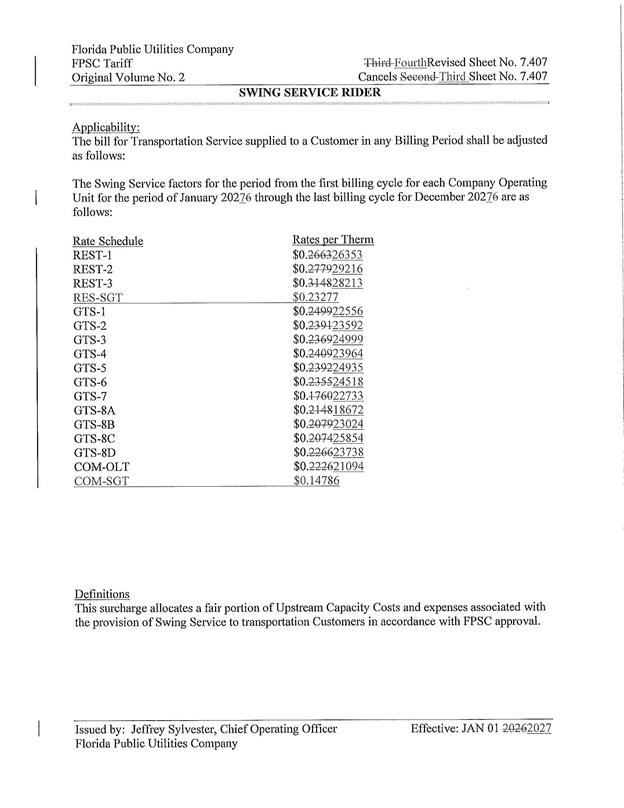
service rider rates were approved in Order No. PSC-2025-0421-TRF-GU. The proposed modifications to the swing
service rider rate schedule are included in Attachment A to the recommendation.
By Order No.
PSC-2025-0421-TRF-GU, the Commission suspended the proposed swing service rider
tariffs for further review by staff. During evaluation of the petition, staff
issued one data request to the utility, for which responses were received
October 7, 2026. Staff also sent an email to ask a follow
up question about the phased-in implementation of the swing service charge for
FCG on October 19, 2026, after which the company sent a response on October 20,
2026.
This is staff’s
recommendation to approve the proposed 2027 swing service rider rates and
associated tariffs. The Commission has jurisdiction over this matter pursuant
to Sections 366.04, 366.041, 366.05, and 366.06, F.S.
Discussion
of Issues
Issue 1:
Should the Commission approve FCG’s proposal to
implement the swing service rider and terminate its current transportation balancing
charge?
Recommendation:
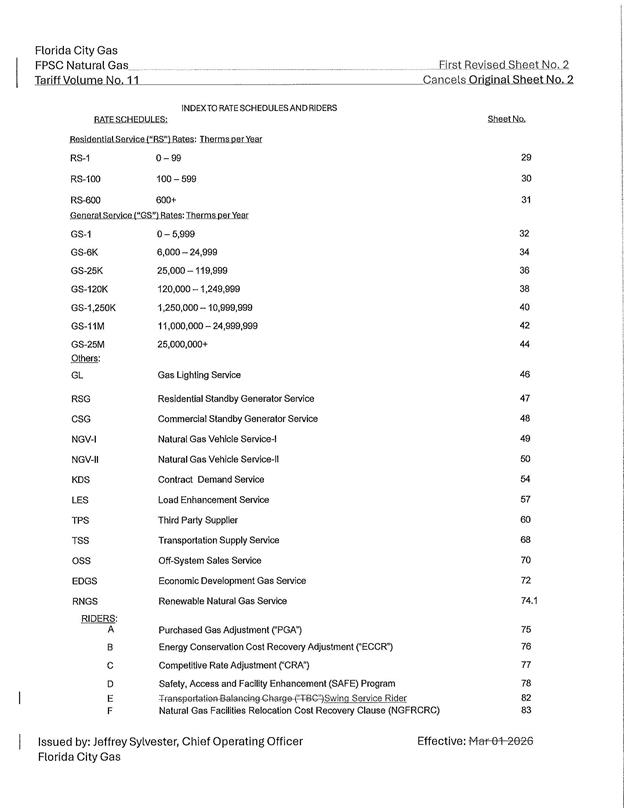
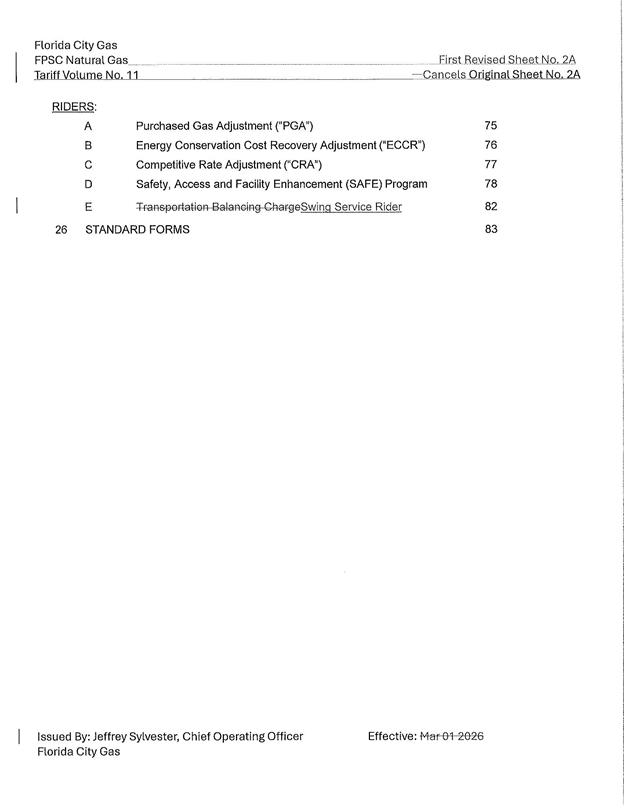
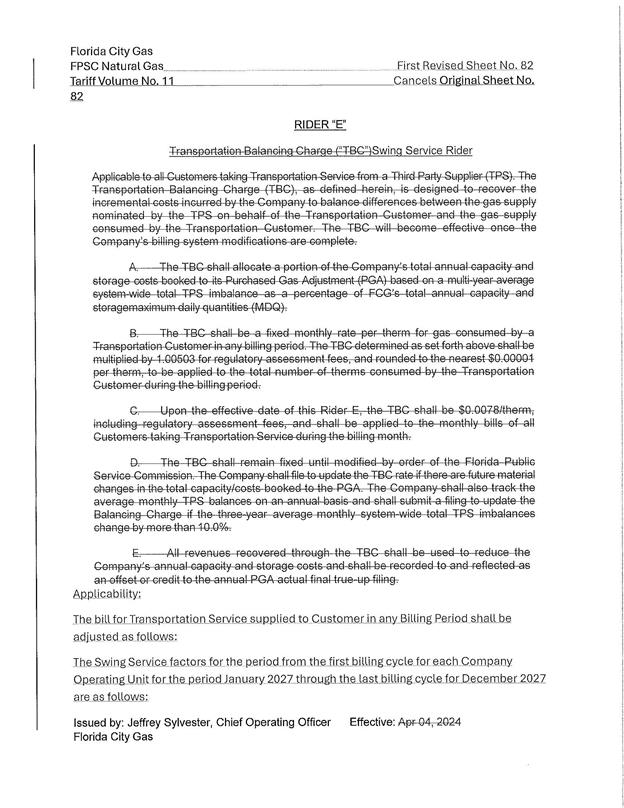
Yes, the Commission should approve FCG’s proposal to
implement the swing service rider and terminate its current transportation balancing
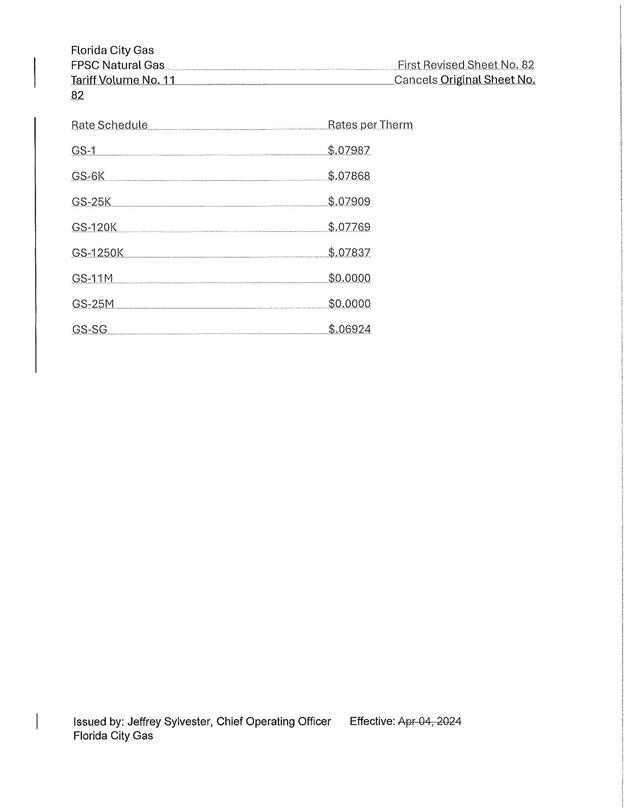
charge, as shown on Tariff Sheet Nos. 2, 2a, and 82, attached hereto as
Attachment A. Staff agrees that implementing the swing service rider would more
closely align FCG and FPUC’s transportation cost recovery while supporting the
ongoing efforts by the Joint Parties to standardize transportation service
programs, tariffs, and administration. (Nguyen)
Staff Analysis:
Since Chesapeake acquired FCG in 2023, Chesapeake
has taken steps to standardize its tariff provisions across its Florida natural
gas operations. FCG currently recovers certain transportation related costs
through its transportation balancing charge. The Commission first approved the
transportation balancing charge in March 2024. In
the order approving the transportation balancing charge, the Commission found
that the charge was similar to the swing service riders implemented by peoples
Gas System in 2000 and by Florida Public Utilities Company in 2016.
Aligning Transportation Cost Recovery
Chesapeake had an outside consultant, Atrium Economics,
LLC (Atrium), evaluate the recovery and allocation of upstream capacity and
balancing related costs for FPUC and FCG.
The results indicated that separate approaches for these costs are less
effective than having a consolidated swing service peak and average method for
more consistent and transparent allocation and recovery of transportation
related costs. The proposed swing service rider would replace FCG’s existing
transportation balancing charge. Pending Commission approval of the swing
service rates in Issue 2, FCG’s proposed tariffs revisions should become
effective January 2027.
FCG Three Year Phase-In
The swing service rider is proposed to be phased in over a
three-year period for FCG. FCG currently recovers its transportation costs
through their transportation balancing charge. The current FCG transportation
balancing charge would be terminated if the proposed three-year phase-in
implementation is approved.
During this proposed three-year period, if approved, FCG customers would pay
only a portion of the swing service costs, increasing over the three years,
until they transition directly to 100 percent of the combined swing rate with
FPUC. The Parties state that this proposed three-year phase-in approach is
appropriate to align FCG’s transportation cost recovery methodology with FPUC’s
while mitigating potential rate impacts to transportation customers. The
parties explained in the response received on October 20, 2026, that the
proposed swing service charge is higher than the previous transportation
balancing charge because the costs for FPUC and FCG were consolidated in the
swing service charge. They also state that the methodology for the proposed
swing service charge assigned the actual costs to the transportation customers
annually while the methodology for the previous transportation balancing charge
was to take an average of the costs over two to three years. Furthermore, in
direct testimony, witness Noia argues that a phased-in approach was previously
used during the implementation of FPUC’s swing service rider.
Conclusion
Based on
the above, the Commission should approve FCG’s proposal to implement the swing service
rider and terminate its current transportation balancing charge, as shown on
Tariff Sheet Nos. 2, 2a, and 82. Staff agrees that implementing the swing
service rider would more closely align FCG and FPUC’s transportation cost
recovery and supports the ongoing efforts by the Joint Parties to standardize
transportation service programs, tariffs, and administration.
Issue 2:
Should the Commission approve the Parties' proposed
swing service rider rates and associated tariffs for the period January through
December 2027?
Recommendation:
Yes, the Commission should approve the proposed
swing service rider rates for the period January through December 2027, as
provided in Attachment A to the recommendation. The Parties’ proposed swing
service rider reflects the updated cost of swing service for transportation
customers. Staff reviewed the total projected intrastate capacity costs and
verified that the costs included are appropriate. Furthermore, the methodology
for calculating the swing service rider rates is consistent with the 2016
Order. (Nguyen)
Staff Analysis:
The Parties incur intrastate capacity costs when they
transport natural gas on intrastate pipelines (i.e., pipelines operating within
Florida only). The Parties have two types of natural gas customers: sales and transportation.
Sales customers are primarily residential and small commercial customers that
purchase natural gas from an LDC, and receive allocations of intrastate
capacity costs through the PGA charge. Transportation customers receive natural
gas from third party marketers, known as shippers, and therefore do not pay the
PGA charge to the LDC.
The swing service rider allows the Parties to recover allocations of intrastate
capacity costs from transportation customers.
Updated 2027 Swing Service Rider Rates
The updated 2027 swing service rider rates were calculated
based on the same methodology approved in the 2016 Order. As stated in
paragraph 14 of the Parties’ petition, the intrastate capacity costs, other
related costs, and LDC-to-LDC interconnects for the period July 2025
through June 2026 are $68,044,412, compared to $37,509,443 for the period July
2025 through June 2026.
The total intrastate capacity costs reflect payments by the
Parties to intrastate pipelines for the transportation of natural gas, pursuant
to Commission-approved transportation agreements. In addition, the Parties’
other intrastate capacity cost changes include payments associated with legal
and consulting fees, employees who directly work on the PGA and swing
functions, software to manage customer usage and determine the gas supply and
capacity needs, and the subscription of S&P Global Platts used to retrieve
market data and daily gas pricing.
Of the intrastate pipeline costs, $6,751,010 will be recovered through special
contracts. The remaining costs of $61,293,402 will be recovered during the
period January 1, 2027 through December 31, 2027.
Updated Swing Service Costs
The increase of $30,534,969 in
cost recovered for the swing service rider can be mainly attributed to
combining the transportation costs of FPUC and FCG. Most of the new costs cited
in Schedule D pertain to FCG’s system. Lines that were previously included in
Schedule D of prior swing service filings have increased due to FCG’s system as
well. Specifically, the largest change from the most recent swing service rider
to present is the Peninsula Pipeline Company (PPC) contracts cost. In response
to staff’s data request, the Parties state the change from $32,360,718 in
2024/2025 to $59,714,412 in 2025/2026 is primarily attributable to the
aggregation of PPC contract costs for both FPUC and FCG within a single line to
maintain confidentiality of these contracts with PPC. The Marlin Gas Services
cost also changed from $2,724,308 in 2024/2025 to $5,431,031 in 2025/2026. In
response to staff’s data request, the Parties state this increase is primarily
attributable to the aggregation of Marlin costs for both FPUC and FCG.
Calculation of Swing Service Charges
The Parties used combined actual therm usage data for the
period July 2025 through June 2026 to allocate the intrastate capacity costs.
Based on the usage data, staff agrees that the appropriate split for allocating
the cost is 68.11 percent, or $41,744,896 to transportation customers and 31.89
percent, or $19,548,506, to PGA customers, as demonstrated on page 6 of the
instant petition. The sales customers’ share of the cost of $19,548,506 is
embedded in the PGA.
The transportation customers’ share of $41,744,896 is
allocated among FPUC and FCG transportation rate classes based on each class’s peak
and average responsibility. The
resulting class revenue requirements and applicable billing determinants are
used to develop the combined swing rates. The resulting class revenue
requirements are divided by applicable billing determinants and adjusted for
the applicable tax factor to develop the combined swing rates.
Credit to the PGA
The total intrastate capacity costs are embedded in the
PGA with the projected 2027 swing service rider revenues incorporated as a
credit in the calculation of the 2027 PGA. On page 6 of the instant petition, the
Parties state the transportation costs, including costs the Parties expect to
recover through special contracts, will be credited to the 2027 PGA in the
amount of $35,245,635.
Conclusion
After reviewing the information provided in the petition
and in response to staff’s data request, staff recommends that the Commission
should approve the proposed swing service rider rates for the period January
2027 through December 2027, as provided in Attachment A to the recommendation.
The Parties’ proposed swing service rider reflects the updated cost of swing
service for transportation customers. Staff reviewed the total projected
intrastate capacity costs and verified that the costs included are appropriate.
Furthermore, the methodology for calculating the swing service rider rates is
consistent with the 2016 Order.
Issue 3:
Should this docket be closed?
Recommendation:
Yes. If the tariff is approved and a protest is
filed within 21 days of the issuance of the order, the tariff should remain in
effect, with any revenues held subject to refund, pending resolution of the
protest. If no timely protest is filed, this docket should be closed upon the
issuance of a consummating order. (Rauch)
Staff Analysis:
Yes. If the tariff is approved and a protest is
filed within 21 days of the issuance of the order, the tariff should remain in
effect, with any revenues held subject to refund, pending resolution of the
protest. If no timely protest is filed, this docket should be closed upon the
issuance of a consummating order.